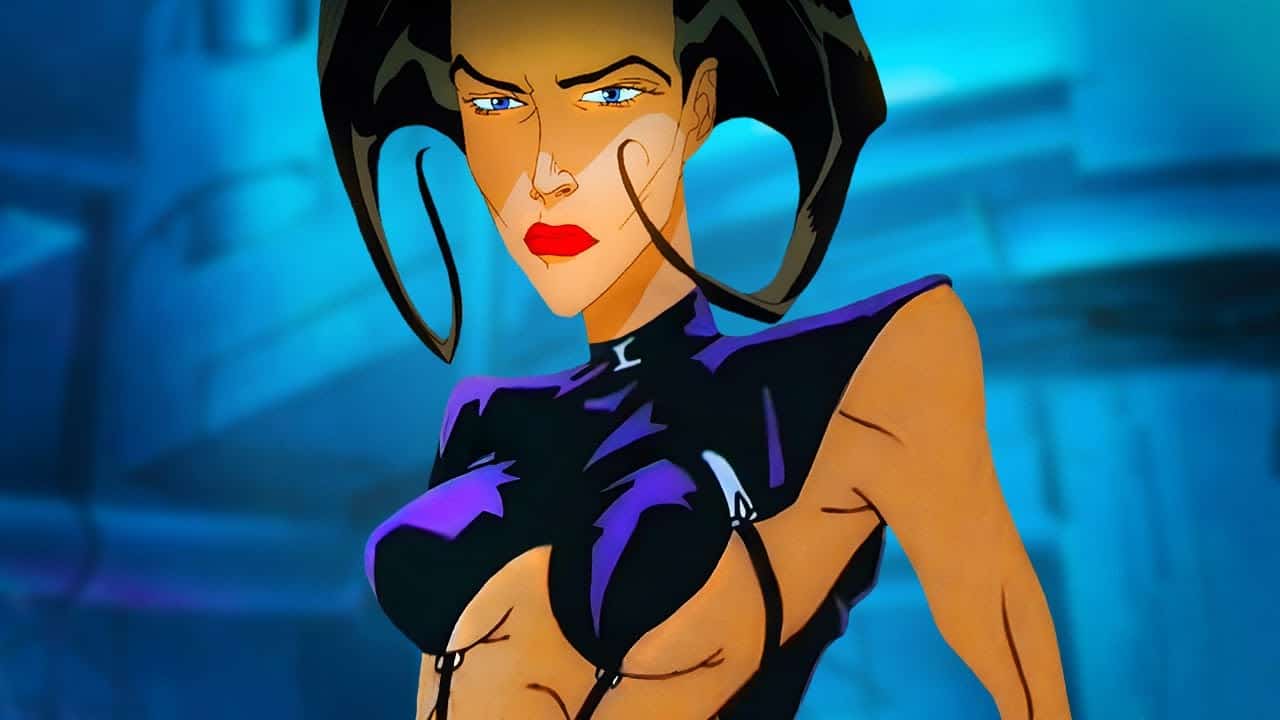
Aeon Flux (1991 – 1995) – Horror TV Shows We Miss
Honestly, it all started with Liquid Television and Akira – stuff a 7 or 8-year old probably shouldn’t have been watching, but did anyway. That early exposure cracked something open. Same with horror. It wasn’t just about shock or cool visuals. It was the ambiguity, the dread, the feeling that something big was happening and no one was going to explain it to you. Shows like Aeon Flux hit because of that. They don’t hand you answers – they trap you in a mood, a weird little world, and leave you to figure out how to breathe in it. That stays with you. It did with me. Still does.
Aeon Flux started as a handful of experimental shorts on MTV’s Liquid Television in the early ’90s – Peter Chung’s way of throwing a wrench into everything he hated about safe, formulaic animation. He wasn’t interested in characters that followed rules or stories that held your hand. It was weird, gorgeous, and smarter than I realized at the time. Chung’s influences, Moebius, Schiele, a dash of Lynch, were baked into it. It felt like something I wasn’t supposed to understand, and I think that’s why I couldn’t stop watching. The result is something that feels alien but weirdly grounded. Aeon was designed to break the mold – she’s smart, skilled, sexy, and totally unreadable. She’s not your typical female action lead; she’s a contradiction that refuses to make sense in a way that works because it doesn’t.
When the shorts blew up, MTV gave Chung the go-ahead to expand it into a full series – and instead of smoothing things out, he made it weirder. The series added dialogue, but it never dulled the edge. It was sharp, philosophical, and somehow exactly what you’d expect these characters to sound like without ever hearing them speak before. Aeon and Trevor’s dynamic also grew – it wasn’t just about physical tension anymore, it was ideological. The plots stayed messy and morally grey. The episodes don’t just tell stories; they dare you to interpret them, mess with what you think you know, and leave you wondering if you missed something (you did, lean in closer). Chung focused hard into design and visual storytelling, with layered background details and symbolism that rewards rewatching. It’s chaos by design, and no one’s ever really replicated it – not successfully, anyway.
A Last Time for Everything:
This might be my favorite episode of Aeon Flux because it lets us see a version of Aeon we rarely get: one who’s not constantly on the hunt, not just the badass provocateur. She’s “playing house” with Trevor, and while there’s something tender and oddly perfect about it, it’s also clearly not real – for either of them. The episode plays with that tension. Aeon sends her clone to do recon, while the real version of herself goes to Trevor. And Trevor, of course, thinks he’s getting what he wants: Aeon, close and moldable. But he realizes it’s the chase he’s addicted to – the back and forth, the resistance, the power struggle. Aeon has her own version of that realization. She’s not built for comfort. She only knows how to survive in motion, in opposition. Being tethered to Trevor feels sweet, but it’s not who she is. And by the end, that softness unravels into something colder – maybe even a little tragic.
And of course, in true Aeon Flux fashion, it ends on a note that’s equal parts brutal and poetic. The real Aeon is gunned down – not because Trevor hesitates, but because he can’t shut the system down fast enough. He tries. He’s desperate. But it doesn’t matter. The clone Aeon is the one who makes it over the border, laser-focused and unshaken. And that’s the part that stings. The one who was beginning to question the role, who tried on softness and connection, is the one who dies. What survives is the mission.
It’s a final gut punch and a perfect reset– bringing us full circle to the idea the original shorts hammered home: maybe there’s no true version of Aeon. Maybe there never was. What matters is that she survives – always shifting, always refusing to stay pinned down.
Tide
I had to go with a short – no, it’s not the one with the tonguing and the secret message in the tooth. Like the others, there’s no dialogue and only sparse ambient sound, moaning, the episode leans hard into tension and unease. Aeon moves through a nail biting cycle – riding an elevator from floor to floor, shooting a sky hook to keep it from latching, searching for the right door. The key is in hand, but the number it matches was tossed by Trevor into an impossible spot. Her partner, whose loyalties remain a mystery, only adds to the chaos. It plays like a ritual with no instructions. There’s no clear goal, only a sense of urgency that builds until it breaks. Aeon dies before we understand why any of it mattered. And in the final moments, her partner removes a plug from the correct door– but instead of using it, she discards it. That decision seals her fate. Alone on a concrete slab in the middle of the ocean, it becomes clear: no one betrayed her. There was no sabotage. Just her own selfishness. Aeon and Trevor are dead, and she’s left with the consequences – stranded, with no one left to manipulate. The final shot isn’t a twist. It’s a punishment.
Reraizure
This episode is a slow, deliberate unraveling of betrayal, grief, and manipulation, all revolving around whether memory defines us – or if we’re just what others choose to remember. Aeon and Trevor get twisted with a Breen couple, Rorty and Muriel, whose relationship is rooted in heartbreak and erasure. Aeon’s time with Rorty feels more grounded than her usual flings, but it’s no less calculated – and ultimately, it leaves him devastated.
Aeon gives Muriel a pass. Muriel panics anyway – stabs her. In the chaos, she’s thrown into the vent. A single drop of blood lands on Muriel’s finger before she falls. Aeon didn’t mean for it to happen. But it registers. It’s the moment that pushes her toward Rorty. Rorty and Muriel serve as foils to Aeon and Trevor: opposites in their need for devotion and peace. Maybe that’s why Aeon and Trevor are drawn to them – but it only underscores that genuine connection or domestic bliss is always out of reach for Aeon and Trevor.
The final blow is subtle but brutal: Aeon arrives seconds too late to save Rorty, who’s already lost himself to the bliss pill. There’s a sharp cruelty in the fact that Aeon and Trevor never take the pill themselves – they don’t escape memory. They bend it, weaponize it, and try to outrun the version of themselves others insist is real. The episode closes with a chilling reminder: “We are not what we remember of ourselves. We can undo only what others have already forgotten. Learn from your mistakes so that one day you can repeat them precisely.” It’s not a warning. It’s a cycle.
Reraizure feels like a thematic cousin to Thanatophobia, where the couple dynamic flips – Trevor is more invested in Sibyl than Aeon, which makes you wonder if Trevor’s connection to Aeon runs deeper than hers to him. Both episodes explore complicated relationships under pressure, but Reraizure highlights how memory, manipulation, and loss shape those connections, and leave everyone worse for it.
Ether Drift Theory
This one opens with a haunting image: bodies suspended in a viscous sea, frozen mid-scream, like a dream paused at its worst moment. The Habitat is its own strange biome, equal parts science experiment and existential trap, where a single misplaced bullet, cracked egg, and spilled drink become the catalyst for total collapse. Aeon and Lindze arrive to rescue Bargeld, Lindze’s partner, and dismantle Trevor’s operation. But, as always, motives blur. Aeon might be helping out of genuine care, or just to undermine Trevor. Probably both. There’s always a tension in her – self-interest threaded with bursts of sincerity. That duality sharpens when Lindze catches her in an intimate moment with Trevor, even though everyone knows about their tryst.
The Habitat feels especially eerie this time around, almost liminal, with its empty spaces, endless corridors, and metal robot spiders (???) roam. In a humorous moment, Trevor and Aeon end up in this weird standoff, each holding some bizarre lobster claw and tentacle weapon. Neither has a clue how to actually use them: Trevor just shrugs and goes, “I have no idea what this thing does.”
When the hybrid egg and drink sludge starts eating through the structure, everything accelerates. Aeon, true to her word, dives back in to retrieve the key. She makes it. But not fast enough. As the building deteriorates around them, Bargeld’s plan to neutralize the paralyzing sea dies with him. Trapped and suspended in the fluid, Aeon becomes part of the same haunting image that opened the episode. It’s jarring: she tries to do the right thing and pays for it. Trevor escapes with Lindze, but you get the sense that if Aeon had made it in time, it would’ve been her beside him, and Lindze left behind. Maybe.
Trevor muses that cats always land on their feet. But Aeon isn’t a cat – she’s a question mark. And we’re left asking: Will someone come back for her? Or will they just make another?
The Purge
The beginning of this one is immediately wild. Aeon boards a train, and the first thing we see is a guy in the bathroom, pants down, asking her to hand him toilet paper – which, of course, is nowhere nearby. Then we start moving through the train: there’s a kid on a swing trying to grab a piggy bank, a paraplegic with a dog, and eventually a grassy cab where Trevor’s set up a miniature office, calmly tinkering with some bizarre little toy. Meanwhile, Aeon’s charging ahead, chasing down Bambara, and she doesn’t stop to help anyone along the way. Trevor eventually stops Bambara and implants him with a custodian: a living, crawling, metallic conscience that enters through the belly button. Trevor sees this as a breakthrough. If someone doesn’t have a conscience, why not give them one? But the real question becomes: where’s the balance if everyone is artificially programmed to be “good”? Trevor’s obsessed with free will, but only when he’s the one curating it.
Aeon’s quest to purge Bambara is next level. She gives her blood and then is expected to eat some ice cream consistency cabbage from a distribution box. And two things from this episode have never left my brain: the kid singing that eerie song while shoveling cabbage into his mouth (I randomly sing it, along with Danger Boy)– and the moment when the custodian tries to force its way into Aeon’s body. Later, in true Trevor as game show host fashion, he marks Aeon with the telltale sign of implantation. She insists she feels no different, that she’s still in control. But when she gets the chance to take Trevor out, she hesitates.
Only, surprise – Trevor isn’t Trevor. He’s a custodian shell, piloted by that creepy little dancing toy he was fiddling with earlier. Bambara crashes the scene but gets dropped through a trap door before he can finish what he started. Aeon shrugs, walks away. But not before seeing a custodian outside, reenacting the exact same lever motion she made moments ago. Did she choose? Or was she always just pulling the levers someone else built?
Where to Find it?
This is pretty readily available. There were a few VHS offerings, even a UMD offering, and of course, the DVD which you will see behind me in the video. If you want the series in its entirety all in one place, that’s the option to go with. Here’s hoping that one day I get my hand on the VHS copies. OH, the score is on vinyl and it’s majestic thanks to Waxwork Records. I do not own it. Maybe one day.
What Happened?
Oh, you’re really going to make me talk about it, huh? Look, some things just shouldn’t be made live action. We all know this. Akira is one of them (thankfully still untouched), but someone thought the world of Aeon Flux would translate in 2005. It didn’t. Chung himself has said he’d rather see it stay animated, but Hollywood can’t help themselves.
Do I think Aeon Flux could come back? Absolutely. Should it? That’s where I hesitate. I saw a Chung-created super short floating around online – in that original style: rough, strange, and full of potential. I’d love to see more of that, as long as it’s not boxed in by expectations or stipulations. What I love most, aside from everything else I’ve already said, is how Chung engages his audience. Sure, that’s what any good creator should do, but he does it with care. He trusts us to keep up, to dig deeper, to sit with discomfort. That’s rare. And honestly? That’s what makes Aeon Flux what it is. I wish we had two hours to talk about this. It doesn’t hand you answers. It dares you to keep asking better questions. And for me, that’s the kind of story worth holding onto.
A couple previous episodes of Horror TV Shows We Miss can be seen below. If you’d like to see more, and check out the other shows we have to offer, head over to the JoBlo Horror Originals YouTube channel – and subscribe while you’re there!
The post Aeon Flux (1991 – 1995) – Horror TV Shows We Miss appeared first on JoBlo.