Mars Attacks! (1996) – What Happened to This Sci-Fi Comedy Movie?
Let’s just get this out of the way: Mars Attacks! is a movie where Tom Jones fights aliens, Jack Black gets obliterated in his first major studio role, and humanity is saved by a yodeling grandma. That’s not a fever dream — that’s just the plot. But how did this bizarre alien invasion comedy become one of the weirdest, most divisive blockbusters of the 1990s? Why was it stacked with A-list celebrities, most of whom get vaporized in hilarious ways? And did you know it was inspired by a series of violent, pulpy trading cards from the ’60s — cards so graphic they were pulled off shelves? Well, if you didn’t, or just want to relive the glory days of the ’90s, then sit back and strap in as we dive into What Happened to Tim Burton’s Mars Attacks!
Before the CGI Martians melted Congress with their ray guns and screeching “ACK ACK ACK!” they were cardboard illustrations. Mars Attacks began life in 1962 as a Topps trading card series, cooked up by artist Wally Wood and painted by the legendary Norman Saunders. The cards told a sequential sci-fi story across 55 hand-painted panels — and they were gnarly. Melting flesh, skeleton soldiers, dogs on fire. This was not your average baseball card pack. The controversy was immediate. Parents freaked out, PTA groups assembled, and Topps pulled the line before it finished a full run. But decades later, those same gory cards would find a second life — thanks to a man who had a thing for the macabre: Tim Burton.
The Mars Attacks trading cards had quietly developed a cult following through the ’80s, and in the early ’90s, Topps began licensing them for reprints and collectibles. British screenwriter Jonathan Gems, known for working with Tim Burton on unproduced scripts (Beetlejuice Goes Hawaiian), pitched a Mars Attacks! film to Burton in the early ’90s. Burton — already a fan of kitschy B-movie horror and sci-fi seemed interested. Gems’ pitch wasn’t to make a serious alien invasion film à la War of the Worlds or Independence Day (which was in development around the same time). Instead, he proposed a chaotic, darkly comedic ensemble piece that paid homage to 1950s alien invasion movies, with modern FX and a satirical twist. After hearing the pitch, Tim latched onto the idea. After all, this was a guy whose brain already looked like a Martian in diagram form. Warner Bros. greenlit the project, hoping Burton could deliver another Batman-sized hit. But there was just one small problem: nobody could figure out what tone this movie was supposed to have. Was it a satire? A comedy? A kids movie where a chihuahua gets fused to Sarah Jessica Parker’s body? Burton’s answer? Yes.
Warner Bros., riding high off Burton’s box office clout (Batman, Batman Returns, Edward Scissorhands), gave the project the go-ahead in 1993, even before Ed Wood began production. The film would be Burton’s first major project under his own production banner and a passion project to boot. But even Burton admitted: no one quite knew what tone the film was supposed to have. Early drafts of the script featured over 60 major characters, modeled after disaster movies like The Towering Inferno and The Poseidon Adventure. The idea was to cast dozens of stars — and kill most of them in increasingly absurd ways. Burton gave Gems and the other screenwriters (including Scott Alexander and Larry Karaszewski at one point) a free hand to go wild. The script ballooned — at one point, over 60 major characters were written in. The idea was to make it like a disaster movie, a genre that audiences understood: big cast, big destruction, big consequences. Only this time, the consequences were Jack Nicholson playing two roles, both of whom died horribly.
The studio was banking on big names, and it worked… in terms of drawing attention. Burton assembled an eye-popping cast: Jack Nicholson initially signed on to play the President, but Burton wanted him to do double duty as two characters. Nicholson agreed, ultimately playing President James Dale and Vegas hustler Art Land. According to Burton, it was partly to save on budget, partly because it felt right for a film where chaos ruled. Glenn Close, Annette Bening, Pierce Brosnan, Sarah Jessica Parker, Michael J. Fox, Natalie Portman, Martin Short, Danny DeVito, Pam Grier, and Tom Jones all signed on — many for the chance to work with Burton or just be part of something uniquely weird. Jack Black, then a rising actor from TV and acting in such films as Neverending Story 3, Waterworld and The Cable Guy, was cast as a patriotic, dimwitted soldier — a comic relief role that ends in an instant Martian death beam and is actually one of the highlights of the movie, albeit depressing as hell. Lisa Marie, Burton’s then-fiancée, played the Martian Girl, a silent seductress in a skin-tight outfit and giant wig. Her performance was done mostly in mime and physical acting. Over a decade ago, she was interviewed by “toofab” and admitted that wig was reportedly so tight and heavy that it left a permanent scar on her scalp.
At the end of the film, and yes we’re jumping into spoiler territory, does anyone find it funny that Natalie Portman is appointed the leader of the free world after the martian attack? Was this what made George Lucas cast her as Queen Amadelia for The Star Wars Prequels? Who’s to say? Did we mention Tom Jones plays himself and ends up being one of the heroes of the film? You’re saying we actually DID mention it? Well too bad it’s TOM FREAKING JONES!
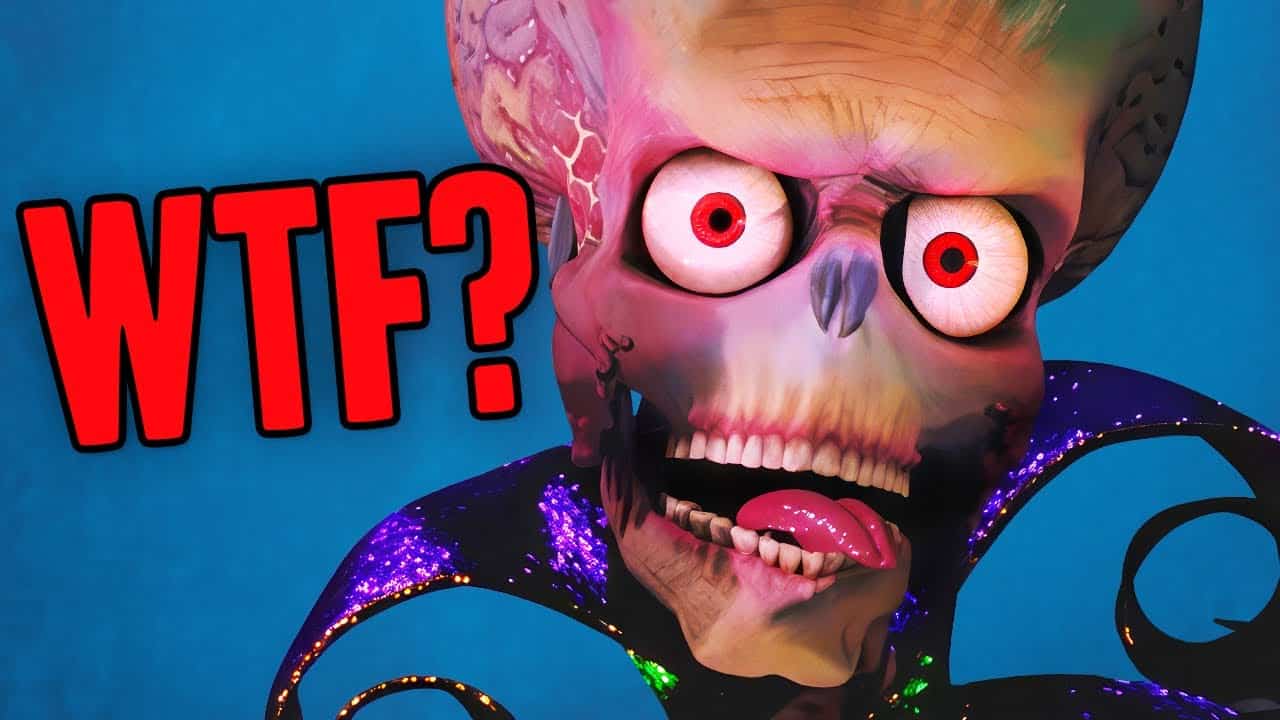
The film also worked in terms of torching the budget. Burton originally wanted to use stop-motion for the Martians — a loving homage to Ray Harryhausen — but Warner Bros. panicked when they saw the cost estimates. CG was ultimately the cheaper option, even in 1996, so ILM stepped in and created those bug-eyed, skeletal little creeps we know today. This decision saved time and money, but arguably robbed the film of the charming, handmade vibe Burton was initially chasing. Still, the Martians’ movements — rubbery, jerky, and just off enough — remained delightfully unsettling.
Principal photography for the film kicked off in August 1996 with most shooting done in California soundstages, and additional location filming in Nevada, Las Vegas, and New Mexico. The setting was meant to evoke an Atomic Age Americana vibe — retro diners, casinos, deserts, and suburbs straight out of 1950s pulp fiction. Production design by Wynn Thomas leaned heavily into bright colors, retro architecture, and toy-like environments. The goal was for the film to resemble a live-action cartoon — not just in style, but in tone. Burton treated the movie like a live-action cartoon — colorful sets, surreal lighting, as well as over-the-top performances. There was a surreal sense of freedom on set, but also disorganization. The film’s script was being constantly rewritten, with entire subplots dropped mid-shoot. Characters were rewritten or zapped entirely. There were so many celebrity deaths that Burton made sure no actor knew for sure if they’d make it to the end. (Spoiler: most of them didn’t.)
Speaking of over the top, Burton encouraged the actors to push their performances to the edge. Nicholson, for example, was so game he insisted on playing two characters: the doomed U.S. President and a sleazy Vegas developer. Burton agreed — partly because it saved casting another actor, and partly because it just felt right for a movie where Martians impersonate hookers and disintegrate Boy Scouts. Martin Short’s lecherous White House press secretary bordered on Looney Tunes, while Sarah Jessica Parker’s performance was split between her normal head and a chihuahua’s body. It required separate green screen sessions and complex visual compositing. Pierce Brosnan, after wrapping his first outing as James Bond in GoldenEye, played a disembodied floating head and fell in love with Parker’s dog-lady hybrid. Danny DeVito, in a glorified cameo, wanted to ham it up as much as possible, offering to ad-lib and improvise lines, too bad his character wasn’t in it for longer.
Fun fact: the Martians’ screeching “ACK ACK ACK” dialogue? Completely made up in post. The script just labeled it as “Martian gibberish” and Burton figured it out later. Sometimes chaos is the plan.
With ILM handling the Martians and Danny Elfman providing a theremin-laced score, post-production turned into a race to blend Burton’s retro flair with modern (for the time) effects. The CG Martians were an uphill battle — animators struggled with their translucent skulls and bony hands — but the end result is still delightfully grotesque.
Elfman, fresh off a brief falling-out with Burton during The Nightmare Before Christmas, returned to score the film, and he nailed it. The Mars Attacks! score is pure atomic-age madness, channeling B-movie horror and sci-fi with horns, clanging percussion, and lots of theremin weirdness. And yes — the movie ends with yodeling. Because if you’re going to make a satire about Earth’s destruction, why not have Slim Whitman save the day?
Filming wrapped in late 1996, just weeks before the movie’s December release. Editing was chaotic, with several sequences trimmed for runtime, and some characters, as mentioned before, were completely removed from the final cut.
Mars Attacks! released in theaters on December 13, 1996. It’s biggest problem upon release was who it opened against, a little film called Jerry Maguire… ever heard of it? It also faced another problem, Independence Day, which had just been released over the summer. It was THE blockbuster film of the year, and would go on to be the highest grossing film of 1996. That movie was patriotic, bombastic, and triumphant. Mars Attacks! was the opposite: gleefully nihilistic, chaotic, and bizarrely mean-spirited — and not everyone was in on the joke, or maybe they just didn’t like Jack Nicholson in dual roles?
Critics were split. Some praised the visuals and audacity, while others thought it was a mess with no emotional core. Audiences were equally baffled. To this day, it’s one of the few movies my parents still call “attrocious”. Despite a $100 million budget and all that star power, Mars Attacks! only made about $37 million domestically. It did better internationally, but it wasn’t the hit Warner Bros. hoped for.
Despite all of that, Warner Bros. went all-in on merch. It was one of the weirdest, most wonderful pieces of merchandise and it perfectly captured the chaotic, grotesque energy of the movie itself. Produced by Trendmasters, the toy company behind many cult-favorite 90s lines (Godzilla, Voltron, Independence Day), the figures were a bizarre blend of cartoonish design and graphic alien carnage. The line featured highly detailed Martian soldiers with their signature exposed brains, gleeful grins, and bulging eyes, often packaged with human victims, disintegrator guns, or horrific accessories like exploding heads. There was also a line of oversized Martian heads, talking figures, and even vehicles, like the Martian saucer, which yours truly owned.
The toys were bright, gory, and unashamedly weird—everything a kid who probably shouldn’t have seen the movie would’ve wanted. But perhaps because the film’s tone confused audiences and it wasn’t a massive box office smash, the toys didn’t exactly fly off the shelves. Over the years, though, they’ve gained a cult following and have become cherished collector’s items for fans who appreciate Mars Attacks‘s bonkers brand of sci-fi satire. It’s a toy line that’s long overdue for a retro re-release—or even a full-blown NECA-style revival, complete with modern sculpt. There were action figures, comic books, shirts and there’s even a video game releasing soon. Trendmasters released a full toyline — including ray guns and Martian leaders — which today fetch a decent price on eBay if you didn’t rip the packaging off as a kid.
Back in the day, this was a true staple of the VHS and early DVD era. You’d easily find it tucked between Men in Black and Independence Day at your local Blockbuster, practically daring you to rent it. Its chaotic tone, all-star cast, and over-the-top alien mayhem made it a go-to movie for kids who wanted something just a little offbeat.For a generation, Mars Attacks! wasn’t just a movie—it was a rite of passage through the wonderfully weird corners of ‘90s home video. Today, Mars Attacks! stands as one of the weirdest studio films ever made. It’s messy. It’s mean. It’s visually overloaded. And it’s still completely unique.Its mix of schlock, satire, and sincere B-movie homage influenced filmmakers who wanted to break from blockbuster formulas. Edgar Wright, James Gunn — even shows like Rick and Morty owe a little debt to Mars Attacks!’s chaotic DNA. And Burton himself has called it one of his most “free” experiences as a director, even if the critics didn’t get it at the time. Plus, let’s be honest: any movie where Pierce Brosnan’s head gets attached to a chihuahua deserves a damn reappraisal.
So what happened to Mars Attacks!? Well, it crashed and burned, then climbed out of the wreckage to become a VHS-era staple, a Hot Topic icon, and a fan favorite for weirdos everywhere. It didn’t save the world. It didn’t win any awards. But like a Martian in a giant robot suit, it stomped into pop culture and refused to leave. And if you listen closely… you can still hear the faint echo of “ACK ACK ACK” every time a studio greenlights a “bold new reboot.”
A couple of the previous episodes of the show can be seen below. To see more, head over to our JoBlo Horror Originals YouTube channel – and subscribe while you’re there!
The post Mars Attacks! (1996) – What Happened to This Sci-Fi Comedy Movie? appeared first on JoBlo.