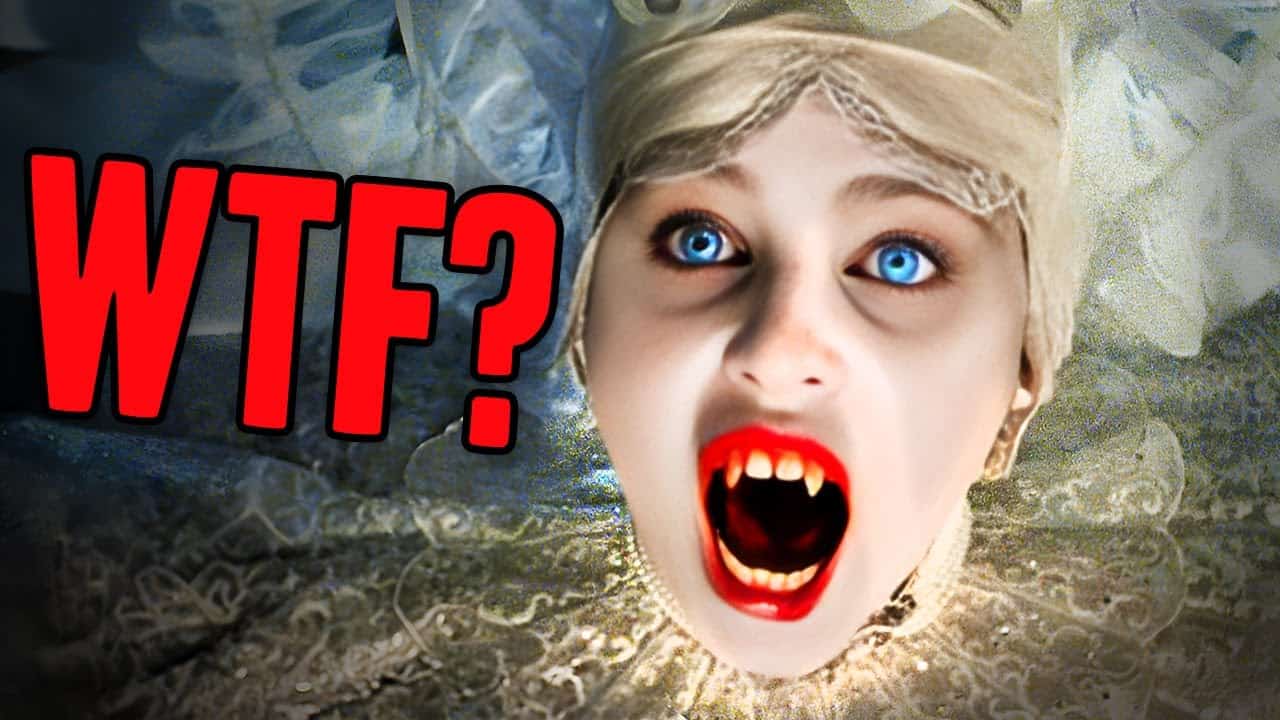
Bram Stoker’s Dracula (1992) – What Happened to This Horror Movie?
“Dear unholy night, do we need ANOTHER Dracula movie”? Folks have been saying this since 1992 when a new(ish) writer couldn’t get anyone to finance his dream project. A project that literally kept him up at night staring longingly at the jugular in his wife’s neck. Well, he found his way when a couple of nice fellows agreed to finance a TV project for him that ballooned into a full-fledged, ocean- and time-spanning epic directed by the dude who made The Godfather. This is the story of the sex-fueled, bloodsucking, weird-as-hell vampire movie that pop culture hasn’t been able to shake off since. This is what happened to Dracula.
While the story of Bram Stoker’s Dracula started in 1897 (and the stories that inspired it long before that) director Francis Ford Coppola’s Dracula began during an unfortunate incident making The Godfather Part III. There were a lot of unfortunate incidents with Godfather III, but this one involved the young actress he’d hired becoming unable to participate due to career exhaustion. Coppola had to rush to find a replacement, cast his daughter Sofia in the role, and you know the rest. That young, exhausted actress was Winona Ryder. Who Coppola thoughtfully decided a year later to reach out to, to make sure she knew there was no ill will over the unfortunate event. As fate would have it, one of their conversations during that meeting led to Ryder showing the director James V. Hart’s script for Dracula.
Hart’s love for Bram Stoker’s book had been a weird one. Some would argue unhealthy, as the Hook screenplay writer became so overwhelmed by a particular scene that was, in his words, “so intensely erotic and diabolically evil” that he passed out reading it on a plane. He recalls another night when he became overwhelmed again and threw the book into his closet, only to find himself hovering over his wife at 2 AM staring at… again… I can only convey this in his exact words: “watching the jugular pump seductively in her neck.” Look… this guy really liked the Dracula book.
Hart reached out to the head of the English department at San Francisco State University at the time, Leonard Wolf, who was born in Transylvania and an expert on the subject. The two were never able to make the script work despite their best efforts. However, Hart carried his eternal torch for the story and tried many times over the years to sell the idea to producers who were burnt out on the idea. Finally, in 1990, producers Robert O’Connor and the late Michael Apted gave him his shot to write it for them as a television film.
Back to Winona Ryder, who was considering playing Mina in the film, asking her friend his thoughts on the script. A friend who would later accept an invitation by Columbia Pictures to direct the film himself. What neither Hart nor Ryder knew was that Coppola had been a fan of the novel since he was 18 years old and would read it to attendees at a summer camp he worked for. Neither were they aware he was currently interested in entering the goth market and making a faithful adaptation of Mary Shelley’s Frankenstein. This would allow him to make a sweeping horror epic without having to write the script himself. Hart and Coppola agreed to try and keep things as close to the source material as possible but did make several changes to the original novel. They added an origin story for Vlad, amped up the eroticism, shifted the narrative structure, and added the romance element between Dracula and Mina.
With Hart’s dream job and director on the wagon, not to mention the talents of Winona Ryder as Mina, it was time to cast the rest of the film. One of the big changes from the book to Coppola’s on-screen production was the character of Van Helsing. Coppola called the book version of the character a “fuddy-duddy” and rewrote the character into a wilder, drunker, swashbuckling type. Influencing these changes would be none other than the improvisation of Sir Anthony Hopkins himself, fresh off an Oscar-winning performance in The Silence of the Lambs. It’s a great fit, and it comes as no surprise when you consider the ensemble casts Coppola has put together over the years from The Godfather to Apocalypse Now. Dracula would show off more of that prowess with the talents of Cary Elwes, Richard E. Grant, Billy Campbell, Sadie Frost, and even musician Tom Waits rounding out the inspired supporting cast. Then there’s the character of Jonathan Harker, which, of course, went to Keanu Reeves. Though today audiences’ love for Reeves’ performances is only surpassed by their love for what a legendarily kind human being he is, the world wasn’t always so welcoming to Keanu. More on that later.
Now, who would play the bloodsucker with the Bugles-shaped hair? Coppola knew he couldn’t find anyone who could pull off both handsome and grotesque the way Dracula had been built up in his mind. He instead set out to hire someone who would simply be able to make it as unique and personal as possible. He wanted people to walk out of the theater saying that they’d never seen a Dracula like that before and he knew Oldman was capable of bold swings. While the actor had never been chomping at the bit to play the character previously, he wanted to work with Coppola and became particularly enamored with a particular line in the script. Oldman later recalled being able to read “I’ve crossed oceans of time to find you,” on screen was worth accepting the role alone.
Not only did Coppola want his Dracula to look and feel like nothing that had been on screen before, but he didn’t want his film to look like any other Hollywood production. He hired the legendary cinematographer behind Goodfellas, Michael Ballhaus, to achieve the unique look of the film, and one he was happy with. But that was not always the case, as no one on set seemed to listen when he explained that he wanted no special effects or CGI in post-production. He wanted to film it all live and in front of the camera as you would a magic trick.
Eventually, the director grew so frustrated he fired his visual FX team and hired his son Roman instead. Because…get this…he was “enthusiastic about magic.” They employed several old-school techniques to capture the shots in the film, from double exposure to composite shots that reused film multiple times to achieve the desired effects. Clearly, it worked out for the look of the film, and Coppola would later admit he thought his son should have won an Oscar for his work on Dracula, were it not for the voters at the Academy being partial to certain kinds of FX. Coppola also noted that 99% of the film was created on sound stages, even including the dramatic chase scene at the end of the film. Which, if you look at the scope of what was created here, seems… unfathomable. Part of the drive to do so came from Coppola having issues keeping films like Apocalypse Now under budget due to extreme location budgets and unpredictable weather. He also admitted he had some boyhood fears about shooting at a castle somewhere in Romania in the middle of the night.
As Coppola demanded the sets remain small (and later lamented it to be a battle he lost), he also required the costumes be bigger. Eiko Ishioka, whose impressive work you’ve likely seen in eye-catching films like The Fall or The Cell, was chosen and given immense freedom to inflict her talents. Ishioka deemed the character should be “male and female, old and young, ugly and handsome, animal and human.” Which kind of sounds like getting my Wife to decide what she wants to eat for lunch. It’s complicated and confusing, and I’m a little scared. But the result on screen amazingly checks all those boxes somehow.
The many looks of Oldman’s Dracula were an ongoing process, fueled in part by Oldman himself, who would have a lot of downtime in the early days on set. Oldman achieved the ear of makeup designer Greg Cannom and schemed the many ways they could unveil the visuals of his demonic disposition onto audiences. While the audience came out winners in this scenario, getting multiple wild and out-there versions of Dracula to feast our eyes upon, it ended up biting Oldman in the ass. Some days he would spend seven hours in the makeup chair, ten hours on set, and then have to sit for an hour and a half just to have it all removed. This could have, in part, led to a later-released awkward behind-the-scenes video of Oldman in full Drac regalia, talking a little bit of Transylvania shit, and then storming off in anger with a handler hilariously holding his cape.
Coppola hired a talented team around him to assemble the all-important look and feel of the film but demanded that nothing be brought before him unless it were original or, in his words, “weird.” While he meticulously crafted the look of the film alongside his team through storyboards and animation, he helped evolve the characters and actor cadences with staged performance readings of the script at a theater in San Francisco. Coppola would also have the actors all convene at his home (or gigantic winery, rather) to accomplish various trainings related to their performances. Cary Elwes and the boys would be sent hot air ballooning and horseback riding together to bond, which is hilarious. What a life. Oh darn, I have to go drink wine and fly kites with the boys all day. Elsewhere, Oldman was kept separate from everyone as he toiled away at his character, even learning to take his voice an octave lower. Also, fun to imagine is the story that Coppola would tell Oldman to whisper strange things to the other actors on set while in character to scare them. It led to some issues, but goddammit, tell me that wouldn’t be hilarious to watch from afar. Just Gary Oldman in full makeup leaning over to Keanu Reeves like: “Do you bleed? You will!”
All this intense preparation and experimentation didn’t come without its drama. Oldman and Ryder had a personal falling out one day on set and had trouble working together the rest of the shoot. Ryder would later acknowledge that she would later learn he was going through a tough divorce at the time, and the two of them are thankfully friends as of today. All of this strangeness was sure to invite rumors, and it did. Whispers around Hollywood were that Coppola had a brand-new castle built on the set at Columbia and was starting from scratch. Others claimed audiences were vomiting at test screenings. The truth was audiences were simply split on what they were watching. This caused Coppola to head to the editing booth, eventually calling up Hart in the middle of the night desperate for help. In full-on Hollywood crisis mode, he told Hart that he hated the entire film and needed him to come help edit immediately. The Outsiders editor Anne Goursaud was also brought on and ended up making changes to almost every scene in the film.
Finally, Dracula would release upon the earth like the wicked one’s shadow across a long hallway in November of 1992. Toting a budget of $40 million, all that sex, blood, and rock and roll proved financially viable. The film sucked its way to over $215 million worldwide. It need not be spoken the effect the movie has had in pop culture in the years since, as one of the most universally known and referenced vampire films in history. Dracula was received about as well from critics and audiences as you could expect from an arthouse film on a massive stage. It wasn’t for everyone but money was made and awards were won. Dracula took home three Academy Awards for Best Costume Design, Makeup, and Sound Editing.
All in all, you’d have to say things went amazingly well. Maybe for everyone except Keanu. The beloved actor caught a lot of flak for his performance, mostly because of a tough go at the English accent. He wasn’t exactly set up for greatness here. Coppola would later admit they just wanted a heartthrob actor who would sell tickets in the role because the part wasn’t all that good to begin with. The role that had originally been offered to Christian Slater was one Reeves probably just wasn’t ready for at that time in his career. Still yet, Coppola, like anyone else, has nothing but great things to say about Keanu as a person. He lamented that Keanu simply tried too hard to do the part perfectly, and he, as a director, wasn’t critical enough of him on set because he liked him so much as a person. We get it. And I think it’s safe to say Keanu has overcome all of the backlash.
I say… is the castle far? Not at all. We’ve arrived at our final destination, and there’s a hungry old man waiting for you inside. That sounded weird… never mind. Thanks for watching what happened to Dracula.
A couple of the previous episodes of the show can be seen below. To see more, head over to our JoBlo Horror Originals YouTube channel – and subscribe while you’re there!
The post Bram Stoker’s Dracula (1992) – What Happened to This Horror Movie? appeared first on JoBlo.