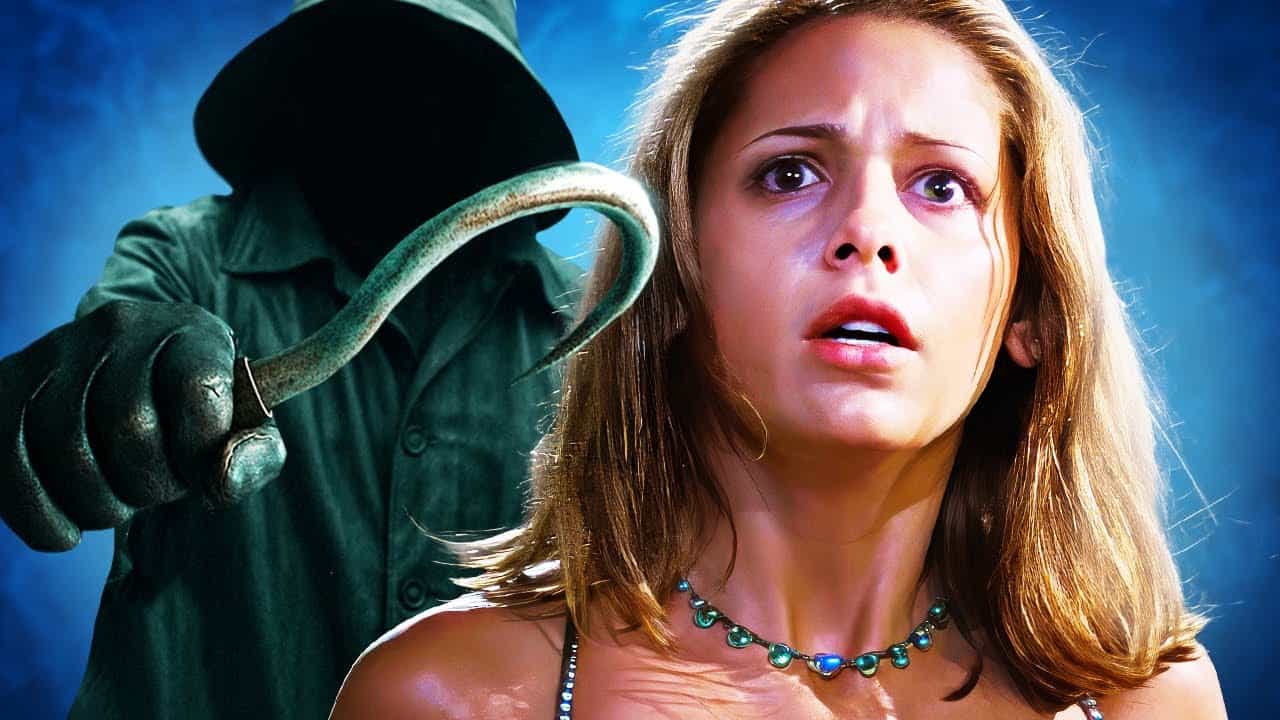
I Know What You Did Last Summer (1997): Looking back at the Helen Shivers chase sequence
Most slasher chase scenes are high impact but low emotion. They hit you with adrenaline, tension, the classic run for your life energy, and then, almost inevitably, a predictable end. But I Know What You Did Last Summer breaks that mold. It gave us Helen Shivers, and more than that, it built an entire sequence around something rare in slasher films: hope. Not just hope in the abstract, but that sharp, flickering kind that flares when you’re almost safe– the kind that cuts the deepest when it’s snatched away.
Most slasher chase scenes build toward a grim, predictable end. Characters sprint, stumble, and hide, but the tension almost always comes from knowing their fate is sealed. What makes Helen’s chase so striking is how it defies this expectation. She fights back, outsmarts her killer, and inches closer to safety in a way that feels earned and real. The scene sustains this fragile hope longer than most, making the moment it’s taken away all the more gut-wrenching.
Helen’s chase scene is one of the most tightly constructed, emotionally loaded sequences in modern slasher history, and somehow it never gets the credit it deserves. People remember Sarah Michelle Gellar in the prom dress– an image that inevitably brings to mind her role as Buffy, whose iconic episodes like The Prom and Homecoming also blend teenage rituals with horror and high stakes. But unlike Buffy’s triumphant fight, Helen’s sequence is a slow, brutal unraveling. They remember the alleyway, the fireworks, the prom night aesthetic. But they don’t often talk about how brutal the editing is– the way every cut feels like a heartbeat accelerating and then skipping. Or how the scene stacks tension like a survival countdown, piling on obstacles and false hope, each one just a little more desperate than the last. Or how, just for a moment, you really believe she’s going to make it.
Though Helen Shivers’ chase in I Know What You Did Last Summer feels emotionally distinct, it shares a creative lineage with another iconic sequence: the opening scene of Scream. Both were written by Kevin Williamson, whose masterful ability to stretch out suspense and craft devastating near escapes shines through in each. Casey Becker’s death is a cold, calculated shock– a star killing moment that rewrote the rules of horror. Helen’s, in contrast, is a slow-burn heartbreak. We spend the entire film getting to know her, watching her falter, fight back, and hope for survival, which makes her loss feel deeply personal. Where Casey’s death serves to prove a point, Helen’s is a tragic consequence of silence and disbelief. Williamson crafted both with thoughtful orchestration, but their emotional impacts could not be more different.
It all begins at the stage of the Croaker Queen pageant, a name that once felt like harmless small town kitsch, but now lands with grim irony. Helen watches nervously from the wings as Barry stands guard above her. Their chemistry still lingers. They’re not back together, not exactly, but something’s softened between them. There’s a kind of safety in the way they look at each other– wordless, maybe even a little hopeful. She tosses him a glance. He gives one back. It’s quiet, but it means something. But then, just as with any horror story, that fragile moment is shattered. The fisherman appears behind Barry, cold and relentless, and kills him in what feels like plain sight.
Helen’s scream pierces the chaos. The moment explodes into panic, but somehow, nobody seems to care, not truly. The most frustrating, infuriating part of this scene isn’t just Barry’s death. It’s how Helen is dismissed, treated like a hysterical child rather than someone sounding the alarm. Audience members physically hold her back. Even the cop acts dismissively, and that might be the most devastating part: the people who are supposed to keep you safe don’t believe you until it’s too late.
Helen is shoved into the back of a police car and sent home. On the way, she pleads with the officer, her voice shaking but clear. She tells him exactly what she saw, that the killer is real and still out there. But he laughs, actually laughs. “Did he use the same hook to cut all your hair off?” Like it’s funny. Like her fear is just some dramatic aftershock of a bad haircut. It’s so dismissive, it’s insulting. She’s terrified, and he turns it into a punchline. She begs him to take her seriously. Then a broken down truck blocks the alley.
We know what’s coming. Helen knows. But the cop doesn’t. He steps out to investigate, and sure enough, the fisherman strikes again. Helen is left utterly alone.
Trapped in the back of the cruiser, Helen fights with everything she has. She kicks at the windows, struggles with the locks, her desperation growing more tangible by the second. The odds feel stacked against her. But then, with raw determination, she manages to escape, on broken glass no less. She bursts out into the alley, running hard with the fisherman stalking behind her– slow and steady, like death itself. She races toward her parents’ department store. The door is locked. She screams pleading for her sister, Elsa, to open it.
Elsa finally lets her in, annoyed and dragging her feet. But Helen knows they don’t have time. “Do what I say, goddamn it!” she shouts, panicked and breathless. It’s not just fear– it’s frustration. Nobody has listened to her all night, and now her own sister is moving too slow.
They manage to lock the front entrance, but the relief barely lasts. The back door is breached. The killer is inside. And Elsa never stood a chance.
This shift from frantic escape to uncanny horror is where the scene deepens. Helen is thrust into a nightmare landscape filled with mannequins wrapped in plastic, frozen and faceless. The cold showroom feels eerily familiar. It took me back to moments from Tourist Trap or After Hours, those strange, suspended spaces where the inanimate suddenly feels aware.
Helen doesn’t run. She moves slowly now, descending the stairs after Elsa’s scream, every step careful, cautious. The trip-hop beat of 2Wicky fades into nothing, and suddenly, it’s silent. She’s surrounded by mannequins draped in plastic– faceless, their shapes blurred and obscured, but Helen knows all too well what lies beneath. She walks among them like she’s in a minefield, half expecting one to lurch forward. And then one does. The fisherman. The safe space Helen hoped for has turned into a trap. And somehow, that makes what’s coming feel all the more inevitable.
Despite the terror, Helen survives the encounter and escapes upstairs on a pull-rope elevator, pulling herself up to the top floor. There, more mannequins stand silently, eerily lined up in the stillness. Then, at last, a window. A glimmer of escape. She takes a leap of faith, literally, jumping into a dumpster below. Bloodied and breathless, but alive. The celebration, the parade, the safety she’s been running toward are just blocks away.
And for a moment, it really seems like she’s going to make it. Julie arrives at the pageant. The seats are empty.
Meanwhile, Helen runs through the alley, drawn toward the distant lights and fireworks. The sounds of joy and celebration are excruciatingly close. Safety is within reach. She slows. She hears something. A beat of hesitation. And that single moment becomes her undoing.
We all do it. Yell at the screen, “Don’t stop, keep running!” But she does. And somehow, even now, it still gets to you. Because she sees the lights, she sees the people. She knows she’s close. And still, she looks back. Not because she’s careless, but because she’s human. It’s a basic reaction. One that wouldn’t matter in a fairer world. But here, it costs her everything.
She turns back toward the sound, just for a second. And when she turns forward again, he’s there. The fisherman grabs her. It’s over.
She dies within reach of the parade. Within earshot of the music. Just steps from safety, celebration, and light. It’s not just that she doesn’t make it. It’s how close she comes. The chase doesn’t end in chaos. It ends in quiet devastation. And that’s what stays with you.
The killer doesn’t just take her life. He takes the possibility. Her hope, her effort, her sheer will to survive– none of it mattered. Not because she wasn’t strong enough. But because no one listened.
Helen always felt like a final girl in the making. She had the arc. She had the growth. And she fought like hell to earn it. People connected with her, not just because she was played by Sarah Michelle Gellar, but because she carried that same spark. That same fight. She deserved to live. But this wasn’t Buffy. There’s no supernatural strength, no perfect stake, no last-minute twist to save her.
This time, she did everything right and still didn’t survive. That’s the real gut punch here. Not that she died. But that she almost didn’t.
The post I Know What You Did Last Summer (1997): Looking back at the Helen Shivers chase sequence appeared first on JoBlo.