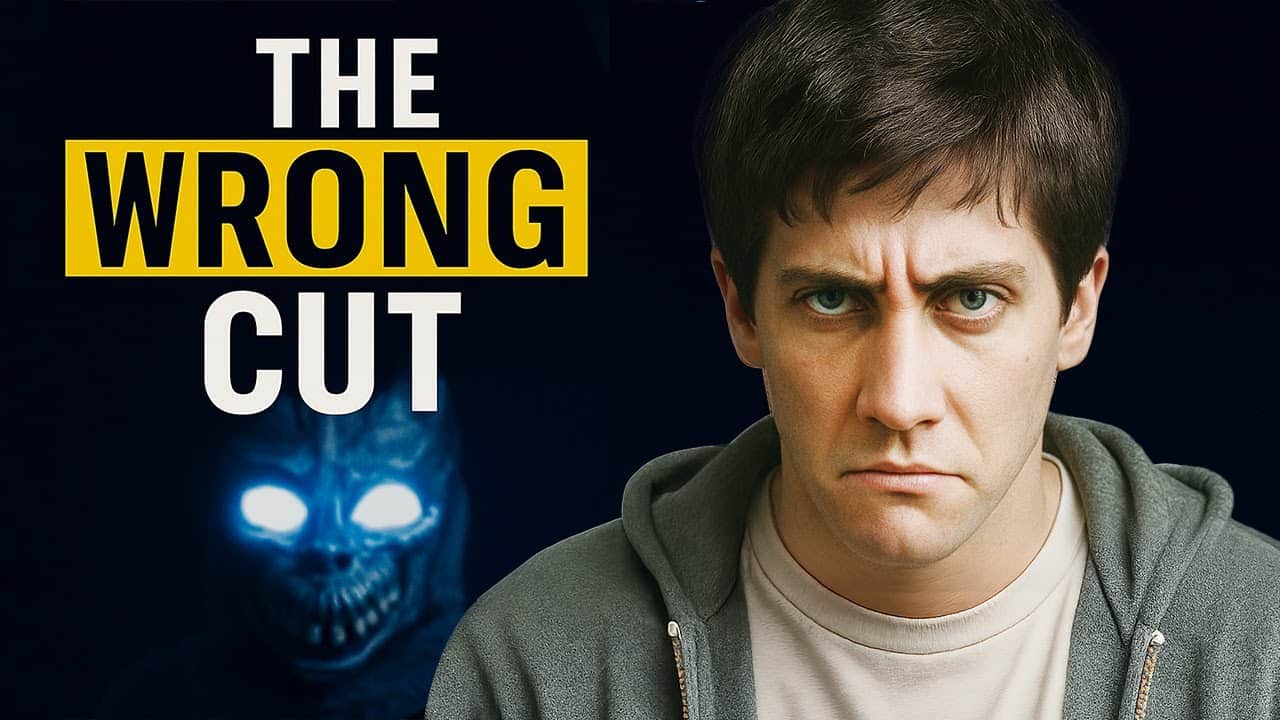
Why Donnie Darko’s original version beats the Director’s Cut
When assessing a filmmaker’s uncompromising vision, debate still rages on whether a Director’s Cut is better than the original theatrical version. With sterling examples on both sides of the ledger – Blade Runner being all-time good, The Warriors being all-time bad – one great cult classic that terminally suffers from the Director’s Cut is Donnie Darko, Richard Kelly’s piercing psychological genre mash-up that is at its best when it poses provocative, open-ended questions rather than providing demystifying answers that undermine the movie’s puzzling surrealism.
The original Donnie Darko, released in theaters in October 2001, captured the hearts and minds of angst-ridden teenagers and young adult misfits everywhere, only to relinquish all the popular goodwill by releasing the absurdly silly Director’s Cut in 2004. Straight up, the original Donnie Darko never should have been tampered with and reedited for monetary gain. Going one step further, the Donnie Darko Director’s Cut nearly ruins all the movie magic that made the original such a beloved cult favorite. As the film nears its 25th anniversary, it’s time to examine how and why Richard Kelly nearly ruined his cinematic legacy with the abysmal Donnie Darko Director’s Cut!
Now, before delving into how and why the Donnie Darko Director’s Cut came about, it’s worth reminding fans of the key differences between it and the original. Released in 2004, the extended version of the film includes 20 additional minutes re-edited into the film, enhanced sound, and extra special effects. Additionally, several head-scratching changes were made to the original’s near-perfect soundtrack, which established the unique mood and otherworldly tone of the movie. Most of the footage inserted into the Director’s Cut consisted of deleted scenes, many of which add little to the story. Worse yet, most scenes are awkwardly tainted by heavy exposition and silly superimposed imagery that excessively overexplain the movie’s core mystery.
While nearly every newly added scene is unnecessary and inconsequential to the plot and does more harm than good, there are two exceptions. The first involves Donnie’s English class engaging in a Poetry Day. Donnie recites an ominous poem about Frank, in which he admonishes: “A storm is coming, Frank says a storm that will swallow the children and I will deliver them from the kingdom of pain I will deliver the children back to their doorsteps And send the monsters back to the underground I’ll send them back to a place where no-one else can see them except for me because I am Donnie Darko.”
Donnie’s classmates immediately burst into laughter, reinforcing his awkward outcast status and growing disillusionment. But the sequence also portends the apocalypse Frank has been warning Donnie about all along, sowing fear and paranoia among the viewers at once. This scene would have been effective if kept in the original version, as it does nothing to undermine the movie’s overarching enigma. On the contrary, the unsettling omen adds to the intrigue of the movie’s encrypted meaning.
The other scene that plays well and could have remained in the original cut also takes place in Donnie’s English class. His teacher, Karen Pomeroy, speaks about Fiver’s fate in the book the class is reading, Watership Down. Fiver, a rabbit with a five-letter F-name like Frank the bunny who visits Donnie, has apocalyptic visions. Ms. Pomeroy tells the class that trusting Fiver’s disturbing visions will lead to their salvation. Gretchen agrees, and Donnie disagrees. The scene ends with Ms. Pomeroy explaining that a Deus Ex Machina will rescue the rabbits from death.
While it’s easy to understand why the second scene was cut, deemed superfluous due to Donnie and his science teacher, Mr. Monitoff, speaking about a similar concept without naming it a Deus Ex Machina, linking it to Frank in the English class would have made the previous poem Donnie read even more unnerving. Then again, explaining the entire plot away to a convenient “God in the Machine” would have been such a convenient cop-out that it too would undo the cerebral intrigue of the movie’s central puzzle.
Beyond those two scenes that could have potentially played well in the original cut, nearly every other scene in the Director’s Cut is poorly conceived, horribly executed, and downright embarrassing. Among the most ludicrous additions is the visual motif of Donnie’s eyeball opening in extreme close-up, with digital water and flames superimposed over it to convey some sort of awoken religious divination. Frank’s visage is also reflected in Donnie’s eyeball. Care to guess how many times this asinine image appears in the extended version? Four. Four F*cking times! Kelly returns to the eye imagery every 20 to 30 minutes, each time sapping the story of its fundamental intrigue and inducing more laughter than suspense.
Further stripping away every morsel of mystery that makes the original cut so timeless, ambiguous, and debatable is the inclusion of Roberta Sparrow’s The Philosophy of Time Travel Handbook. For some reason, Kelly felt the need to spoon-feed the audience answers regarding Donnie’s inexplicable fate with one laughable page of scientific jargon after another. Chapter by Chapter, Kelly superimposes text from Sparrow’s manifesto onto the screen, happily giving away all the cryptic secrets and hidden plot devices, to the point that there’s no mystery left at all. The silly imagery overlaid with the philosophical text does not come off as deep or intellectually challenging. On the contrary, it shamefully dumbs down the film’s quizzical events and explains them with such precision that all the abstract provocations that the original was built upon quickly crumble. Once or twice might be excusable. But Kelly overlays pages from Chapters 2, 7, 4, 6, 10, 9, and 12. In the quest for coherence, Kelly ends up looking more foolish than sagacious, forcing hardcore fans of the original to digest such silly subjects as “Water and Metal,” “The Manipulated Living,” The Ensurance Trap,” “The Living Receiver,” and other lofty lunacy that makes the Director’s Cut far inferior to the theatrical version. In the attempt to clarify plot points, Kelly only confounds his audience more with pretentious nonsense.
The second-most significant alteration to the Director’s Cut relates to the soundtrack. Kelly originally wrote the script with certain songs in mind, for many of which the original budget could not afford the licensing. The most glaring example is the opening track, with the original version’s tone-setting “The Killing Moon” by Echo and the Bunnymen replaced with INXS’ “Never Tear Us Apart.” If that wasn’t bad enough, Kelly moved “The Killing Moon” to the Halloween party scene, which previously played The Church’s “Under the Milky Way” with such ethereal perfection. In the Director’s Cut, “Under the Milky Way” now plays in the car when Donnie and his father almost hit Roberta Sparrow on the road. Straight up, these changes do a disservice to the viewers, making the artistic merits of the original feel like they were stumbled upon by accident rather than a deliberate, fully fleshed-out vision. Is Richard Kelly the true visionary genius that his cinematic debut, the original cut of the film, announced him to be? That’s the conversation that began to well up in the aftermath of the severely unnecessary Director’s Cut.
Now, for a word on how and why the extended version was even conceptualized in the first place. Per usual, everything in Hollywood boils down to money.
Indeed, it’s not often that a Director’s Cut of any movie is fashioned only three years after the theatrical one. With the benefit of time and hindsight, most Director’s Cuts are made decades after the original. In Donnie Darko’s case, the idea to create an extended version was directly born out of the movie’s cult following on the midnight circuit and the desire to capitalize on the movie’s growing popularity. The idea was to compensate for the original version’s poor ticket sales, which many attributed to bad timing in the wake of 9/11.
Following its premiere at the 2001 Cannes Film Festival, the original cut of Donnie Darko struggled to find a distributor for months. According to Kelly: “People like to dismiss it as something that doesn’t work. So, after Sundance, we sort of deemed it as a failure, an impressive, interesting failure, but as an experimental film that just doesn’t work. But then Newmarket finally picked it up.”
Once Newmarket acquired the film, Donnie Darko was slated for a limited U.S. release on October 26, 2001. However, due to the morose mood Americans were in six weeks after the tragic events of 9/11, the movie failed to resonate among the masses. Remember, a large plot element in the film concerns a jet engine falling from the sky and colliding into Donnie’s bedroom, an all-too-painful reminder of the hijacked airliners crashing into the Twin Towers. Coupled with the jumbled tone and fusion of science fiction, horror, teen comedy, and coming-of-age movie genres, the film simply could not find an audience during its initial release phase. As such, Donnie Darko grossed a meager $110,000 on opening weekend and just $420,000 by the end of 2001. Yet, despite the poor early returns, the film steadily gained massive popularity during midnight movie screenings, primarily at The Pioneer Theater in Manhattan, where the film ran for a stunning 28 consecutive months. Word of mouth kept the movie viable for the next two years until it gained an even bigger following in the U.K.
The success of Donnie Darko’s midnight screenings directly led to a hike in DVD sales for the original cut. When the international release outperformed its domestic run, earning $2.5 million in the U.K., Newmarket, and 20th Century Home Entertainment saw dollar signs flash in front of their eyes. Throw in the fact that Gary Jules’ haunting cover of Tears for Fears’ “Mad World,” the hypnotic song that ends the film, shot to #1 in the U.K. record sales, and the idea to make a Director’s Cut started to shape. The movie was more popular than ever, and there was money to be made.
Newmarket Films’ President, Bob Berney, suggested re-editing the film to expand Donnie Darko and capitalize on the popular midnight movie screenings. As Kelly tells it: “I’d always artistically felt like there was a longer version of the film that I wanted to exist and assemble at some point.”
However, Kelly never expected the chance to craft his true vision, especially as a first-time filmmaker, and certainly not so soon after the original release. Kelly adds: “I thought I’d maybe get to do [a new version] in like 10 years or something further down the road. Yet they decided that they really liked that idea because if would go through the trouble of putting it back in theaters this would give them the opportunity to market something new for people to see. So it became a win-win situation for everyone.”
Did it? Did it honestly become a win-win for the diehard fans who felt a strange kinship with Donnie Darko’s adolescent angst, existential dread, and isolated alienation? Kelly claims the additions and subtractions made to the original cut were meant to clarify the more esoteric plot points, while Berney maintained that the Director’s Cut was: “A combination of artistic and financial decisions. We felt that there would be some sort of closure by making these finishing touches and re-releasing it.”
Yeah, it sounds like the powers that be saw more money to milk and did whatever was necessary for the Director’s Cut to net as much dough as the original edit lost, detracting from the artistic brilliance that made the original so timeless and returnable. The result is page after page of Roberta Sparrow’s nonsensical time travel theories splayed on the screen, and other compromising measures taken to remove the Lynchian ambiguity and dreamlike surrealism that warranted repeat viewings in the first place. More like a Sad World, ay Gary Jules?!?
While some may favor the extended version, the biggest indictment of the Donnie Darko Director’s Cut is that it makes the original feel like it was assembled by happenstance. The cool cinematic curio that repeatedly challenged viewers to untangle its meaning lost all of its provocative appeal once the Director’s Cut cheated every answer to the test.
Now, almost 25 years later, Richard Kelly has returned from decades of absence with plans to make a third Donnie Darko movie. In 2017, Kelly teased fans with plans to make a sequel “much bigger and more ambitious than the original.” In 2021, Kelly claims he was encouraged by James Cameron to continue the Donnie Darko mythos, who, after seeing the film in 2010, called it “disturbing.” While that’s hardly a ringing endorsement, Kelly took Cameron’s words to mean, “there was really something big, something epic that could be done” with a potential sequel, and that “an enormous amount of work” had been completed on the script.
Whatever fate holds for Donnie Darko, the Director’s Cut was a missed opportunity to improve the original theatrical version. Not only did the alterations woefully demystify the enigmatic appeal of the original, but they also showed that Kelly might not have been the cinematic wunderkind he announced the world to be in his feature debut. If Kelly does make Donnie Darko 3, here’s hoping that he’ll lean more into the mystery than shy away from it. To retain it rather than explain it.
The post Why Donnie Darko’s original version beats the Director’s Cut appeared first on JoBlo.