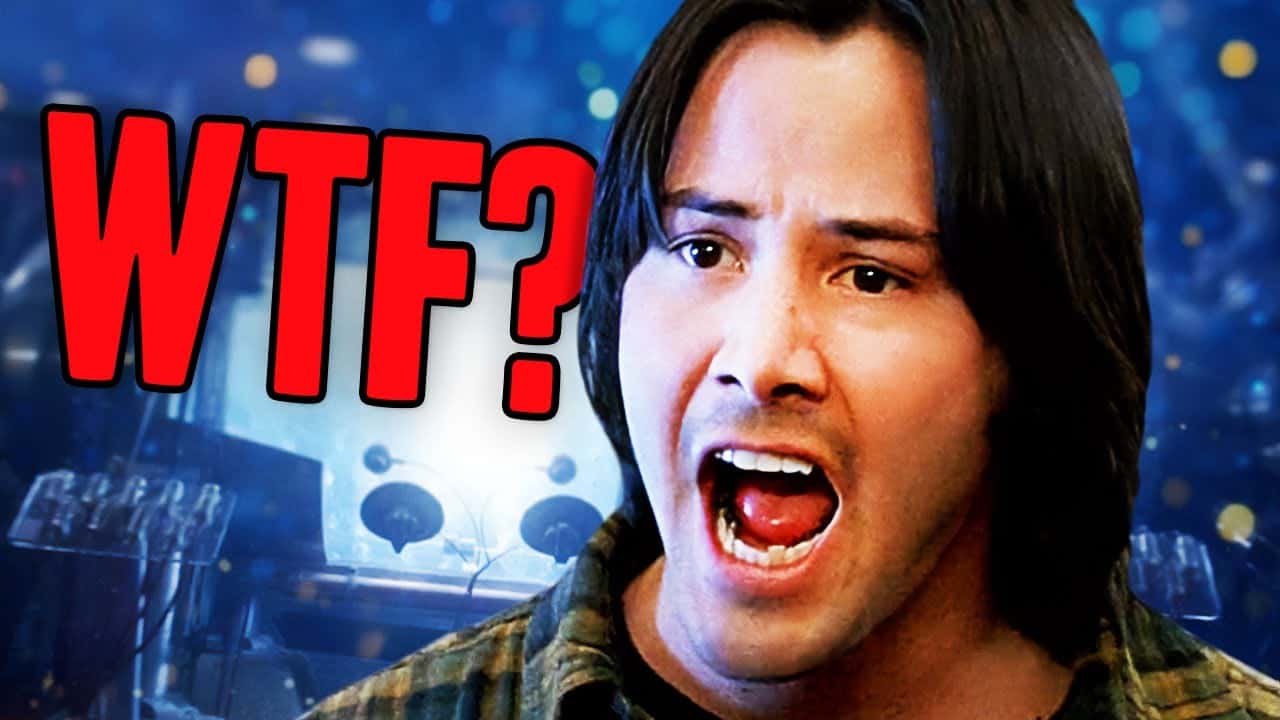
Chain Reaction (1996) – What Happened to This Sci-Fi Action Movie?
The Chain Reaction episode of What Happened to This Horror Movie? was Written and Edited by Jaime Vasquez, Narrated by Tyler Nichols, Produced by Andrew Hatfield and John Fallon, and Executive Produced by Berge Garabedian.
In the summer of 1996, Chain Reaction hit theaters with just about everything you’d want from a ’90s action thriller. Keanu Reeves was still riding high as the sympathetic action hero from Speed. Morgan Freeman brought his A-game and his signature weapon voice. Even director Andrew Davis was a hot commodity, fresh off directing The Fugitive, which had critics cheering and audiences running to theaters like they were being chased by Tommy Lee Jones. Throw in classic ‘90s plot elements like government conspiracy, corrupt suits, and a groundbreaking scientific discovery, and you’ve got popcorn gold. Or at least you should. The script went through many rewrites, which resulted in a frustrated cast. Filming took place during a Chicago winter so brutal, production had to be cut short. And through it all, Keanu and Rachel Weisz performed their own stunts. Drink at your own risk every time The Fugitive is mentioned. This is What Happened to Chain Reaction.
The story of Chain Reaction came from an unlikely trio. Making his screenwriting debut was Josh Friedman, who’d later go on to write War of the Worlds and Terminator: Dark Fate. He was joined by Rick Seaman, a veteran stuntman with over a hundred stunt credits, from RoboCop 2 to Charlie’s Angels. Strangely, this is his only writing credit. Rounding out the crew was RoboCop producer Arne L. Schmidt, who also served as co-producer here. Adapting their story into a screenplay was Michael Bortman, who later wrote Resurrecting the Champ, a Josh Hartnett/Samuel L. Jackson sports drama you might recognize from the prestigious “recommended for you” section on Netflix. But the real wild card here was J.F. Lawton, the writer behind Under Siege, its sequel, Under Siege 2: The Dark Territory, and you guessed it… Pretty Woman. Okay, maybe you didn’t guess that, but who says you can’t go from Julia Roberts falling in love to Steven Seagal blasting nuclear terrorists with a submachine gun?
Director Andrew Davis spent the ’80s turning out a few solid but not particularly remarkable films, but that all changed in 1992 with the Steven Seagal action film, Under Siege. The movie pulled off the absolute unthinkable: a Seagal film with two Oscar nominations. Davis had an even bigger hit the following year with The Fugitive, which was a game-changing phenomenon. Starring peak-era Harrison Ford, the film brought in $370 million at the box office, racked up seven Oscar nominations, and even scored a win for Tommy Lee Jones, who yelled and chased his way to a Best Supporting Actor trophy. The Fugitive set the gold standard for sophisticated, crowd-pleasing action thrillers in the ’90s.
Before it became Chain Reaction, the script went by the title Dead Drop, and earlier drafts steered the story in various directions. Morgan Freeman was originally set to play the main villain, a man who would frame Keanu Reeves’s character for murder and industrial espionage. Keanu’s character was first meant to go on the run alone, until later rewrites added Rachel Weisz’s character, shifting it into the “duo on the run” version we eventually got. Mira Sorvino was originally attached to play Weisz’s role, but dropped out to star in the ensemble dramedy Beautiful Girls. Another casting possibility was Tommy Lee Jones in a role that ultimately went to Brian Cox. Because someone at the studio probably said, “We’re already halfway to The Fugitive, just put him behind a desk instead of on the hunt, no one will care.” The final product also had a shift in tone. The vibe went from slow-burn conspiracy in the same vein as the Tom Cruise legal thriller The Firm in favor of delivering something similar to another 1993 blockbuster. That’s right, The Fugitive; where running, shouting, and exploding science labs were more the focus. Either way, this movie wasn’t aiming low.
In a 2001 interview with news outlet UPI, Keanu described his character, Eddie Kasalavich, as originally having the vibe of a Hitchcock protagonist; an everyman caught in an unjust nightmare, similar to Barry Kane in the 1942 chase thriller Saboteur. That film follows a factory worker wrongly accused of blowing up the plant he worked in and forced to flee across the country, which is eerily close to the final version of Chain Reaction. But Eddie’s original backstory was much heavier. Keanu said his character’s work obsession led to the death of someone close to him, possibly a wife or child. Given all the Fugitive vibes, we’ll guess it was the wife. Eddie was so guilt ridden, he quit the project, but his superiors hunted him down to make sure he finished the job. That storyline was scrapped, and Eddie became a 24-year-old machinist with zero family ties and even less backstory. Keanu questioned the director about the changes. Davis responded by saying the rewrites were meant to improve the story, but Keanu didn’t necessarily agree. In the final film, Eddie’s a clean energy whiz at the University of Chicago, helping extract renewable energy from water.
Prior to filming, Reeves injured his back playing hockey and put on a bit of weight; something I didn’t notice until coming across the Internet’s sharply pointed finer details. Whether it’s weight or wearing layers of clothes due to freezing temperatures, it kind of gives him a bit of a lumberjack look that works for the role.
When Dr. Alistair, Eddie’s mentor and the project leader, is murdered and their research lab mysteriously explodes, Eddie and physicist Lily Sinclair are framed for both crimes. In her first major film role, Rachel Weisz was cast as Lily. Weisz proved to be a solid choice for the character, bringing both credibility as a physicist and enough physicality to match Reeves in the action scenes.
Morgan Freeman plays Paul Shannon, a fashionable fellow with good taste in cigars and enough stealthy edge to keep you guessing whose side he’s on. He oversees the university’s project as head of a mysterious funding group called C-Systems Research. After Shannon advises Eddie and Lily to turn themselves in, they’re not sure if they can trust him. And neither can we, the audience. Freeman described his character’s motives as “ultimately political,” which just amps up both the mystery and the intimidation factor. Because Morgan Freeman really needed that.
Working alongside Freeman’s character is Lyman Collier, the chairman of C-Systems Research, who’s played by Brian Cox. Cox described his role as “the devil” to Morgan Freeman’s “angel.” While Shannon’s morality largely remains a mystery, Collier is unapologetically bad, operating with zero conscience, a maximum sense of entitlement, and just generally the kind of vibe that makes you leave the building instead of calling for help when you know he’s stuck in an elevator.
Fred Ward and Kevin Dunn play scene-stealing FBI agents Agent Ford and Agent Doyle. These feds are loosely based on characters from The Fugitive, U.S. Marshals Sam Gerard and Cosmo Renfro (played by Tommy Lee Jones and Joe Pantoliano, Joey Pants if you’re on a nickname basis). The agents spice things up with a hundred-dollar side bet. Initially skeptical, Ford ends up betting on Eddie and Lily’s innocence, while Doyle bets the opposite. Gotta make your own humor in those gloomy homicide cases, I guess.
In his memoir Putting the Rabbit in the Hat, Brian Cox reflected on his time filming Chain Reaction. Known for being brutally honest about fellow actors, Cox had only praise for Keanu Reeves, saying his growth as an actor has genuinely impressed him through the years. As for Morgan Freeman, he noted that the legendary actor had every reason to have a bad attitude during the shoot, but he remained, as Cox put it, “an absolute gentleman.” Which was probably still the case in an instance when Freeman and the director failed to see eye to eye. Cox noted that despite “about eight writers” working on the script, the actors were often left with little more than a “beats script.” The basic story structure was there, but the actors had to come up with the dialogue. One example occurred during a scene where Lyman and Paul race to an elevator to escape an explosion. Director Andrew Davis, who generally encouraged his cast to improvise, asked them to do so here. But Freeman, having been on the film longer than his co-star and worn down by the endless rewrites, refused to ad-lib. Though we’re guessing he declined in the classiest way possible. Brian Cox came up with a monologue on the fly and even began singing (which sadly didn’t make the final cut). Eventually the scene got a proper reshoot with scripted dialogue, proving yet again that sometimes “just wing it” works best if you’re a jazz musician. Or Nicolas Cage.
Morgan Freeman’s issues with the film weren’t limited to rewrites. They extended to the weather. Filming took place during one of Chicago’s infamous subzero winters, with temperatures dropping as low as sixteen degrees below zero. In an on-set interview, Freeman said, “I don’t do cold weather. I’m tropical.” According to the director, the fire department actually showed up on set to warn the crew that it wasn’t safe to film in those conditions. One particular sequence; a high-speed chase involving Lake Geneva and an airboat, was especially brutal. The freezing winds and dangerous speeds added to the pressure when the cast and crew only had about two takes to get the sequence right. Rachel Weisz said shooting the scene left the actors with a bad case of windburn, thanks to the boat speeding across an ice lake at about 70 miles per hour. Weisz also mentioned that the helicopter filming the sequence hovered over them a little too closely. Meanwhile, the airboat had no brakes and no way to reverse. On the bright side, that probably helped sell the terror on their faces in the couple of takes they managed to get.
Stunt coordinator Walter Scott praised Rachel Weisz for handling the demanding stunt work like a pro. He also commended Keanu Reeves for casually agreeing to do a stunt, then nailing it on the first try. As if dodging helicopters and running from exploding buildings was all part of a normal workday.
Director Andrew Davis praised Keanu’s willingness to get his hands dirty, saying, “We had doubles and stunt people, but Keanu did a lot of his own stunts.” One of those stunts involved a foot chase down Michigan Avenue in Chicago, where Reeves climbed a drawbridge tilting 120 feet into the air; or as I would call it: “Absolutely not.” Davis said that even with safety wires, “(Keanu) put himself in danger without any qualms.” Reeves later admitted he actually enjoys performing stunts with some risk involved.
The film’s pivotal lab explosion was created by visual effects team Digital Domain. Using detailed storyboards, they built an intricate scale model of the lab and its surrounding street. The model stood eighteen feet tall and twenty-eight feet wide. So basically, a very fragile dollhouse waiting to get blown up. Keanu filmed his part of the escape separately, riding a stationary motorcycle on a green screen stage while an industrial-strength fan blasted wind through his hair to simulate the fireball chasing him like he was a Super Mario brother.
Chain Reaction hit theaters in August 1996 with a weak $7.5 million opening, trailing behind holdovers like A Time to Kill and Independence Day. It was never gonna beat the likes of those films, but even Matilda, which was released the same weekend, nudged it down to #4. Not exactly the… reaction the studio was hoping for. Ultimately, the film made $21 million domestically, with a stronger $39 million overseas, totaling $60 million on a $50 million budget. Reviews didn’t help with a measly 18% from critics and 27% from audiences on Rotten Tomatoes. So where did it all go wrong? Well… Chain Reaction looks and sounds like a thriller, and it hits all the right thriller beats. And yet, it fails to actually be… thrilling. There’s never a real sense of danger, especially when the villains seem to surrender to defeat faster than a Friday the 13th victim.
You can feel Keanu’s disappointment with the script rewrites in his performance. It’s classic Keanu, playing the grounded, nice guy dodging bullets we all know and love. But there’s a lack of energy rarely seen in his other films. Both he and Rachel Weisz’s characters feel so sanitized and one-note, that it’s hard to fully invest in them. On the other hand, Morgan Freeman stays true to form with that trademark voice that demands attention. There were even moments that had me wondering if he was snubbed for an Oscar. But let’s be real: come awards-season, birds of a feather flock together, and Chain Reaction wasn’t flying anywhere near that pack, even if the director had recent Oscar cred with a certain movie whose name I’ve exhausted at this point. Speaking of, shout-out to Fred Ward and Kevin Dunn as the FBI agents: with no pressure to carry the film, they kick back, play off each other nicely, and look like they’re having the most fun of anyone on screen.
Ultimately, Chain Reaction isn’t a bad movie. It’s just kind of… there. It’s a decent comfort watch, but it could’ve been great had it taken more risks and frankly, had more fun. An early scene shows the research team celebrating their breakthrough moment by drinking champagne and dancing along to Bob Marley’s “One Love.” More oddball moments like that could’ve taken this film to cult classic levels. Alas, it fell short of its full potential. And that, my friends, is What Happened to Chain Reaction.
A couple of the previous episodes of this show can be seen below. To see more, head over to our JoBlo Horror Originals YouTube channel – and subscribe while you’re there!
The post Chain Reaction (1996) – What Happened to This Sci-Fi Action Movie? appeared first on JoBlo.