Channel Zero: No-End House (2017): Horror TV Shows We Miss
I’m doing something a little different this time. I got the greenlight to talk about one of my favorite series, one that most people seem to have written off– Channel Zero. But we’re not covering the whole thing, at least not all at once. Each season has its own mythology and tone, and it wouldn’t be fair to cram them together. It’d be like trying to review American Horror Story as a single story– it just doesn’t work. So I’m starting with my favorite: Season Two, No-End House. This one means something to me. It aired two years after I lost my dad, and it hit me in a way that felt uncomfortably specific. I was already deep in the grief cycle, and the show knew exactly which nerves to press. No-End House is, hands down, the best season of the four. Comparing it to the others would be pointless– it would dominate every category. They deserve their own space, and we’ll get there if you guys are up for it. But first, let’s set the stage with a little background on the series, before we dive into one of the most gut-wrenching, deeply terrifying things I’ve ever seen.
Channel Zero is an anthology horror series created by Nick Antosca, known for adapting lesser-known creepypasta stories into atmospheric, unsettling TV seasons. No-End House, the show’s second season, premiered in 2017 and follows a group of friends drawn to a mysterious, ever-changing haunted house with six rooms, each more terrifying and psychologically intense than the last. The series dives deep into themes of memory, trauma, and grief, wrapping supernatural horror in the messy emotional landscapes of its characters.
The original No-End House creepypasta is all escalating horror– nine rooms of psychological torment designed to break a person down through shock and spectacle. It’s punchy, eerie, and leans heavily into traditional haunted house tropes like dead parents and demonic figures. Antosca’s adaptation couldn’t be more different. Instead of a test of endurance, it becomes a meditation on memory and grief. The scares are slower, sadder, and far more personal. In his version, the house isn’t just something you survive– it’s something you’re tempted to stay in. The threat isn’t a monster, but your own longing to hold onto the past. It’s like the original story was Goosebumps for adults, but Antosca made it Lynchian horror meets emotional collapse.
Episode 1: This Isn’t Real
This series didn’t just resonate with me– it leveled me. When it aired, I was still deep in grief after losing my dad two years earlier. Watching Margot stumble through a surreal, haunted maze that weaponizes memory and loss wasn’t just compelling– it felt personal. The episode opens like a dream already in progress: suburban houses single numbers on them, no doors, something slightly off– except the black house at the end of the street. A girl is tackled just before entering it (this ends up being Lacey). “This isn’t real” is carved into her arm, a warning disguised as harm.
Then we meet Margot, played by Amy Forsyth, and see a montage of home videos with her dad, played by the truly magnificent John Carroll Lynch. We learn he died of an allergic reaction– a freak accident. She found him. That “if only I’d been there” guilt? That’s the kind that doesn’t go away.
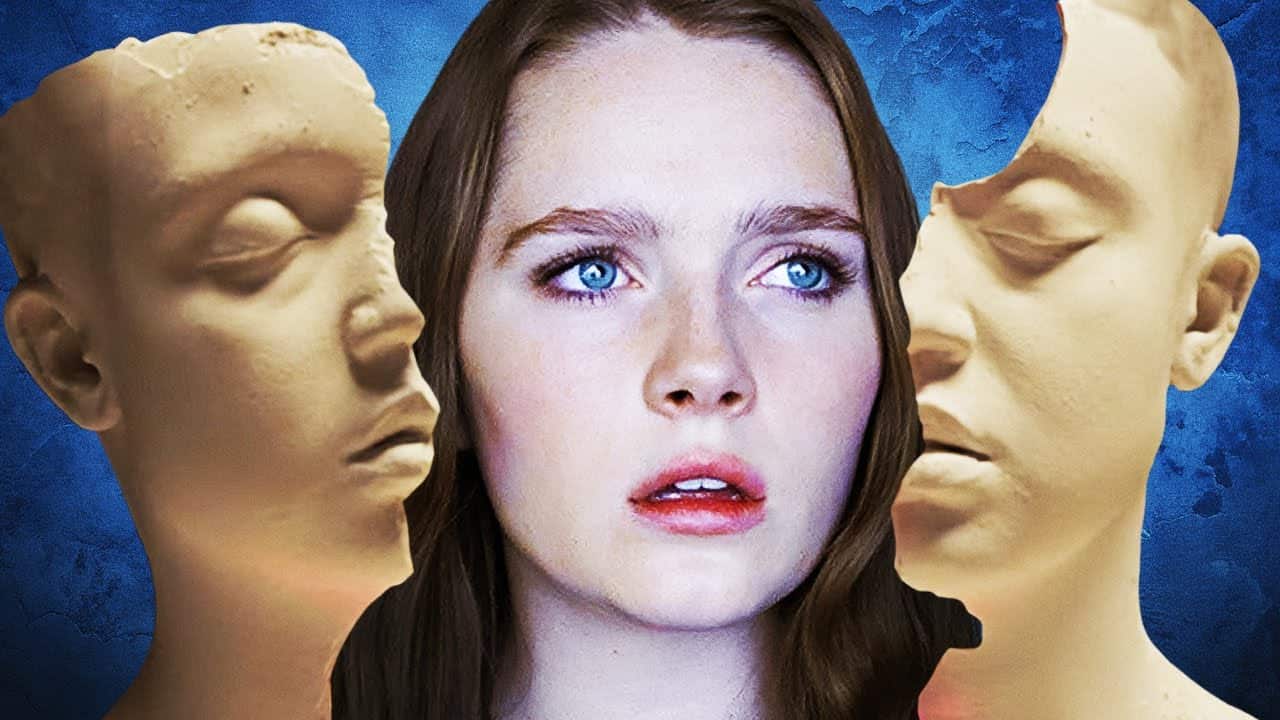
The catalyst is small: cryptic videos, a house that appears from nowhere. Six rooms, they say. No one gets to the sixth. It’s all supposed to be psychological… “fun.” But the deeper they go, the less fun it gets. Room one tears apart sculptures of their faces. Room two introduces a masked figure whispering, “Welcome back, Martian.” Room three is a lit hallway with a single mirror with a man behind it laughing maniacally and it disorients more than it scares. Room four is the gut-punch: a jumbled reel of memories projected out of order. Distorted conversations. Scrambled faces. That’s what grief does– it makes memory cruel and untrustworthy. But room five wrecks everything. It’s her living room. Her dead father wearing a plaster mask, bloated and lifeless, slumped on the couch. Then alive again. Clingy. Too happy to see her. He tells her she has to go through to get home. She does, and emerges not into safety, something familiar but not quite. Then home. Or what looks like it. Too quiet. Too still. And on the door: the number six.
And then: her dad’s in the kitchen. Smiling. Making breakfast. Like nothing ever happened.
Episode 2: Nice Neighborhood
Jules is unraveling. She lies about what she saw in Room 5, but we know the truth: a glowing orb filled with warped voices is calling her back. Back home, Margot’s dad is alive—but something’s off. Everything feels like a copy, just close enough to pass. Meanwhile, Seth and JD have escaped into a cul-de-sac of near-strangers– NPCs built from memory. JD meets a violent double; Seth hears from strangers who claim they’ve always known him. Everyone’s grip on reality is slipping, especially Margot. Her dad admits he’s manipulating Jules’ guilt, and even though Margot knows he died, she wants to believe in the illusion. She’d give anything for this version to be real.
Three brutal moments before we close the episode: Jules returns to the orb, JD is attacked by his copy, and Margot’s dad eats a replica of her mother in the basement. The cannibals weren’t a metaphor.
Episode 3: Beware the Cannibals
The cracks are starting to show. Jules’ memory sphere is taking shape—alive, pulsing, forming something new. Meanwhile, Margot’s dad has started rehearsing which version of “good morning” sounds most convincing. Dylan’s still trying to reach his wife Lacey, but she’s rewritten her reality without him in it. Real JD is gone, burned by his doppelgänger, and the fake one is unraveling, picking at his skin like a suit he doesn’t fit in anymore. Seth just stands there and watches. Margot begins to question the man calling himself her dad. He offers hollow reassurances, the kind that pretend grief can be smoothed over with a soft tone and a smile. But when she sees a replica of her mother’s head tossed in the trash, the illusion breaks. That’s not her dad. It never was.
The group regathers, and Dylan finally explains what’s happening: the house feeds on pain and memory. It wants them isolated, because isolation makes them easier to control. But Margot and Seth might’ve found its weak point. Jules, meanwhile, is quietly spiraling– returning to the sphere that siphons pain, unable to let go.
The episode closes with JD peeling away his skin and Seth noticing, and Jules slipping further into numbness. The house is still winning. And Seth? Still no one’s clocking him.
Episode 4: The Exit
Today’s the day they try to go home, but nothing about this place wants to let them go. Dylan’s attempt to jog Lacey’s memory with a necklace ends with her stabbing him, and it’s evident to us that Lacey isn’t going to come around. The group moves toward the house, but Margot’s dad isn’t far behind. The NPCs, clones born from the memories of those trapped inside, aren’t too happy that they’re leaving. Seth explains these beings can only feed off the people who created them, which raises the question: how does he know that?
The answer comes fast. Near the corn maze, Seth cracks. He compares himself to an orchid mantis: beautiful, deceptive, predatory. He confesses: he lives here. It’s the only place he ever felt like he belonged. Jules wanders deeper into the dream terrain, and Dylan leaves Lacey behind to follow her. The group is isolated again just like the house wants. Seth begs Margot to stay and build a life with him. JD is revealed to be a copy, and Dylan torches him. And during a moment in the maze, Margot runs into her father. Fighting against another very real death, he tells her to run, but follows her anyway.
They find the house again. Dylan sacrifices himself to destroy it, but doesn’t get that opportunity and Margot’s dad gets inside. The girls get out and emerge into the real world, spotting a dandelion and two new visitors approaching the house. It’s over… until it isn’t. Her dad made it through, too. Which begs the question: if your memories come with you, does the nightmare ever really end?
Episode 5: The Damage
The girls are back but we know it’s not our happy ending. Jules admits the house took her memories, while Margot wrestles with the wreckage of her father’s suicide. Her mother reveals the business was underwater and that the accident, his death, let them keep everything. It’s not closure. It’s more grief on top of grief. Her dad sacrificed himself for them. And now, the copy of him is loose in their world, hiding in the shadows of their backyard shed.
Seth shows up, tells Jules the truth: Margot’s dad is inside the house, and he’s struggling not to feed. But that resolve slips. He does it anyway. Margot forces his hand, and he is forced into the basement– desperate to stay alive. Meanwhile, the house is using Jules as a breeding ground for copies. Margot can’t bring herself to destroy her dad, even knowing he’s not real. Seth makes the call. They trick him into eating a memory-laced version of the meds that killed him before, and the story he told before about it being painless…another lie.
Just when things seem quiet, Margot’s mom walks in. Her dad reappears and lounges out at them. And Margot freezes. Seth saves her, but Margot turns around and chooses to re-enter the nightmare and leave with her father anyway, to protect them. And the house? Gone again. Jules stands in its place, alone.
Episode 6: The Hollow Girl
It’s been a year. Margot lives inside No-End House with her father and Seth, trying to survive on routine. She writes down memories she wants to keep. He feeds when he has to. It’s not living it’s just limbo. Seth plays the part of content boyfriend, but we know it’s an act. Meanwhile, Jules finds the house again, now relocated to Quebec. Determined to bring Margot home, she reenters. Seth warns her: whatever the house hasn’t drained from her yet will be next. But Jules is done listening, but not before Seth knocks her out and traps her in a basement with the sphere.
When Jules escapes she violently cuts her way out of the memory sphere like it’s nothing and you believe it. She’s changed. Margot is losing her grip on her old life, but Jules reminds her who she is and what matters. Together, they uncover Seth’s secret: he’s been using the house to create a life for himself, feeding on women he lured in. One by one, they emerge from every house, calling for him. When Margot sets the trapped family loose on him, they consume everything he ever was.
Her father watches quietly. He’s changed too. There’s still love in him, even if he was never real. In the series’ most gutting moment, Margot chooses to let him go. It’s the final release– the grief, the guilt, the fantasy of keeping the dead alive. She and Jules walk into the daylight. No End House is behind them. But the ache? That lingers. And that’s the truth the show never flinches from: surviving means learning how to live with the loss.
What Happened?
Viewership fell off over time– unfortunately, I get why. Each season of Channel Zero earned solid reviews, but the show never marketed itself particularly well. As an anthology, it asks you to commit to an entirely new story and tone every season, and not everyone’s up for that kind of long-haul investment. The audience dipped after each season, and honestly, I lost interest myself after season three. That said, fans of the series often refer to Brand New Cherry Flavor as the unofficial fifth season, and I can definitely see it. It’s funny how some people even discovered Channel Zero because of Brand New Cherry Flavor. Oh, and it stars our least favorite “nice guy,” Seth– a.k.a. Jeff Ward. No shade here since he absolutely nailed it.
I love hearing people’s rankings of the seasons (even when they’re wrong). Just kidding. No, I’m not.
If you want to watch it, Channel Zero is currently streaming on Shudder, a.k.a. my favorite streaming service, or you can grab the full series on DVD in case it is surrendered to the void. Nick Antosca, if you happen to come across this: we need you to get back to the weird stuff.
No-End House doesn’t just explore grief– it inhabits it. The missing memories echo how it feels to lose someone: terrified of forgetting because those memories are all you have left. At one point, Seth calls memory a disease. And in the depths of grief, it can feel like one. But even when they hurt, memories are worth keeping. They’re proof that love existed. That you existed in it. Until next time, my creepy companions.
A couple previous episodes of Horror TV Shows We Miss can be seen below. If you’d like to see more, and check out the other shows we have to offer, head over to the JoBlo Horror Originals YouTube channel – and subscribe while you’re there!
The post Channel Zero: No-End House (2017): Horror TV Shows We Miss appeared first on JoBlo.