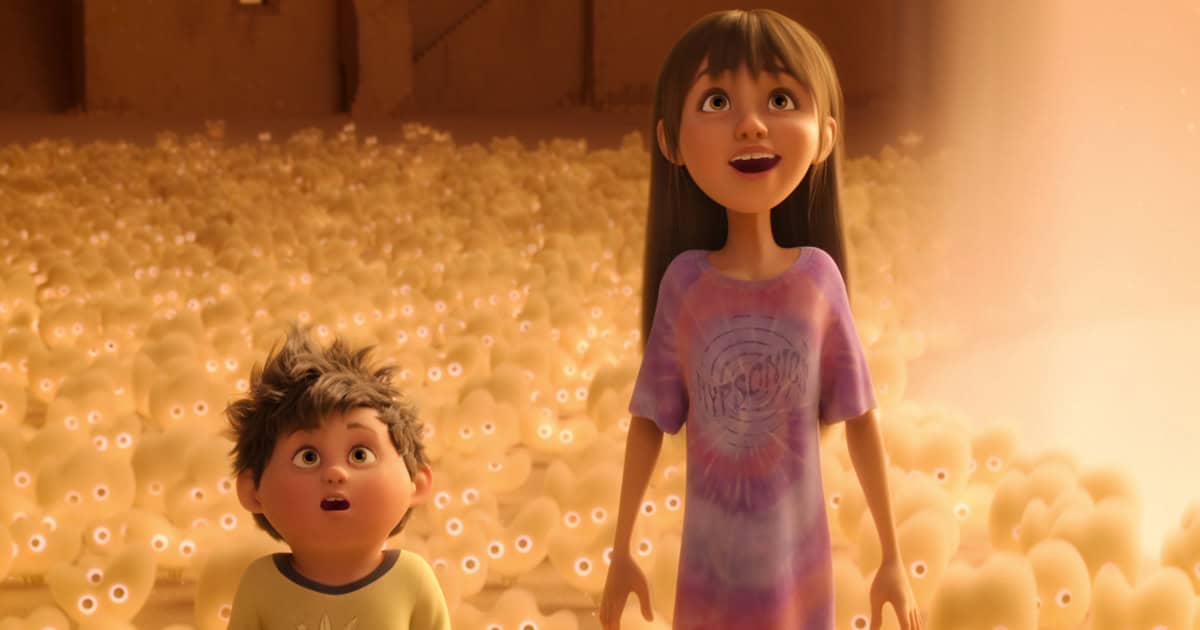
We interview In Your Dreams director Alex Woo & production designer Steve Pilcher – plus the new trailer!
The following interviews took place on Tuesday, July 29th at Netflix Animation Studios as part of a visit for In Your Dreams.
ALEX WOO: Director
I was curious, what do the teens possibly bring to their characters or voice acting in general that maybe the adults aren’t able to channel in a story like this?
What I love about working with, especially child actors, I actually really like working with actors, kid actors that aren’t trained actors. There was like a purity and a naturalness to their performances that I think you sometimes don’t get when you have like these sort of Disney-trained actors and Elias [Janssen, who voices Elliot] had that, even though he’s done other work before. But he brings this sort of organicness and a naturalness to his performance. Less of a machine work. And he was able to maintain that all the way through our five-year sort of production schedule.
Was the entire recording process five years?
Yeah…what we would do is…the way animation works is you put up reels, right? So you do like iterations of the story with storyboards. And you do that like every six months, you probably up another set of reels and you’re looking at the movie and saying whether or not it works. So every time we do that, we record a bunch of voices with our actors. So every couple of months we would record new pages or new scenes with him and with Jolie [Hoang-Rappaport, who voices Stevie]. That took place throughout the entire course of the five-year production…So I think what teen actors or kid actors can bring, I think they can be a lot less affected by their performance than I think the great adult actors. They can get past that sort of effectiveness or past that self-consciousness. But kids sometimes naturally…don’t have that self-consciousness. They can just be who they are. That’s what people love seeing in a performance. They don’t want to see the mask. They want to see the true person underneath. And I think that’s what kids can bring to performances. And I think that’s what Jolie and Elias brought to our characters.
In Your Dreams is your first feature. But obviously you have a working relationship with Netflix [Woo co-created Go! Go! Cory Carson for the studio] Are there certain pressures that come along with that?
Obviously we want to maintain a good reputation and a good relationship with them. But I think that would be the case even if we didn’t have a preexisting relationship with them. I think any time you’re working with partners, you want to do right by them. I mean, you know, Netflix gave us this huge opportunity to make this film, and it’s an original animated film, which is really hard to come by these days. And it’s also a challenging film because it deals with some challenging issues, right? A kid dealing with parents who aren’t sure what their relationship in their future holds. So I’ve really got to give them a lot of credit and I wanted to do right by them and do them justice…making this film the best film I could possibly make.
It’s evident that it hits on themes that children go through and the same with adults. So what do you hope viewers of any age are really taking from this? Are they different?
I think the takeaway or the “message” of the film, it’s for audiences of all ages, which is that life is imperfect and we aren’t perfect. But that the love that we have for each other, that’s going to get us through an imperfect life. That’s really what the message of the film is. You haven’t seen the whole thing yet, right?
No.
OK. So when you do, I think you’ll see that this movie’s really about the bond that Stevie and Elliot have and are carrying them through this time of uncertainty. And the family sort of coming together and Stevie realizing that no matter what happens in the family, they’re always going to be a family.
You’ve got a lot you can pull from regarding dreams. So how do you determine, dream-wise, what stays and what goes?
I think it’s a combination of, we only wanted to put dreams in there that felt like they came from people’s firsthand experience, like direct personal experience. We spent a couple days where we just collected dreams that people in our story department had, people in the art department had. And we put a lot of big lists and from those, we felt we tried to draw the ones that would fit within the narrative framework that we had established for the film. So a lot of it was sort of like matching people’s firsthand direct experiences with this to the skeletal structure of the story. So that’s kind of how we chose it. We wanted it to be authentic, but then it had to make narrative sense and fit with the story.
Do you remember any crazy ones that you would have loved to include but just didn’t work?
I’ve had this recurring dream – it’s really strange – of my parents as lobsters. Yeah, I don’t know why.
Are your parents human-sized lobsters in this scenario?
No, they’re like normal-sized lobsters and I’m cooking and I’m about to put them in a pot to boil them and they’re like trying to tell me in lobster language that they’re my parents, but I can’t understand them. It’s really weird. Obviously, that didn’t make it in the movie because it has no sort of connection to the story. But that was one of these things where it was a very vivid dream that I had. I don’t really know what it means. And I thought about putting it in, but it just didn’t really fit…It would have been a little startling. So there’re things like that, it just doesn’t – even though it’s an authentic dream or experience – it doesn’t really fit into the narrative.
Is there anything that you didn’t cover that you wanted to get across to viewers once we get closer to the actual release date?
I think [the film] has a lot. It has everything that I love about movies that I loved about movies when I was a kid. It’s got a lot of adventure. It’s got some fantasy and magical elements to it. It takes you to this incredible surreal sort of world of dreams. It’s got great characters, it’s really funny and absurd, but it’s also got a ton of heart, and I think the themes are really sort of resonant. I hope that it really resonates with people, and I hope they like it.
You had mentioned some of the films that influenced you when you were younger. I don’t know if it’s intentional or not, but to me, the bed seemed like your version of the DeLorean in a way where that’s the mode of transportation.
{Laughs} That was not deliberate…Probably in my subconscious it was in there the whole time. I still want to buy a DeLorean. I know they’re terrible cars, but just because I know they’re a great, great driveway piece.
STEVE PILCHER: Production Designer
I was wondering if you could talk about your specific working relationship with Alex Woo that has developed here as far as the freedoms that he was allowing and encouraging you and the team.
Yeah, I thought it well, at first it was great, and I’ve known Alex when I was working in Pixar, and I was production designing Finding Dory, but I knew him a little before that too…Just very easy going honest, transparent [person], and I just like that a lot. So we just clicked, right? But we didn’t work super closely together, but we would, you know, talk and stuff like that…I’ve worked with probably over 17 directors in my career so far. And he’s extremely collaborative and very open minded. And I felt very free that way that we could talk and banter back and forth. And if I didn’t think something was working, I would just from our standpoint, which isn’t that separate from what they’re doing, because I have to make the visual work, I have to make it storytell itself. I say, ‘Who are these characters? Like, why is this threat here? Like, what’s the background? We got to dig deeper, right?’ So we would do a lot of frank talks like that, because if you guys don’t figure it out, we’re going to figure it out, right? This is all in a friendly way.
So whereas I’ve worked with directors they won’t even talk about things, but the movie suffers terribly for that. Some of the worst movies I’ve ever worked on…it was just like that, really broken apart. You know, total collaboration is the key with everybody in all departments and working together, make one vision that’s a shared vision, that’s a collaborative vision, where you’re honestly trying to make a great film. And it’s really that simple, but amazingly, that doesn’t happen all the time. So it’s really the personality of the people respecting each other and appreciating each other, and knowing that everybody, every single person is bringing everything they can to make it great.
And we were the underdogs, like, we were a very small company, which I found very appealing. I wanted to join a really small company. Like, it was nobody. We had no art team, we had to build everything from scratch. And I just like Alex a lot and we have respect and appreciate each other…
So going off of that, as far as the animation team goes, we’re talking about dreams, which are very unique to the individual. How do you get to that center? How do you get to the core of the happy medium that decides, OK, this is what we are putting there?
Well, there’s standard ones, right? And Alex is working on that in his story, and…we researched. Okay, there’s flying dreams, which usually means you’re trying to escape from something from your life sometimes. They’re still trying to analyze them, right? There’s, like, you know, the naked dream or the embarrassment dream, or you can’t find something dream…So we took some of the standard ones, and they’re in the film. And then you have to go to other ones that just start out like a lot of them are, just kind of like fun dreams, like it’s something enjoyable…Sometimes dreams, you just wake up and you feel good. You had a great dream or whatever it was, or you just woke up because it went bizarre, right? And then sometimes it’s literally scary, very scary, really fast. So those are sort of motifs that are guidelines in the film…a few dreams that everybody can relate to, and then many dreams that are just particularly relatable to their characters in our movie.
So like Elliot and Steve, they go to Polly’s Pizzeria, you know, there may be a dream that will take some elements from that restaurant activity, place, and take it into a dream, right? So we made sure that everything kind of did that for the most part. If it’s a distant memory, if it’s a memory that’s just one of the kids’ dreams, right? So all that kind of weaved its way into the storytelling.
So you’ve worked with a few different animation companies. You’ve got a long history of Pixar. What is Netflix bringing to the world of animation?
Currently right now, what I really love that they’re bringing to the field of animation is this diverse range of expression and animation. So, from skewing very young and different styles, different styles and techniques, being employed and used, all the way to your complete adult stuff that’s…another range from like 2D shaders or experimental stuff or 3D taken very seriously. Right now there’s this dynamic range that I find as an artist extremely appealing. Different pockets.It’s not narrowly branded with its focus. It’s wider. It’s willing to take risks. Some things will, that’s what art is. To do art, you’ve got to take a risk to create something. It’s just inherent in what the process is, right? Whether you’re painting, sculpting, whatever you’re doing, the creative process is that. That’s what I really like about them is that spirit of art creation in film is alive and well now. And they’re doing awesome stuff, obviously, so it’s great to see more in that game.
The clips we saw during the deep dive and elsewhere play a lot with scale characters versus other things. How do you go about hitting that right note that, oh, this muffin is too big or something like that?
We sort of sort of make the world itself like, for example, Breakfast Town, relate to itself and scale. When we bring Stevie and Elliot in, with their more miniature…the dream is larger than life, right? So when we bring them in, everything that’s like Delilah the muffin is relatable to a popsicle stick or the tiara, if you put a tiara on a muffin, that’s how big it is. But to [them], it’s way oversized. But Stevie and Elliot are the miniature ones in the world, same with Baloney Tony…So we relate them to themselves, and then the world they’re in to itself. And most of the time, because it’s charming…it’s more amplified, the emotional impact that that will have, like, if you’re in a Breakfast Town and everything’s a miniature, you go, the popsicle sticks aren’t that big, but the kids are really little, right? And they’re moving by these because they’re moving them out of the way. It just makes it charming. So that’s kind of what it just became an obvious motif to look at them as miniatures, even the bass that jumps out of the water. That’s based on Billy Bass, the talking fish. That ship is made of like a Lego-like structure. It’s completely built, colored, and can function. It had its whole sequence on its own. But all you see of it now is like the deck, and then that thing coming up, and that’s exploding. But it was completely vatted out at one and it still exists in our archive files. that’s like something that people won’t know. There’s so much stuff like that. But larger than life…How does that work if you’re on a ship like that? We did so many sequences like that with that.
Could you talk about some of the reference points that you have? Were there any specific film/cultural references that you guys pulled from?
Yes, in the montage, there’s a Terminator one, where a Polly’s Pizzeria character has a Terminator character. So everything has callbacks and relationships to the real world, right? You’ll see if you watch the film – you won’t pick them all up because they’re there, but you won’t pick them all up. So if you rewind or you so much choose to watch it again, you probably start to notice those things, Go, ‘Wait a minute!’
I think this is going to take a lot of people longer than an hour and a half to watch.
If they’re enjoying it and they want to do it, awesome.
It’s like, Oh, that was that one Shining reference, clearly. And the bed is reminiscent of the DeLorean a little bit.
Yeah…Essentially when you talked about Polly’s Pizza, like, Chuck E. Cheese is a franchise….not as expensive animatronics on the stage. Kids all love that, they run around, get the tokens and do all that stuff. And so we love that idea of this place that was kind of like that kind of a place for kids that’s kind of somewhat chaotic with kids activities. And, you know, every parent can relate to that kind of thing and kind of finding an angle in that. Then also there’s when they need to travel, every time they go into a dream, they’re moving usually from screen left to right. They’re trying to find the Sandman. So they’re moving. When we went from Polly’s Pizza, we said, ‘How can we get them moving?’ We made a ball pit river…And it does draw parallels to It’s a Small World, it just wasn’t an incidental kind of thing. And we went, ‘Oh, that’s kind of cool, it’s charming. So it’s the charm of that, but also with an angle on it that could turn into a nightmare, because most of our things had to turn into a nightmare. Right? So it had to serve multiple purposes. So when you’re thinking of these things, you’re not thinking of just one little idea, you’re thinking of all these things and how it’s basically how they relate, sometimes how they relate to us ourselves, as the audience members, but usually how it relates to the kids in their world. I think the Chuck E. Cheese was a little bit more like that because we didn’t want the animatronics to be super cool or anything, we wanted them to be kind of broken a bit and not maintained. So it’s funny, if parents can relate to it.
Is there anything that you want people to know that wasn’t covered here or in any of the sessions?
I am seeing that when I do these interviews that there’s a lot of parallels and lots of associations that come from the real world into the dream world that people are just queuing into and if the film’s fun enough, people will watch it again and start to see those things pop up. And I’m starting to see that that’s a pattern that people are talking about. So I just hope that people really enjoy it when they watch it. That’s always the fun part now. Did we do it? Did it work? I want to see it in a normal theater. I know it’ll have a limited run to qualify for awards and Oscars. But I’d love to see it in a theater with an audience to see how people react to see what they laugh, see what they like, and see how it emotionally touches them. So I’m really kind of curious on that.
I’d like to thank Netflix Animation Studios for inviting us to go behind the scenes of In Your Dreams. Be sure to check out the film when it hits Netflix on November 14th!
The post We interview In Your Dreams director Alex Woo & production designer Steve Pilcher – plus the new trailer! appeared first on JoBlo.