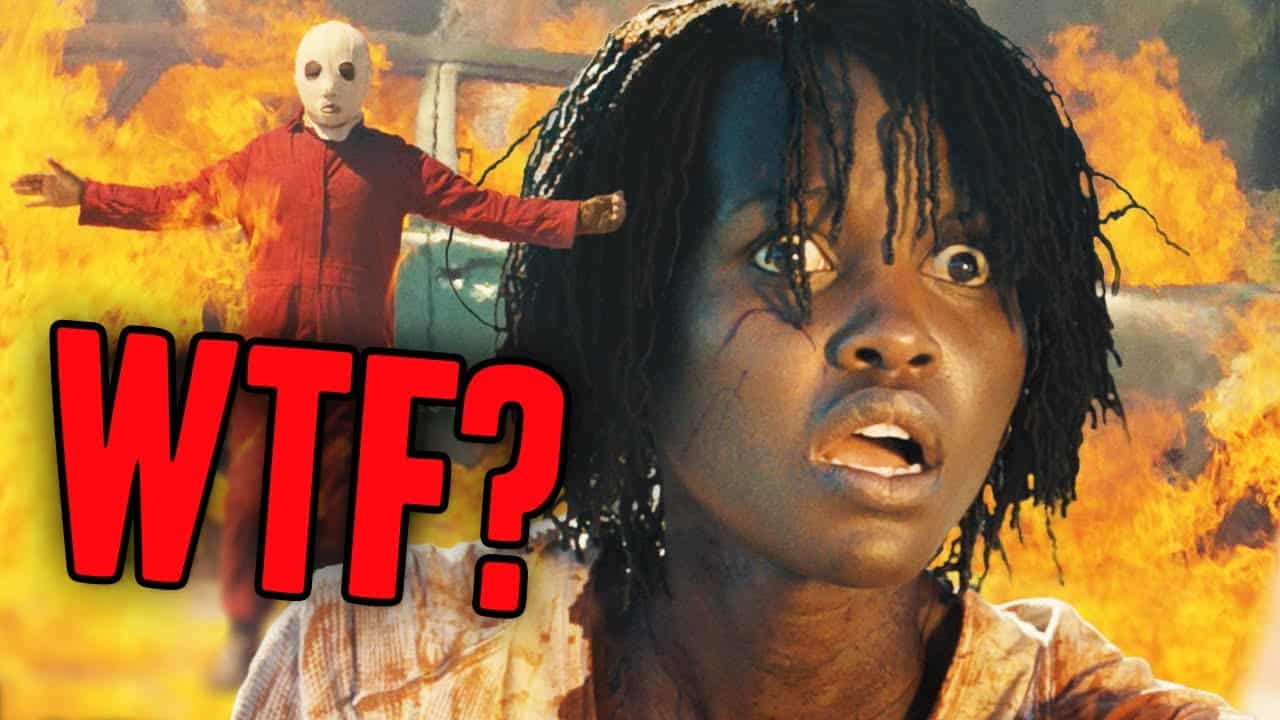
Us (2019) – What Happened to This Horror Movie?
Stop flipping channels and pay attention to this glorious wall of VHS tapes. No, we don’t mean your own personal collection! We’re talking about the wall of VHS’s from Jordan Peele’s sophomore effort.We’re greeted by a shelf lined with clunky 1980s videocassettes: C.H.U.D., The Goonies, The Right Stuff, A Nightmare on Elm Street and the Steve Martin classic The Man with Two Brains. We see them nestled against a TV as a news story about Hands Across America is playing. While this may seem like harmless nostalgia, we know that nothing is ever background noise. These tapes and news stories are guideposts, miniatu re keys to the nightmare we’re about to unravel. C.H.U.D. foreshadows the hidden population living below ground, The Goonies nods to children stumbling through hidden passageways, And A Nightmare on Elm Street which Peele himself has called one of his main influences on the style of this film. Peele lays out his influences in plain sight, daring us to catch them, then weaponizes them. Us isn’t just a story about doppelgängers invading a beach house, it’s a mirror, one that forces us to stare at the ugliest corners of ourselves, as well as raise awareness for Hands Across America. So come join us on a stroll to the Santa Cruz Boardwalk and into the Visionquest Hall of Mirrors, but make sure to not stray too far as we find out what happened to Us?
Before diving into how the film was made and the ideas behind it, we thought we’d discuss the plot to get you up to speed. This is deceptively simple, almost like a slasher film turned inside out. Adelaide Wilson, played by Lupita Nyong’o, returns to Santa Cruz with her husband Gabe (played by Winston Duke) and their two children. They’re ready for a beach vacation that hopefully recaptures Adelaid’s childhood. On the surface, it’s supposed to be a sunny family getaway, but Adelaide can’t shake the memories of a terrifying night from her youth when she wandered into a hall of mirrors and met her exact double. Those childhood fears come roaring back when, late one night, the Wilsons are confronted by another family in their driveway, dressed in red jumpsuits, clutching golden scissors, and looking exactly like them. Who are these people? And what do they want? It’s a simple premise yet Peele puts his unique twist on it.
In 2017, after the massive success of Get Out, Jordan Peele knew he couldn’t simply repeat himself. Instead of leaning into another social thriller with a clear allegory, he set out to make a more ambitious and surreal horror film with Us.
The idea came from a Twilight Zone episode entitled “Mirror Image” which centered around a woman and her evil doppelgänger. He described his concept as stemming from one of the most basic human fears: “the other”. Peele wanted to explore the terror of facing yourself, your exact copy, stripped of privilege and comfort, looking back at you with hate in its eyes. His goal was to invent a new American monster, something as enduring and iconic as Romero’s zombies or the vampires of folklore, but stamped with his own sociopolitical signature. Thus the Tethered were born. Red-clad shadows with golden scissors who weren’t zombies but simply…us. He described the process as liberating but also daunting.
Universal Pictures wasted no time in locking Peele down, giving him around $20 million for his sophomore effort, nearly five times the budget of Get Out. Jordan produced the film alongside Jason Blum from Blumhouse Productions and Sean McKittrick who both produced Get Out.
Casting was critical, and Peele built the film’s very foundation around Lupita Nyong’o. She shouldered the daunting task of portraying both Adelaide, the haunted mother trying to keep her family safe, and Red, her chilling double and the leader of the Tethered uprising. Nyong’o dove deep, crafting Red’s horrifying rasp through research into spasmodic dysphonia, a real vocal condition that affects the muscles of the larynx. The effect was unforgettable, making Red sound both fragile and monstrous, as if every word was dragged painfully into existence, she even created two distinct personalities.
Peele’s casting instincts didn’t stop there. Winston Duke, fresh off his breakout role as the ferocious M’Baku in Black Panther, was given the chance to flip expectations entirely. As Gabe, he became the ultimate dad; part teddy bear, part goofball, a man whose greatest weapon in a fight is probably his terrible sense of humor..but hey at least he can drive a boat! His comedic timing provided levity in the midst of chaos, but Peele carefully used it as seasoning, never letting the humor break the dread.
Then there were Elisabeth Moss and Tim Heidecker, playing Kitty and Josh, the Wilsons’ friends. Moss, who had just cemented her reputation with The Handmaid’s Tale, threw herself into her brief but memorable role, especially when her Tethered double takes the stage in one of the movie’s most unsettling sequences. And Heidecker, best known for his surreal comedy with Tim & Eric, used his knack for awkward absurdity to make his doppelgänger scenes both hilarious and grotesque.
The supporting cast included Shahadi Wright Joseph and Evan Alex, who played the Wilson kids. They had to pull double duty as both charming, believable children and their feral Tethered counterparts. Wright Joseph, in particular, turned Umbrae, the smiling, psychopathic mirror of her character Zora, into one of the film’s most chilling presences. She darts through shadows with a smile plastered across her face.
And then there’s Evan Alex as Jason, Adelaide and Gabe’s youngest child. Jason, who’s obsessed with magic tricks, constantly wears his Chewbacca mask, and likes using an ambulance toy car as a door stopper for some reason. His Tethered counterpart Pluto, is one of the most unsettling creations in the entire movie: a burned, feral boy who crawls and snarls like an animal, his mask hiding both scars and the fragile humanity underneath. Unlike Zora and Umbrae, who are polar opposites, Jason and Pluto share a strange, almost psychic link. Their mirrored gestures during the climax hint at a deeper connection, suggesting that the bond between “us” and our doubles may not be so cleanly cut.
Filming took place between July and October of 2018, with Jordan Peele selecting Santa Cruz, Los Angeles, and Pasadena as his key locations. The Santa Cruz Beach Boardwalk became an iconic backdrop. According to trivia shared by producer Jason Blum, during the Santa Cruz Boardwalk shoot the roller-coaster seats were populated with dummies, which were then digitally replaced or augmented with the actors in post-production, to give the feeling that Boardwalk was truly alive in 1986.
One of the most important locations in Us is the Wilson family’s vacation home, which was filmed in Pasadena. The production didn’t just select any suburban house at random, this was shot in the private, gated community of North Kinneloa Ranch in Kinneloa Mesa. The crew avoided showing a house number, keeping its exact identity under wraps. And they spent nearly six weeks transforming the residence into what audiences saw onscreen.
Peele insisted on practical effects wherever possible, particularly in scenes where the characters had to confront their doubles. This decision meant that the actors had to rehearse precise fight choreography and master mirrored body language to bring the doppelgängers to life. In sequences like the living-room invasion, the eerie effect came from watching performers embody both predator and prey, with blocking and camera work carefully designed so audiences believed in the uncanny mirroring of self. Peele was meticulous about ensuring that these moments never slipped into digital trickery, grounding the horror in something tactile.
The film’s imagery is loaded with symbols, and Peele treated them as much a part of production design as the sets or costumes. Rabbits were chosen as recurring motifs because Peele found their scissor-like ears both “adorable and terrifying.” In the film, the rabbits represent test subjects and failed experimentation, echoing the Tethered’s origins. More than 100 live rabbits were used on set. The weapon of choice, the gold scissors, carried the same layered meaning, serving as tools of violence but also as metaphors for duality: two blades joined together, always capable of cutting apart.
Michael Abels, who had already established a strong creative rapport with Peele on Get Out, returned to compose the score. Peele asked him to create music that was both haunting and unsettling, and the result became one of the most memorable elements of the film. Abels transformed Luniz’s hip-hop hit “I Got 5 on It” into a chilling orchestral piece known as the “Tethered Mix,” a track that underscored the film’s marketing and its climactic ballet-like duel between Adelaide and Red. Beyond that, Abels layered the score with nerve-jangling strings, atonal choral chants, and dissonant drones that recalled classic horror scores such as The Omen.
During post-production, editor Nicholas Monsour emphasized a natural storytelling flow. Rather than forcing rigid structures, Monsour allowed the geography of Santa Cruz, the actors’ physical confrontations, and the layered performances to organically guide the film’s pacing and tone. A particularly complex challenge was editing scenes where the same actor appears as both the original character and their doppelgänger. Monsour addressed this by being deeply involved in pre-production planning with the VFX team, cinematographer, and storyboard artist, enabling him to anticipate how doubles would be portrayed. He also brought on a VFX-savvy assistant editor, Jorge Diaz, to create temp stitches of multiple shots that placed the same performer into one frame. This approach got the doubles to “sell” seamlessly in the edit.
When Us premiered at South by Southwest on March 8, 2019. It was an instant hit. Critics hailed it as proof that Peele wasn’t a one-hit wonder but a filmmaker building a new canon of horror. It was released theatrically only a few weeks later on March 22, 2019. It pulled in $71 million on its opening weekend which was the highest debut ever for an original horror property. It would go on to gross over $255 million worldwide. Audiences, however, were split. Unlike Get Out, Us was more elusive, layered with symbols and ambiguities that invited debate. Some viewers were unsettled by its refusal to explain every detail of the Tethered’s origins. Others who saw this loved that very ambiguity, finding in it endless interpretations about class divides, racial duality, and America’s underclass. Peele admitted that he wanted the film to resist a single reading. Us was designed to be a mirror and what you saw in it said more about you than about the movie itself.
In the aftermath, Us carved out a unique cultural legacy stemming from memes of “the Tethered” flooded social media and even think pieces dissecting every frame. Lupita Nyong’o’s performance was hailed by critics’ groups, though controversially snubbed by the Oscars, sparking debates about the Academy’s ongoing bias against horror.
The film proved that Jordan Peele wasn’t simply a one-hit wonder; he was instead testing the waters of horror. He showed that it could be both terrifying and endlessly interpretable. That it could make audiences laugh nervously one minute and question their place in society the next. It even asked more questions after it was finished than it answered.
But the scariest part wasn’t the golden scissors or the wide-eyed doubles creeping out of the shadows. It was the possibility that the real “others” were us. Peele used a monster movie framework to slip in a brutal truth: sometimes the nightmare doesn’t come from without, it comes from within, from the cracks in our reflection. And that my friends, is what the fuck happened to Us.
A couple of the previous episodes of this show can be seen below. To see more, head over to our JoBlo Horror Originals YouTube channel – and subscribe while you’re there!
The post Us (2019) – What Happened to This Horror Movie? appeared first on JoBlo.