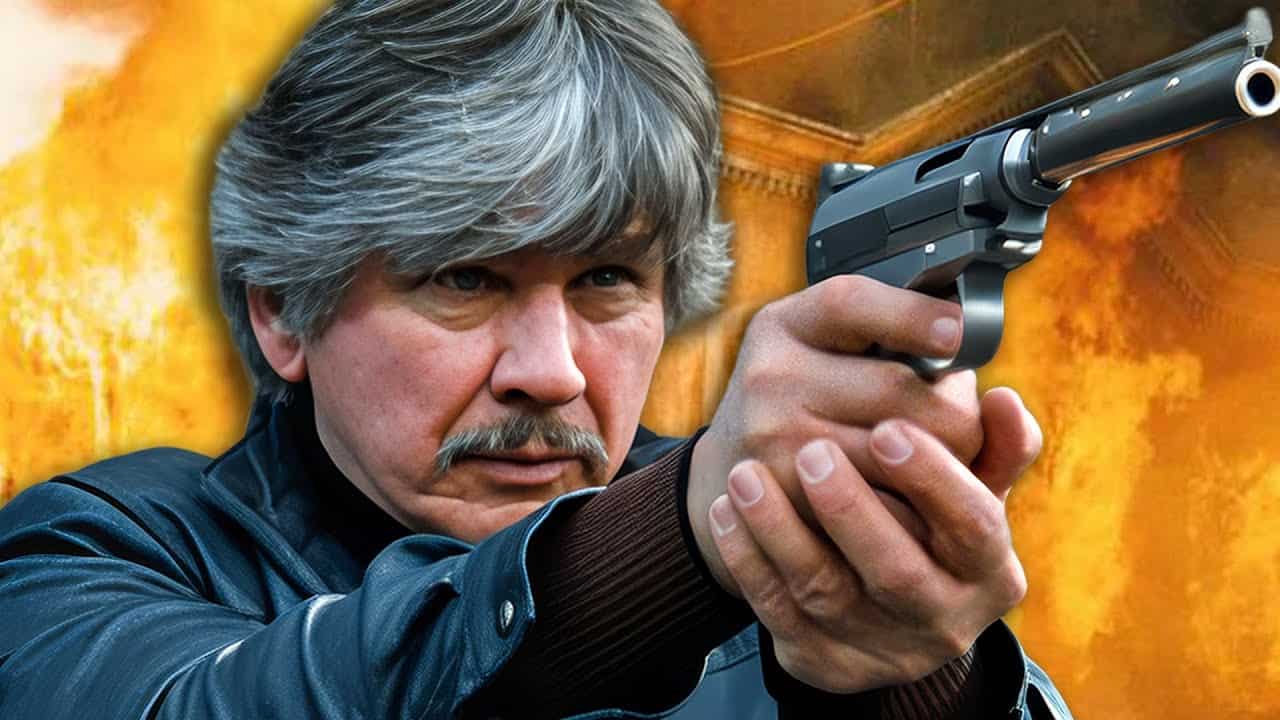
Is Death Wish 3 the is most insane action movie of the eighties?
If you’re a fan of eighties cinema, you know the Cannon Films logo—and that unmistakable music sting that comes with it. Whenever you see that logo, you know you’re in relatively good hands. What you’re about to watch probably isn’t going to be art, but odds are it’ll be a damn good time.
Cannon’s heyday ran from about 1981 to 1989—basically the entire decade—and they carved out their legacy by cranking out an endless supply of low-budget, formula-driven action flicks. Their roster was legendary: Chuck Norris, Michael Dudikoff, Jean-Claude Van Damme (in the later part of the decade), and the crown jewel of their stable, Charles Bronson.
Now, Bronson was different from the other Cannon stars. Norris and Van Damme became stars because of Cannon. Dudikoff only existed because of Cannon. Bronson, on the other hand, was already an established movie star long before Menahem Golan and Yoram Globus came knocking. In fact, by the early eighties, Bronson’s stardom was fading. He was in his sixties, his films weren’t drawing the way they once did, and Hollywood wasn’t lining up to give him leading roles anymore.
But Cannon saw opportunity.
Bronson had always been bigger overseas than he was at home, and his career had been kickstarted in Europe anyway. Sergio Leone’s Once Upon a Time in the West and French crime films like Farewell, Friend and Rider on the Rain had made him a star in his late forties, and he rode that wave into a string of seventies U.S. hits: The Mechanic, Mr. Majestyk, The Stone Killer, St. Ives, Breakout, and more. He was, without question, one of the great tough-guy action stars.
And then there was Death Wish in 1974.
Directed by the somewhat less-than-beloved Michael Winner (read about Christopher Guest’s experience with him HERE) and based on Brian Garfield’s novel, Death Wish was bleak, violent, and controversial. It told the story of Paul Kersey, a mild-mannered architect who becomes a vigilante after his wife is murdered and his daughter brutally attacked. What’s fascinating now is that Kersey never actually tracks down the men who destroyed his family. In today’s Hollywood, the story would’ve been streamlined so he only hunted those guys. But in Death Wish, they’re just random psychos—one of whom, incidentally, was played by a young Jeff Goldblum. Instead, Kersey simply turns his grief and rage outward, killing muggers and petty criminals at random.
The film made Bronson a global superstar. But by the early eighties, that shine was fading. Cannon figured they could use him differently: not as a mainstream box office draw, but as a VHS and cable juggernaut. So they approached Bronson and Michael Winner with an offer to finally make Death Wish II.
Released in 1982, the sequel adjusted the formula. Kersey was softened into less of an antihero, with his targets now being the men who kill his housekeeper and assault his daughter. But at the same time, the violence was cranked up considerably. If the first Death Wish could be called a “real movie,” the sequel was unapologetic grindhouse exploitation. Critics hated it, but audiences showed up, and Cannon was proven right. Bronson was back.
Naturally, this led us to Death Wish 3.
And if Death Wish II was grindhouse, then Death Wish 3 was pure lunacy—arguably the most demented action movie of the decade.
Winner, making his last film with Bronson, seemed to embrace every criticism of the previous installment and just turn the dial to eleven. The result is surreal. This is a movie where the New York City police literally cut a deal with Paul Kersey to wipe out a local gang problem. No law, no justice system, no rules—just, “Hey, Charles Bronson, kill as many punks as you want.”
Plot-wise, Kersey returns to New York (though the movie was actually filmed in England, which explains why none of it looks remotely like New York) to visit an old Korean War buddy. Within minutes, his friend is murdered by gang punks. Kersey is arrested, thrown into jail, and comes face-to-face with the gang leader, Manny (played by a gloriously unhinged Gavan O’Herlihy, sporting a ridiculous reverse mohawk). The cops strike a bargain: Kersey goes free if he promises to clean up Manny’s gang problem. And with that, the carnage begins.
Kersey moves into an apartment complex in gang territory, befriends the neighbors, and becomes their avenging angel. There’s even a scene where a neighborhood kid literally salutes him as if Bronson were Captain America.
And then there are the weapons.
This film is basically a 90 minute advertisement for the NRA. Kersey mail-orders every gun he uses, name-drops them, and the camera lingers on each piece of hardware like it’s porn. He gets the Wildey hunting pistol (which Bronson really did commercials for), an M72 rocket launcher (which he orders out of Soldier of Fortune magazine), and a stockpile of machine guns conveniently stashed by Martin Balsam’s crotchety old character.
The finale is flat-out apocalyptic. Over 100 gang members are slaughtered in a street war that looks like the Third World War transplanted to a random British backlot. Kersey racks up a body count of around 60 himself. His police buddy, played by Ed Lauter, casually kills another 35 or so. By the end, the neighborhood looks like the international news on CNN….
And the weird thing? The movie plays it straight.
This isn’t satire. This isn’t parody. Michael Winner wanted this to be an awesome action movie. And in a way, it is—but in the most gonzo, unhinged way possible. Bronson himself apparently hated how ridiculous it all was. After this, he refused to work with Winner again, shifting to director J. Lee Thompson for the rest of his Cannon run.
Still, Death Wish 3 solidified one of the series’ biggest tropes: anyone who gets close to Paul Kersey is doomed. His war buddy dies immediately. The cute, much-younger reporter he romances? Dead as soon as they kiss. In fact, the only love interest who ever survives is Jill Ireland in Death Wish II—and that’s because she was Bronson’s real-life wife, and he wasn’t about to let Winner script her death.
But despite Bronson’s stiffness (at 65, he was still in decent shape, even busting out push-ups in one scene), Death Wish 3was a smash by Cannon standards. It grossed $16 million at the U.S. box office and became one of the company’s most rented VHS titles. Over the years, it’s grown into a cult classic, celebrated by fans of eighties excess as one of the most gloriously over-the-top action movies ever made.
The series didn’t stop there.
Death Wish 4: The Crackdown, directed by J. Lee Thompson, struck a balance between the sleazy grindhouse vibe and more traditional action-movie thrills. It’s one of only two Death Wish movies without a rape scene, but it still gives Kersey plenty of kills—38 in total—capped by an action climax in a roller rink. Then came Death Wish V: The Face of Death (for some reason they switched to roman numerals for this one), a cheap Canadian tax-shelter flick that was abysmal. Bronson looked ancient and painfully bored, though Michael Parks turned in one of the series’ best villain performances, which almost made the movie watchable.
Years later, Eli Roth tried to reboot the series in 2018 with Bruce Willis, but the remake fizzled. Ironically, the best modern Death Wish movies weren’t even called Death Wish: Jodie Foster’s The Brave One and James Wan’s Death Sentence (based on Garfield’s sequel novel) carried the torch far better.
Still, Death Wish 3 remains unique. It’s not a movie to take seriously, but as a wild, crowd-pleasing, beer-and-pizza action flick, it’s unbeatable. It’s the Cannon Films ethos distilled into 90 minutes: cheap, violent, insane, and unforgettable.
So if you’ve never seen it, gather some friends, crack some beers, and throw it on. For sheer party-movie mayhem, Death Wish 3 is the shit.
The post Is Death Wish 3 the is most insane action movie of the eighties? appeared first on JoBlo.