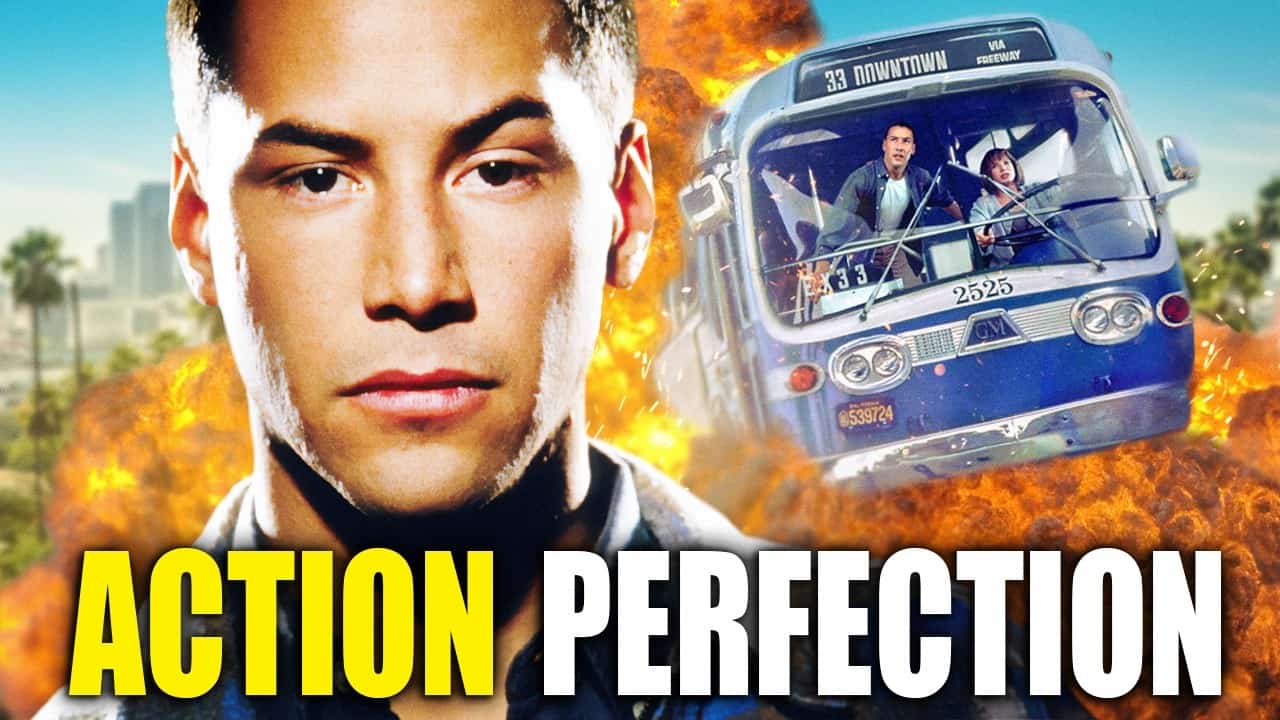
WTF Happened to Speed?
Pop quiz, hotshot. You’re the executives at 20th Century Fox, and you’ve got an action movie that’s entirely set on a bus, directed by a first-timer, and starring two young actors who’ve never opened a movie. What do you do? What do you do?
Well, if you’re them, frankly, you open it in the early summer of 1994, then sit back and watch the big bucks roll in all summer long, as Speed — a movie no one expected anything from — went on to become one of the biggest sleeper hits of the nineties and an action classic that stands the test of time more than thirty years later. But how did this modestly scaled action classic happen? We’ll tell you all about it, because here’s WTF Happened to Speed.
Jump back to the year 1985. Cannon Pictures, a studio much mocked for its reliance on low-budget, B-grade action movies, made a rare action masterpiece. The film was called Runaway Train, and it was about two convicts stuck on an out-of-control train barreling toward a chemical plant. A young Canadian screenwriter named Graham Yost saw the movie and wondered if a similar concept could work on a bus. After all — a train is on a set track, whereas a bus would have to deal with all the perils of a rush-hour commute. And how could the fact that it couldn’t stop be explained? By having the bus unable to go under 50 mph lest a bomb be triggered.
The pitch proved irresistible to Paramount Pictures, who briefly considered it as a vehicle for a martial artist they were grooming for stardom — Jeff Speakman. Given his mastery of Kenpo, the movie likely would have departed significantly from the script to allow Speakman to fight bad guys outside the bus. But his screen debut, The Perfect Weapon, was only a middling success. Some thought was given to turning the film into a John McTiernan vehicle, but he thought it was too thematically similar to Die Hard — and indeed, early ads would celebrate the film as “Die Hard on a Bus.”
However, his DP for The Hunt for Red October and Die Hard, Jan de Bont, was itching to make his directorial debut and became attached to the project. Soon, though, the studio lost interest, figuring audiences wouldn’t want to see a whole movie set on a bus. To that end, Yost — at de Bont’s urging — added the opening elevator sequence as well as the final subway showdown. But the studio still wasn’t interested; truth be told, they weren’t in the market for making this kind of movie back then. Their action slate tended to focus on techno-thrillers, such as the Jack Ryan series, and adult dramas.
As such, 20th Century Fox — who were in the market for action flicks — picked it up and looked to cast a hot young actor in the lead. While it’s hard to imagine anyone but Reeves as the hero, Jack Traven, a rogue SWAT member, he was far from the first choice. In fact, for a while, Stephen Baldwin seemed to have the edge, but he turned the role down, feeling it was too similar to Die Hard. Ouch. Bet he regrets that one.
Another actor who turned it down was Richard Grieco. Who, you may ask? Well, Grieco at the time was a teen idol thanks to his co-starring role as Booker on the TV series 21 Jump Street opposite a young Johnny Depp. He’d actually made a solo action-comedy called If Looks Could Kill, as well as the gangster movie Mobsters, which paired him with Christian Slater and Patrick Dempsey. In a move he would come to regret, he too passed on the part.
Some say Tom Cruise and Tom Hanks were also considered, but Speed was never really an A-budget movie for Fox, as it was seen as a risk. Instead, they were going for rising talent like Woody Harrelson or Wesley Snipes. In the end, though, de Bont wanted Keanu.
Now, to be fair, Keanu was a logical choice, even for the era. While Speed made him a household name, his career was already doing well thanks to both Bill & Ted movies. But perhaps his most important role up to that point was Point Break, another Fox action film. When Reeves was cast, the role changed thanks to a rewrite by Joss Whedon. Initially written as a wisecracking, Bruce Willis-type hero, Jack Traven was retooled to fit Reeves’ persona — less of a tough guy, more polite and professional with the passengers, and even a bit bashful with his on-screen leading lady, who would be played by… well… no one really knew yet.
The part was originally written for Halle Berry. Annie — the passenger who ends up driving the bus — was supposed to be a paramedic and a more capable driver. Berry passed on the role but later admitted it was a mistake. Instead, the love-interest angle was beefed up, and the character was reimagined as a more regular kind of gal — a motorist who’s lost her license for being a terrible driver and is forced to take the bus.
Sandra Bullock was a complete unknown at the time, but she’d made a big impression when she stepped in at the eleventh hour to play Stallone’s love interest in Demolition Man. That made her a hot commodity, and her audition nabbed her the role — the clincher being the amazing chemistry she had with Reeves.
The cast was rounded out by Dennis Hopper as the mad-bomber villain. At the time, Hopper was working his comeback trail, having infamously burned out on drugs post-Easy Rider throughout most of the seventies. By the eighties, though, he was clean and sober and had been nominated for an Oscar for Hoosiers. Notably, he’d also played a memorably unhinged villain in David Lynch’s Blue Velvet and was a popular screen baddie at the time. The year before Speed, he was the villain in Super Mario Bros., and the year after, he would play the bad guy in Waterworld.
In addition to Hopper, there was Jeff Daniels as Reeves’ partner, Joe Morton as their superior, and a memorable cast of character actors — including Alan Ruck — as the passengers in jeopardy.
Shooting the film proved emotionally grueling for Reeves, as early in production his best friend River Phoenix, with whom he had co-starred in My Own Private Idaho, died suddenly. De Bont proved sympathetic, moving things around to give him time to grieve. On a more positive note, Reeves — who had openly admitted he didn’t really like doing on-screen action at the time — began to get very interested in the stunt work, eventually completing many of the most harrowing stunts, including the famous Jaguar-to-bus jump. It would set the tone for future action roles, with Reeves later mastering intricate martial arts choreography for The Matrix and becoming a weapons expert for the John Wick franchise.
Jan de Bont can also take credit for another defining feature of the movie — the score. Initially, the studio wanted Michael Kamen, who had scored many classic action films of the era, including the Lethal Weapon series and Die Hard. Still, de Bont advocated for Mark Mancina, who worked with Hans Zimmer at the time. Mancina’s score was hugely acclaimed, and he became one of the decade’s go-to action composers, scoring Bad Boys, Con Air, Twister, and many others.
Oddly, no one really thought Speed would be much of a hit, and it was initially slated for an August 1994 release. However, the movie started doing exceptionally well in test screenings, so the studio took a gamble and decided to release it in June — before their own action blockbuster, True Lies, which was slated for July. It went up against several heavily hyped films, including The Flintstones, City Slickers II, Wolf, and Beverly Hills Cop III.
Lucky for Speed, all four of those movies were pretty terrible, and Speed was seen as a refreshing tonic at the box office. It opened fairly strongly with $14 million, but what was really noteworthy was its staying power. On its second weekend, it declined only 10% — exceedingly rare in Hollywood (a 40–50% drop is generally considered good). The next week, it fell off just 4%, and so on for the rest of the summer. Word of mouth propelled it to a $121 million domestic gross, landing it in the year’s box office top ten.
It was such a big hit that Fox opted to release it as a sell-through VHS — rare for R-rated movies at the time. Usually, sell-through (meaning you could buy it as soon as it was released on video) was reserved for family films and PG-13 blockbusters.
The movie made Keanu Reeves a major star, cementing him as one of the biggest names in the business. It also made Sandra Bullock a superstar, leading to her being cast in the romantic comedy While You Were Sleeping, which helped make her the biggest female box office draw of the nineties.
Of course, talk soon turned to a sequel — but it would cost a lot. Speed made de Bont a huge director, and his follow-up, Twister, was an even bigger hit. After playing with that kind of budget, he didn’t want to do another small-scale action movie. So Speed 2 was planned as an all-out action spectacular, patterned on the second disaster-movie craze then dominating the box office.
Set on a glamorous cruise ship, its budget was reported to be anywhere from $110 million on the low end to $160 million on the high end. By comparison, the first film cost just $30 million. This was a major gamble — even if it exceeded the first film’s gross (which was unlikely), it would lose money. They figured it would be a hit the size of Twister or Independence Day, so the Hard-R rating was toned down to PG-13 for the sequel.
Only one problem, though — Keanu Reeves, sniffing a dud, passed. It was a brilliant choice for Reeves, though much mocked at the time, as he chose instead to go on tour with his band, Dogstar. He was replaced by Jason Patric — who’s cool and everything, but he’s no Keanu Reeves.
It wound up being one of the biggest disasters of the nineties, and when she was promoting The Lake House, which re-teamed her with Reeves, Bullock admitted he’d been right to turn it down. Yet, a Speed sequel with Bullock and Reeves might still happen, as both are still at the top of their game and famously chummy. Both have said they’d be happy to make a sequel more in line with the original than the bloated follow-up — so who knows. SP3ED?
The post WTF Happened to Speed? appeared first on JoBlo.