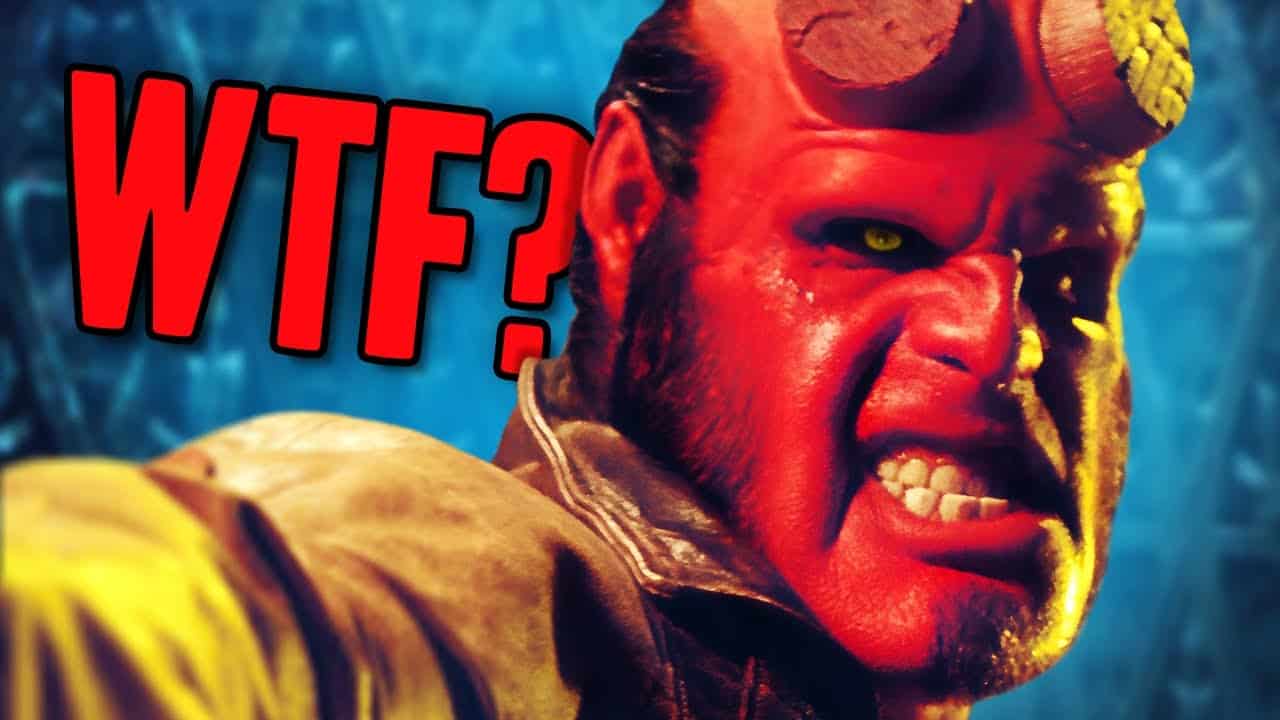
Hellboy (2004) – What Happened to This Horror Movie?
A fantasy dream project and labor of love for cinematic visionary Guillermo del Toro, Hellboy took six years to come to fruition. As many know, the movie adapts Mike Mignola’s popular comic book and takes most of its story cues from Hellboy’s debut issue, Seeds of Destruction. Did you know though that a couple future Avengers were almost cast, one actor had a heck of a time shooting on their 43rd birthday, and a famous television star wanted to go uncredited out of respect for his co-star? Thanks to del Toro and Mignola being in total creative lockstep and perfectly seeing eye to eye on the casting, the character’s mythology, world-building tableau, darkly comedic tone, and light, cartoonish violence, Hellboy has ascended to become a bona fide cinematic franchise made in a time when comic book movies were a dirty word. From the casting phase and studio resistance to the grueling make-up process, creature designs, and cinematic franchise it spawned, it’s time to pour a shot of booze for its lasting legacy and find out once and for all, what happened to Hellboy!
Guillermo del Toro became involved with Hellboy when he began poring through the comics while he was making Mimic in 1997. Del Toro maintains that Mimic was such a difficult and unpleasant shoot that the only saving grace that got him through that rough patch was reading Hellboy comics. An absolute dream project for del Toro, the director always envisioned Ron Perlman to play the title role and never wavered. Remember, del Toro and Perlman previously collaborated on Cronos and Blade II. However, no studio would approve Perlman as the lead and grant del Toro the budget to make the Hellboy movie he wanted. As if fate was written in the stars, when del Toro and Mignola met for the first time to discuss the project, each expressed who they wanted to play Hellboy. At the same time, both of them uttered the name Ron Perlman.
Once del Toro and Mignola agreed on Perlman, the two envisioned Hellboy as a Ray Harryhausen-style movie, where the action unfolds on a wide proscenium and features minimal camera movement. Harryhausen, the master of stop-motion animation, was recruited by del Toro to speak with Hellboy’s animators, but he declined, citing that modern-day film had become too graphically violent.
That wasn’t the only rejection. Nearly every Hollywood studio turned Hellboy down based on its undesirable title, Perlman’s attachment, and the general stigma that superhero movies garnered in the late 90s. When del Toro met with producers early on, they wanted to bastardize Hellboy’s physiological origins. One idea was to have the character start as a human being who morphs into Hellboy once he becomes enraged, a la the Hulk. Another silly suggestion was to have Hellboy be a human from hell throughout. Wisely, del Toro rejected these ideas and stuck to Mignola’s source material.
Following the success of Blade II, del Toro received several offers to direct his next movie. Turning down the chance to direct Blade: Trinity, AVP: Alien vs Predator, as well as Harry Potter and the Prisoner of Azkaban, del Toro chose to make Hellboy as his fifth feature film. Little did he know it would take six years from inception to completion. Before del Toro was named the director, Peter Hyams, David S. Goyer, and Jean-Pierre Jeunet were considered.
Regarding the writing phase, Hellboy primarily follows Mignola’s inaugural comic book story, Seeds of Destruction. However, the movie also incorporates elements from subsequent Hellboy comics, Right Hand of Doom and Box Full of Evil, with passing references made to Pancakes and The Corpse. While penning the script, del Toro dove into research about Nazi occultism and combined historical facts with the overarching lore of H.P. Lovecraft’s Cthulhu Mythos to create a new origin story for the titular demon. The opening even features the famous Lovecraft quote, “De Vermis Mysteriis,” and Sammael (played by Brian Steele) is visually reminiscent of the creatures in Cthulhu. The occult magic featured in the original Hellboy script entailed the opening portal being outfitted with rails made of pentagrams, inverted stars, and other Satanic iconography, which del Toro stated was meant to give the characters interrelated origins.
A leitmotif that began to emerge during the writing process, mazes and labyrinths became a psychological entryway into Hellboy. According to del Toro, Hellboy is all about “choosing the right path,” and that “A labyrinth, it is said, is not a place to be lost, but a place to find yourself.” When writing the Jack Kirby-like dialogue, del Toro always had Ron Perlman in mind to portray Hellboy. A horror maven at heart, del Toro also envisioned the story as a reverse Beauty and the Beast, with Liz being the attractive one who turns into a monster at the end.
Hellbent on casting Perlman as Hellboy, del Toro faced resistance from the studio from the beginning. Revolution Studios and Dark Horse Entertainment wanted a bigger and more bankable star to play the lead. When the project was brought to Universal Pictures, the studio suggested Vin Diesel to portray Hellboy and/or Abe Sapien. Jeremy Renner was also tapped for the title role at one point, but declined the part when he read the script and said, “I don’t get this.”
Although del Toro fought tooth and nail to cast Perlman, one of the biggest casting coups in the film was that of Doug Jones, who indelibly plays Abe Sapien. Before delving into the grueling process Jones went through to give his unforgettable performance, it must be stated that David Hyde Pierce voices the role of Abe Sapien. Out of respect for Doug Jones’ vivid performance and physical embodiment of the character, Pierce requested to go uncredited and declined doing press for the movie, allowing Jones to shine. However, Jones did voice Abe Sapien when reprising the role in Hellboy II: The Golden Army.
As for Jeffrey Tambor, who plays FBI Director Tom Manning, he joined the project one week before cameras began rolling, after the originally cast actor failed to arrive at the set.
To prepare for the primary part, Perlman read every single Hellboy comic. He also worked out for three hours daily, five to seven days a week. He also worked out on his days off during filming. Perlman’s hulking physique likely helped him recuperate from a broken rib he sustained while filming the subway scenes featured in the movie’s second act.
Once the make-up and FX teams were assembled, one of the first considerations was to change Hellboy’s trademark stone right to his left hand to free up the lead actor’s dominant hand. Further proving that only Perlman could play the part, no changes were necessary when the crew realized that Perlman is left-handed and had no problem keeping a stony right hand.
A significant addition to the movie not featured in the comics is Hellboy’s suped-up Samaritan Revolver, created by the BPRD using techno-magic. Although Hellboy prefers to fashion his own whopper bullets and tracking rounds, the Samaritan can fire an array of specialized ammunition tailored to each monster he faces.
Bolstered by an estimated $66 million budget, Hellboy began principal photography in late 2003 and lasted 130 days. During the nearly five-month film shoot, del Toro and his crew worked six days a week without a second unit to capture footage. Filming was scheduled from Monday through Saturday, with Sunday designated for editing. Del Toro insists that Hellboy could have been filmed as early as 1998, but that Hollywood had soured on comic book and superhero movies and could not find studio support. Of course, it’s all comic book and superhero movies in Hollywood these days, with little room or risk for daring originality.
Shot on location in Prague, Czech Republic, and in Barrandov Studios, Hellboy was filmed entirely abroad. The Trondham Abbey in Scotland, seen at the start of the film, was filmed in Prague during one of the coldest Aprils ever recorded. The exterior of the BPRD set in Newark, New Jersey, was filmed outside a genuine Prague mausoleum, where real-life Russian officials are buried. As for Rasputin’s mausoleum seen at the end of the movie, it was filmed on a set built at Barrandov Studios, with the National Monument on Vitkov Hill in Prague used for the interiors. The surrounding cemetery was filmed at Olšany Cemetery, the largest boneyard in Prague.
To film his scenes, Doug Jones required anywhere from five to seven hours to apply his make-up as Abe Sapien, and another three hours to remove it. For Hellboy’s ruddy visage, Perlman spent roughly four hours in the make-up chair before filming each day.
During Hellboy’s clash with Sammael, Perlman came up with a way to avoid graphic violence and onscreen bloodshed by suggesting that Hellboy pick up a gumball machine and bash Sammael over the head with it. The idea was to have the gumballs spray across the screen as a substitute for blood, leaning into the slapstick tone and assuring a PG-13 rating. While a strong concept, del Toro replaced it with Hellboy ripping the payphone off the wall in the subway, beating Sammael with it as coins fly out like a fountain of blood.
Once Abe locates Sammael’s nest and is injured, Abe is shown rehabbing in a medical tank. This scene was filmed on Doug Jones’ 43rd birthday, with Jones being sadistically suspended from a harness for hours to make it appear as if Abe is floating in water. Before the sequence was filmed, del Toro taunted Jones with the greeting, “Happy Birthday, Doug, today we’re going to hang you up by your balls.” Once removed from the harness, Jones was left bruised and bloodied. According to Spectral Motion’s Mike Elizalde, the underwater Abe scenes were filmed using a dry-for-wet process. This entailed combining various techniques to simulate the illusion that Abe is really underwater, using smoke, wires, lighting, and fans to make Abe appear wet and slimy outside the tank and completely matte inside it. Meanwhile, three servomotors were deployed for the movement of Abe’s gills, which were operated by remote control. Similar servomotors were used to control Sammael’s Lovecraftian tentacles. Elsewhere, CGI was utilized for Abe’s multi-eyelid closures.
Another example of del Toro and Mignola being on the same creative page throughout production is Rasputin’s grisly fate. While del Toro came up with the idea to have Hellboy slash Rasputin’s guts and have the Behemoth monster emerge from its belly at the end, it was also an idea that Mignola originally had for Seeds of Destruction that he discarded before publication. The two tacitly had the same vision without knowing it, just as they had independently settled on Ron Perlman as the only actor to portray Hellboy. One key difference between the comics and the film is the timing of Broom’s death. In the comics, he died fairly early on. However, del Toro deliberately delayed Broom’s demise until late in the film, so that audiences could get to know and care about him before his emotional send-off.
Despite the lack of bankable movie stars, Hellboy became a commercial and critical hit when it was released theatrically on April 2, 2004. The movie turned its $66 million price tag into a $99.8 million moneymaker worldwide, grossing just under $60 million domestically and $40 million abroad. Over 20 years later, Hellboy has an 81% Rotten Tomatoes rating, 72 Metascore, and a B- CinemaScore grade, with most critics extolling the morbid humor and kinetic visual splendor. With a 6.9 IMDb rating to boot, Hellboy was successful enough to spawn a superhero franchise before the empirical reign of the MCU. The film also earned five Saturn Awards in 2005, winning one for Best Make-Up. In 2008, Empire Magazine named Hellboy #11 on its list of The 20 Greatest Comic Book Movies.
Of course, nobody was more pleased with Hellboy’s triumphant outcome than Mike Mignola, who gave the finished film a ringing endorsement post-release.
Unfortunately, after hitting a high-water mark with Hellboy II: The Golden Army in 2008, the franchise has suffered diminishing returns ever since. Most disappointing, del Toro was never afforded the chance to complete a trilogy, despite announcing plans to direct Hellboy 3. To make a long story short, del Toro poured too much attention and resources into producing The Hobbit and trying to make At the Mountains of Madness, leaving little time and energy to helm a third Hellboy entry.
After a dormant decade, David Harbour failed to fit the gigantic shoes left behind by Ron Perlman in the painfully average 2019 Hellboy reboot. Worse yet, the franchise plummeted to a new low with 2024’s Hellboy: The Crooked Man, a well-intentioned but grossly under-resourced origin story starring Jack Kesy in the title role.
As for the original, Guillermo del Toro remained steadfast in his creative vision, which was aligned with comic creator Mike Mignola from the start and continued through production. Despite the lack of big-name movie stars, del Toro’s unwavering insistence to cast the incomparable Ron Perlman paid off handsomely among moviegoers and film critics alike. Perhaps most importantly, Hellboy proved the commercial viability of comic book superhero movies with darker material, and without the high camp and risk-averse pandering to children. The film spawned a cinematic franchise that, while showing diminishing returns lately, would be impossible without the OG Hellboy’s smashing success. Twenty-one years after it was released, that’s the gist of what happened to Hellboy!
A couple of the previous episodes of this show can be seen below. To see more, head over to our JoBlo Horror Originals YouTube channel – and subscribe while you’re there!
The post Hellboy (2004) – What Happened to This Horror Movie? appeared first on JoBlo.