The Running Man (1987) – What Happened to This Sci-Fi Thriller?
Long before The Hunger Games or even Battle Royale, The Running Man gave us a dystopian future where entertainment was at the cost of others and aggrandized for corporate America. No, really, as in the government and the TV station are the exact same. With the long in-production remake from Edgar Wright finally being released to theaters soon, it’s about time we looked at how the original came to be. It was not an easy road for this movie to walk before it could, well, run, with multiple directors and actors cycled through the project, a delay that was decided by a star so that he wouldn’t compete against himself, an eventual lawsuit, and even a use of what we would now call a deep fake that freaked out test audiences so bad in 1987 that reshoots had to be made to explain exactly what was being seen on screen. Place your bets on stalkers or runners as we find out what happened to The Running Man.
The story of how the film adaptation of The Running Man came to be doesn’t start with Arnold Schwarzenegger star power or even the draw of Stephen King movies in the 80s. No, the story of The Running Man movie starts with a business owner not connected to Hollywood and a fateful stop at an airport bookstore. In 1982, the owner of the largest lightweight wheelchair supplier in the United States, Paul Linder, came across a copy of The Running Man while waiting for a flight. He had never heard of the author Richard Bachman but the tagline of “Welcome to America in 2025, where the best men don’t run for president; they run for their lives!” that tag line stuck with him like a song lyric in his head that he had to take a chance and get the story turned into a movie. While he thought it would be an easy task to get the rights, he was taken aback when the publisher told him the option to the rights would be $20,00 upfront AND THEN an even bigger bump should the film actually get produced. How could this be with an author that only had 4 published works and a story that only had 100,000 copies out in the world?
Linder couldn’t make a movie by himself though and knew he needed to shop it around. He would end up finding the newly minted team of Taft/Barish who had some big-time experience between them both on the small screen and big. The team of Rob Cohen and Keith Barish were looking for a string of movies to set up for release and had a good mix of Oscar hopefuls like Endless Love and Sophie’s Choice as well as fun audience pleasers like Big Trouble in Little China. The producers liked the idea and wanted to make the movie happen but also gave Linder a hard time for how much he paid for the rights. That is until a Washington DC bookseller figured out that Running Man author Richard Bachman was actually Stephen freaking King. Not only were the three men blown away with Linder even saying that the experience was “like finding a Rembrandt in a K-Mart” but they were convinced that using the King name would only help the movie. One problem with that: King wouldn’t allow it.
By the mid 1980s, King wasn’t happy with a lot of his adaptations and felt after reading the script for The Running Man that it really only had the title in common. True to his words the credits of the movie have it credited to Bachman not King. While the movie was released at a time when the secret of Richard Bachman was out, it wasn’t like today’s easy to use internet searching so the general public didn’t know this little factoid and of course there was no way that Bachman would be as strong of a pull as King. With the rights good to go, a 30-page treatment was made that was a lot closer to King’s dystopian nightmare that the Arnold-fueled one-liner-filled dystopian nightmare we would end up with. The book takes an everyman approach to the main character of Ben Richards, and I don’t know about you, but I’ve never seen ANY man let alone everyman look like the Austrian Oak. The original thought of Christopher Reeve as the main character sounds good on paper but without the clout of the King name on the poster, a star was needed.
In addition to Reeve, Dolph Lundgren and Patrick Swayze were considered before Arnold Schwarzenegger came on board. Once that happened, screenwriter Steven E. de Souza needed to tailor the screenplay away from the meek and desperate character of the book and more to the action heavy superhero that Arnie would bring to the character. De Souza was a good choice for this after his smash success scripts of 48 Hours with Eddie Murphy and Nick Nolte as well as Commando starring the running man himself. After FIFTEEN attempts at the script from the writer he finally had one in place that fit the mold, but the toughest part of that process was making the movie more to what his lead star could do. Gone are the family drama behind the scenes of a sick child and a wife that had to become a woman of the night to try and support her family. Ben Richards would now be an ex-military man who was framed for the murder of hundreds of innocent people and wrongly imprisoned before ending up in the Running Man games when he is recaptured. The games, host, and game show studio were greatly expanded upon as well with de Souza believing the game show aspect of it all would pump up the viewing audience like it does to the studio audience of the show inside the movie we watch.
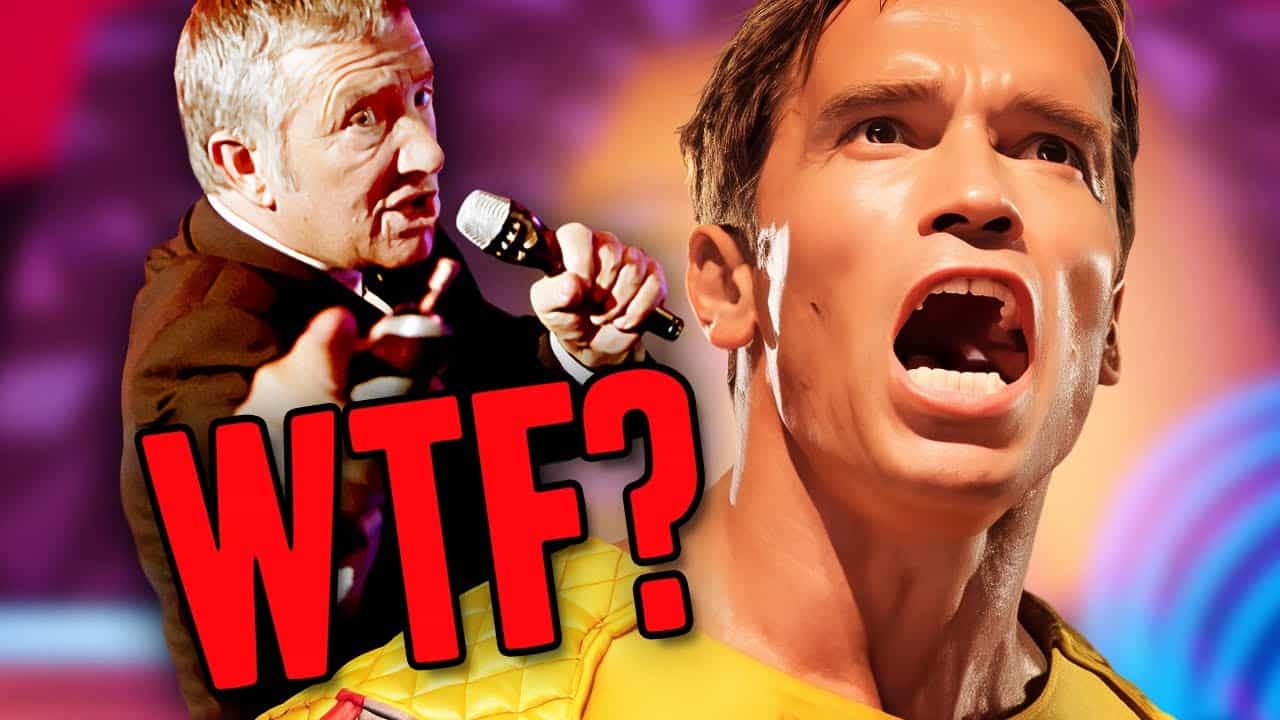
The stalkers were all given beefed-up personalities as well. Instead of mostly nameless and faceless mercenaries hunting down the contestant, we were given gimmicky warriors who were hand picked by the audience, all of which look like they at least stand a chance against the newly beefed-up main character. The casting of these characters went to intimidating actors like former NFL running back Jim Brown, friend of Arnold and wrestler Jesse “The Body” Ventura, another former wrester and often seen henchman in Professor Toru Tanaka, and finally actual classically trained opera singer Erland Van Lidth. On the side of Ben Richards would be his two running buddies played by Yaphet Kotto and Marvin McIntyre, love interest Maria Conchita Alonso, and oh yeah, resistance leader Mick Fleetwood who some fans posit that he is playing himself here. In the middle of the two factions is the real villain of the movie Damon Killian who was combined from two characters in the book. Killian was originally proposed to Burt Reynolds who liked the idea but eventually turned it down when he was told he would be billed last. Production turned to actual game show host Chuck Woolery of Wheel of Fortune and Love Connection fame, but he had to turn it down due to commitments to his multiple hosting gigs. Finally, Schwarzenegger suggested his good friend Richard Dawson who was host of Family Feud and the producers finally had their host and executive.
With the cast and script set to go, producers needed a director and first hired George P Cosmatos after his massive success with Rambo: First Blood Part II. Unfortunately, the director tried to take the script in directions that the producers felt unacceptable like focusing too much on the revolutionary aspect and moving the bulk of the film to a mall location. Depending on which story you believe, Cosmatos either left when the budget was lowered or was fired when producers found out his changes. The film was next offered to Alex Cox of Repo Man and Sid & Nancy, Carl Schenkel who was a popular German director, and Ferdinand Fairfax who was a British director still looking for his big break. Spoiler alert: none of these worked. Cox couldn’t make it work in his schedule with too many movies in succession, Schenkel was terrified of the scope of the picture, and Fairfax, like Cosmatos, wanted to take it in an entirely different direction. With the production date creeping way too close for comfort, they finally found their man in longtime cinematographer Andrew Davis who at that time had only directed forgotten slasher The Final Terror and Chuck Norris vehicle Code of Silence. It wouldn’t turn out great for Davis either.
Filming began and after only 8 days into shooting, Davis was 8 million dollars over budget and nearly a week behind schedule. To make matters worse, he filmed scenes that were entirely created by him that producers didn’t agree with and felt like a waste. Davis would be fired but don’t feel too bad as the rookie director would go on to make a couple of Steven Segal’s most popular films as well as The Fugitive with Harrison Ford. With the film now behind and an ever-ballooning budget, poor George Linder even had to sell his wheelchair company to help with finances, producers looked to Starsky and Hutch actor, yes, really, Paul Michael Glaser. Glaser was moving from acting to directing and had done episodes of Miami Vice for Michael Mann who recommended the former TV actor wholeheartedly. While The Running Man star Arnold was unhappy with what Glaser did with the movie, he did exactly what the producers needed. Like most TV directors, he was able to shoot fast and move on. Glaser kept the movie on budget and on time for the remainder of the shoot. Former Laker girl Paula Abdul would choreograph the extravagant in-studio dances featuring many of her former colleagues and composer Harold Faltermeyer would give a score that is much more somber than his upbeat synth heavy choices on Beverly Hills Cop, Fletch, and Top Gun.
The Running Man predicted quite a few things including reality TV and specifically helped get the hit show American Gladiators with the producer pitching it like the movie but minus the killing, but one unexpected and relevant prediction was deep fake technology. Test audiences mostly liked the movie but were very confused when it appeared that both Ben and Amber were killed off with the use of deepfake technology to swap their faces to other bodies only to have the characters appear shortly after. One producer got worried that all audiences would be confused and turned off to the movie that he had the sequence re-edited to make it clearer what was going on. The final hurdle to release wasn’t fear of how the movie ended up but rather who the movie was scheduled to go against. Arnold Schwarzeneggar had a few duds leading up to 1987 and while The Running Man was an independently produced movie, Predator was backed by 20th Century Fox and neither he nor the studio wanted the actor to go up against himself for revenue. The decision was made to move Running Man into November from the summer slate to try and capture a different audience.
The Running Man was finally released on November 13th, 1987, and while it was initially positive with it finally knocking off Fatal Attraction from the top of the box office, it fell off the rest of the month to things like Planes, Trains, and Automobiles and Three Men and a Baby. Critics weren’t overly kind either and to add insult to injury, the production was successfully sued for plagiarism by the producers of French film Le Prix Du Danger from 1983. Ouch. The final box office numbers were a respectable 38 million but off of a ballooned 27-million-dollar budget. While the movie would eventually be beloved by fans years later it was unfortunately a disappointment to nearly everyone involved. Lets hope Edgar Wright’s version can run its way to more success and fewer lawsuits and that, my friends, is what happened to The Running Man.
A couple of the previous episodes of this show can be seen below. To see more, head over to our JoBlo Horror Originals YouTube channel – and subscribe while you’re there!
The post The Running Man (1987) – What Happened to This Sci-Fi Thriller? appeared first on JoBlo.