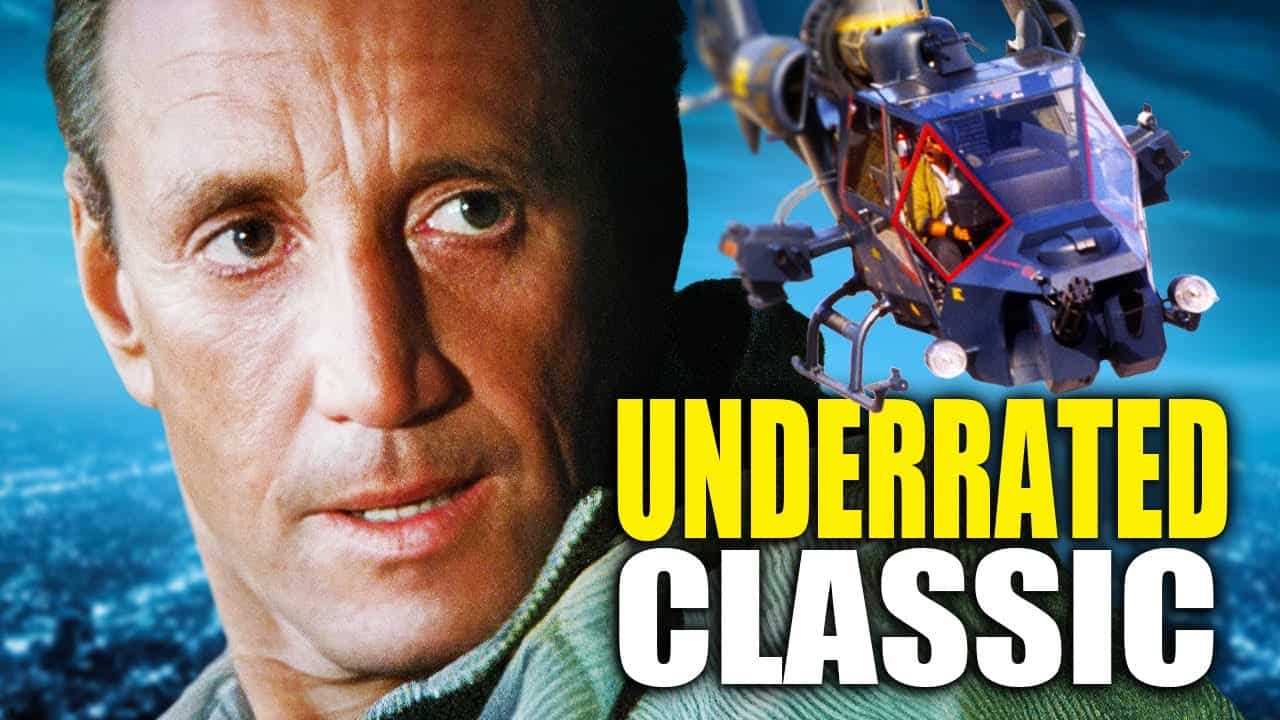
WTF Happened to Blue Thunder?
The 1980s were the era of high-concept action. The decade was dominated by muscle-bound idols like Arnold Schwarzenegger and Sylvester Stallone on the big screen, but before these guys hit their stride towards the middle of the decade, the genre was a little more open, with the films of the first half of the decade perhaps having more in common with ones that came out towards the end of the seventies, when heroes were very much in the everyman mold. One of the best early eighties action movies is 1983’s Blue Thunder, a movie that feels somewhat obscure nowadays but was a major hit the year it came out, with it even spawning a TV series—maybe even two—but we’ll get to that a little later. Oddly, of many of the decade’s high-concept movies, it feels distinctly modern in attitudes, with its fears of government overreach, loss of personal liberty, and high-level corruption. Let us tell you all WTF Happened to Blue Thunder!
Jump back to the late seventies. At the time, writers Dan O’Bannon and Don Jakoby were struggling writers and roommates in Los Angeles, and they started tinkering around with this script while being annoyed by low-flying LAPD police helicopters. In 1979, O’Bannon’s Alien was a serious hit, and suddenly Blue Thunder had some real heat behind it, being acquired by Columbia Pictures, who opted to produce the film through their deal with RASTAR, a company headed by super agent Ray Stark, who bankrolled many of Columbia’s more expensive eighties movies, including Annie and The Toy.
Blue Thunder would be a different kind of action movie for the day, with it the story of a PTSD-afflicted helicopter pilot for the LAPD named Frank Murphy. While investigating the death of a congresswoman, whose murder he was unable to stop from his helicopter, he is temporarily reassigned to a special detail where he’s to test fly a state-of-the-art combat helicopter named Blue Thunder, which is to be used for crowd control during the upcoming 1984 Summer Olympics. While piloting Blue Thunder, not only does he discover the myriad of ways it can be used to spy on an unwitting populace, but he also discovers there’s a conspiracy involving the helicopter that played a part in the murder of the congresswoman. What’s worse is that the head of the Blue Thunder project is his former C.O. from Vietnam, Colonel F.E. Cochrane (use the clip of Murphy saying F.E. stands for “Fuck Everyone”) who—when he realizes Murphy and his young partner know too much—orders their deaths. Too late to save his partner, Murphy steals Blue Thunder and engages in aerial warfare over the skies of downtown Los Angeles.
So, one can for sure see why Blue Thunder was appealing for studio executives at the time. A little movie called Star Wars had come out and broke new ground as far as VFX went. Blue Thunder, with its futuristic helicopter, would marry elements of science fiction with elements of a grounded cop drama. The movie—in some ways—was like Dirty Harry in a helicopter. It also proved to be rather timely as, when the film was in its rather lengthy post-production, which took place over more than two years, Knight Rider had become a major hit on TV, with it sporting a futuristic car with some of the bells and whistles found in Blue Thunder—although Blue Thunder didn’t talk and wasn’t sentient. Clint Eastwood also did his own futuristic aircraft movie, Firefox, although like Knight Rider it leaned more into sci-fi, with it being about a futuristic jet run on telepathy—with special FX by Star Wars maestro John Dykstra. Compared to both of those projects, Blue Thunder was more down to earth, with nothing the Blue Thunder manages to do being especially impossible to imagine, even if it was unlikely for the early eighties.
One of the reasons Blue Thunder works is that Columbia made an effort to put together an A-level cast and crew who could deliver a high-velocity action movie without it coming off as a cartoon. One key element was director John Badham, who, at the time, was best known for directing Saturday Night Fever and the Frank Langella version of Dracula. Nothing in his body of work, which included a lot of TV, suggested he was the man to helm a big-budget action movie, but he nailed Blue Thunder so well that it immediately established him as Hollywood’s go-to guy for this kind of film, with him immediately taking on WarGames, which actually hit theaters just a few weeks after Blue Thunder. When both were smash hits, it made him an A-list director. Another key element was the cinematography by John A. Alonzo, who, rather than give Blue Thunder a cartoonish, slick look, opted to make it look as realistic as possible. The score is an interesting counterpoint to this realism, with Badham’s regular composer, Arthur B. Rubinstein, crafting a hard-driving synth score, which is something of a classic of the era.
Yet, of all the elements that came together to make Blue Thunder fly, probably the most important was the choice of leading man—Roy Scheider. Had Blue Thunder been made a few years later, either a big action star or a hunk would have gotten his role. His casting was more of a leftover from the seventies, with him having established himself as perhaps the greatest everyman hero in American movies thanks to his iconic role as Chief Brody in Jaws, as well as its sequel. In the years since those movies, Scheider had starred in Bob Fosse’s All That Jazz to great acclaim, and this would actually be his follow-up to that movie as—despite its May 1983 release date—Blue Thunder was actually shot at the end of 1980 and into January of 1981. The fact that the movie had seemingly sat on the shelf for a little while became clear when, by the time it hit theaters, one of the movie’s stars, Warren Oates, who plays Murphy’s police chief, had already been dead for over a year.
Scheider is terrific in the role. A man of about fifty at the time, Scheider makes Murphy believable as a guy who’s been around the block and battered by life, selling his PTSD as a NAM veteran shaken up because he saw his C.O. murder POWs. Arguably Murphy is the first in a long line of NAM vet eighties action heroes with PTSD, with Eastwood’s hero in Firefox similarly afflicted, as is John Rambo. Riggs and Murtaugh in the Lethal Weapon series are also NAM vets, although their pathos from the war is somewhat downplayed.
Interestingly, Scheider himself, while proud of the movie’s success, would lob one criticism at the makers—and it’s one he’s absolutely right about. His issue is that one of the big aerial battles, which takes place over downtown L.A. and involves a missile slamming into the side of the ARCO Plaza office building, was a dumb choice as far as logic goes. He argued that Murphy, being a cop who’s trying to protect people, would never allow himself to get drawn into an aerial dogfight over a populated area and would have lured them to an unpopulated area. That said, an aerial dogfight over L.A., with the helicopters bobbing and weaving between skyscrapers, looks very cool—so even if he’s right from a logic standpoint, the movie might not have been as big of a hit had Murphy been a more responsible hero.
Of course, a movie is only as good as its villain, and Blue Thunder has a doozy. Malcolm McDowell is probably the last guy you’d cast as a United States Army Colonel, especially as no effort is made to cover up his English accent, but his good guy/bad guy chemistry with Scheider is spectacular. Scheider is excellent at needling him by mocking his accent, and you really get the sense that on a fundamental level these two guys despise each other. Ironically, they REALLY got along in real life and would often do sci-fi conventions together in their older age. An amusing thing about the movie is that McDowell, despite playing an aerial ace, is deathly afraid of flying. When she saw the movie, his wife at the time, Mary Steenburgen, was amazed that the filmmakers had somehow gotten him to participate in the grueling aerial scenes, and at the end of the movie, Cochrane’s grimaces are all real, as McDowell was utterly terrified the entire time.
The movie also gives Daniel Stern an early role as Murphy’s rookie partner, Lymangood, who’s nicknamed JAFO for “Just Another Fucking Observer.” You get that he and Murphy would become friendly, and Scheider plays his devastation when JAFO is murdered in an authentic way. Plus, there’s Warren Oates, in one of his last roles as the stock angry captain who, in this case, backs up his guy Murphy even if he is a pain in the ass. Oates is so good here that had he lived, he probably would have played the angry police captain in every eighties action movie that followed. Plus, American Graffiti’s Candy Clark has a nice role as Murphy’s unconventional love interest, a single mom whose reputation as hell behind the wheel of a car comes in handy towards the end, with her spunkier and having more agency than most love interests of the era.
It’s very strange that Blue Thunder took over two years to come out, but one imagines that post-production had to have been tough on this one, as this was done in an era long before CGI, so the VFX work was limited to models and real second-unit aerial photography. All of this makes Blue Thunder a lot more timeless than its chief competitor—Firefox—which used high-tech gadgets but looks comparatively dated. Perhaps the reason Blue Thunder feels more like an offshoot of seventies paranoia thrillers is due to the fact that it was written and filmed just as the seventies came to a close and the new decade began. Delays aside, Blue Thunder was a big hit in 1983. It came out shortly before Return of the Jedi and managed to dominate the box office for a while before Jedi took over. It managed to make $42 million domestically and was one of the twenty highest-grossing movies of the year.
While it didn’t get a sequel, Columbia wasted no time turning it into a TV series. Only six months after it hit theaters, it spawned a short-lived TV series of the same name, which starred James Farentino as a Murphy-esque cop hero, while a young pre-SNL Dana Carvey played JAFO. The show wasn’t well received as it was mainly built around outtakes and stock footage from the film. It also didn’t help that it was competing with Airwolf, which was another high-concept, high-tech helicopter show which—you guessed it—also had a hero afflicted with PTSD from NAM. It was the hit the TV version of Blue Thunder never became.
As for the movie, despite its success, probably because of the show and the fact that audiences weren’t as sequel-crazy in the eighties as they are now, it never received a follow-up. It became a staple of HBO, but it was one-and-done for it as a franchise. However, some years ago, there was talk of remaking Blue Thunder to focus on drones, which wasn’t a bad idea. There was also a rumor—which turned out to be BS—that Christopher Nolan was planning to do a quasi-remake of it, but that turned out to be nonsense. While I’m usually opposed to remakes, I actually think you could do a good one for Blue Thunder, especially if you work in drones and AI and hang on to your everyman hero. A guy like Matt Damon, Ben Affleck, Jon Bernthal, or Idris Elba, being a little bit of a vet at this point, would be a cool choice to step into Scheider’s shoes. And heck, if you want to talk about it, Sony—you can reach me through JoBlo.com! I’m available for consultations. As it is, though, Blue Thunder is a terrific early eighties action movie, with a top-notch hero and villain. It cries out to be less obscure and holds up pretty well forty-three years after the fact.
The post WTF Happened to Blue Thunder? appeared first on JoBlo.