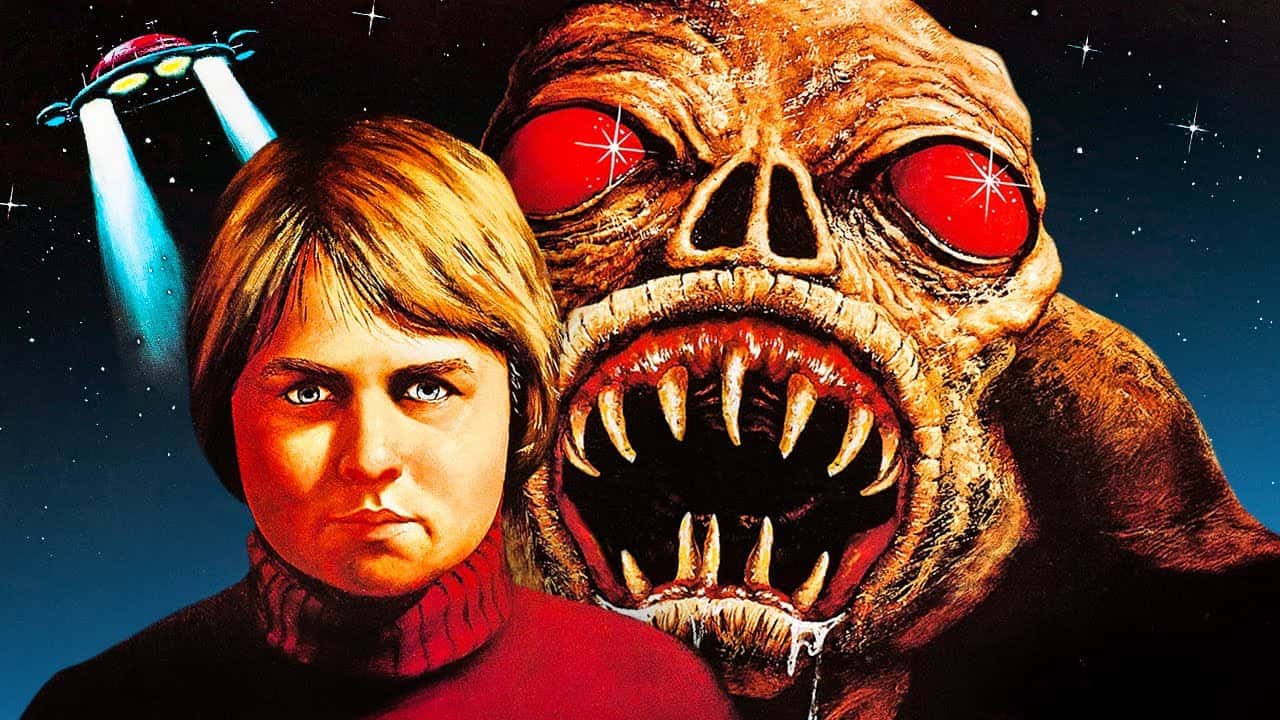
Xtro (1982): The Bizarre, Brilliant, and Bloody Black Sheep of ’80s Sci-Fi Horror
We did it again. We found a body-horror, Alien-inspired, shot-on-a-shoestring-budget, almost-video-nasty gem. Raise your hands—digitally—if you’ve ever heard of Xtro. Okay, cool. Now raise your hands in the comments if you’ve actually seen it. Bonus points if you knew this wild movie was the first entry in a series. By all accounts, the four (yes, four) writers on this movie indulged in their mood-changer of choice and went to town creating a very special, very messed-up version of E.T.—only this extra-terrestrial shows up angry and plays for keeps. With a strange plot, fun practical effects, weird casting choices, and one of the most downbeat endings of the early ’80s, Xtro achieves far more than it should, given what it is and how it got there. Join me for a dysfunctional family, an alien abduction, and the black sheep of early ’80s sci-fi horror.
Xtro came to life when writer and eventual director Harry Bromley Davenport brought the script (or at least the outline) that he and friend Michael Parry had written to producer Mark Forstater. Forstater wasn’t new to the game; he helped get Monty Python and the Holy Grail made. But unlike that project, Xtro didn’t have a beloved British comedy troupe to lean on. Meanwhile, across the ocean, Bob Shaye and New Line Cinema hadn’t struck gold with A Nightmare on Elm Street yet. They had seen some success with films like Alone in the Dark, The Evil Dead (distribution only), and Sonny Chiba titles from Toei. They agreed to distribute Xtro in the U.S., which helped make the movie surprisingly profitable. On a budget of only $60,000, the film brought in over a million dollars. Not Blair Witch-level ROI, sure, but still far better than anyone expected.
Parry had previously written the feline-horror anthology The Uncanny (1977), while Davenport had directed the low-budget Whispers of Fear, which earned some money and a little critical praise. Since they only had a rough outline for Xtro, they brought in Robert Smith and Ian Cassie for support. Neither had written a screenplay before, but Cassie had been an assistant director on Schizo (1976) – and since I’ll probably never get another chance to say this: please go watch Schizo. It’s great and barely anyone talks about it. Smith would go on to write the script for the first of the two completely unrelated Xtro sequels, but outside of some TV work, his film credits are limited.
The cast included Philip Sayer, primarily a TV actor who also appeared in Slayground and The Hunger; Bernice Stegers from Macabre; and Maryam d’Abo, who would later become a Bond girl opposite Timothy Dalton in The Living Daylights. Filming took about six weeks, and although the movie was slated for a 1982 release, it was eventually pushed to March 1983 in the U.K.
So, what is Xtro? It’s a fever-dream alien-abduction movie that blends a little Cronenberg, a little Lynch, and a handful of clever low-budget filmmaking tricks. The movie opens with a father and son playing outside when the father, Sam Phillips, is suddenly abducted by a blinding light. Three years pass, and no one believes young Tony about what happened. His mother, Rachel, assumes Sam ran off or died. She’s moved on, now dating American photographer Joe and relying on a live-in au pair to help take care of Tony. Tony’s luck improves here, because his French au pair is played by the stunning Maryam d’Abo.
One night, a glowing object streaks through the sky; think The Blob or Night of the Creeps. Out of it emerges an alien. And kudos to the filmmakers: instead of the typical grey-man design, they hired a contortionist mime to walk on their hands, covered in goo, emerging from a pulsating organic mass. Up close, it’s not the most convincing creature ever put on film, but the team used what they had to create some genuinely compelling visuals. In fact, the next scene, where a car hits the creature, is strangely unnerving, delivering one of those rare, low-budget jump-scares that actually lands.
A couple hits the alien invader, and the male passenger goes looking for it—which tells me they clearly didn’t see the same thing I saw, because there is no universe where I’m wandering into the woods after that. In a scene that feels waaaaaay too reminiscent of James Gunn’s Slither, the guy finds the creature, pokes it (classic horror mistake), and is promptly killed. The alien then sets its sights on the woman, who also doesn’t make it. While Xtro doesn’t boast the highest body count of the early ’80s, the kills it does deliver are memorable, whether by axe, impact, or alien tongue-from-hell.
The creature soon finds a secluded house, complete with a nice blonde woman and her dog. Then, pulling straight from the school of Roger Corman, it impregnates the poor woman with its own special brand of alien offspring. This is where the body horror kicks in, and where the film really starts giving off Cronenberg-lite vibes. It’s an unconventional scene: the alien uses an appendage… no, not that one… to deliver DNA through the woman’s mouth. And, of course, this species has a much faster life cycle than humans.
Meanwhile, young Tony seems to have a psychic connection to the alien, and this is where the on-screen chaos reveals exactly what happens when a room full of writers pass a joint back and forth. Seriously. Director Davenport admits on the DVD commentary that he and the writers were on drugs and threw anything they wanted into the script. You’ll see even more evidence of that shortly.
Back with the woman and her dog, things get rough. The dog eats what’s left of the alien, and the woman enters a bizarre, rapidly accelerated pregnancy. Her belly inflates in another surprisingly effective practical-effects moment, and she definitely isn’t enjoying the experience. Matters get worse, much worse, when she gives birth not to a baby, not to a creature, but to a full-grown man. Yep. A whole adult. That man? Sam, the father from the beginning, assuming you were paying attention. He cleans himself off like it’s just another Tuesday and heads off to find his family.
Much of the film shifts into a strange family-drama phase at this point. Sam tries to reintegrate himself into the household, while Rachel’s new boyfriend is understandably on edge. Their interactions turn into a series of passive-aggressive, then outright aggressive, showdowns—with some bizarre interludes sprinkled between. For instance: Sam casually eats his son’s pet snake’s eggs. Totally normal behavior for a recently reborn man-alien-hybrid. The neighbor later crushes the snake and tosses it into her salad (protein?), which leads Tony to respond in a completely reasonable way: he summons a little-person circus ringmaster, who brings one of Tony’s toy soldiers to life. This isn’t like the Stephen King-style tiny plastic toys attacking people. Oh no. This toy soldier becomes full-sized, armed with a functional gun of sorts, and moves with unsettling, jerky precision. Remember the “writers on drugs” part? Yeah, this is the fruit of their labor. Also, a panther shows up. For… reasons.
The oversized soldier kills the older neighbor, and no one notices because everyone else is dealing with their own nightmares.
Sam and Rachel head back to the location of his abduction in hopes of restoring his memory, leaving Tony in the care of Analise and her boyfriend. During a game of hide and seek, Analise is captured by Tony and somehow cocooned in a chrysalis. Why? Because Tony now has alien powers alongside his telepathy. How did he get them? Oh, simple: Sam gave him alien abilities by sucking on his shoulder earlier. Try to keep up.
Director Harry Bromley Davenport was mortified by the film upon its release, even though it earned a million dollars on a tiny budget. Over time, as Xtro gained cult status, he softened his stance and went on to direct the two sequels, one of which I proudly own on Blu-ray thanks to a Vinegar Syndrome release a few years back.
Analise’s boyfriend eventually finds her wrapped up in that grotesque chrysalis, and she unwillingly lays eggs in a moment that would make Cronenberg nod in approval and say, “Yeah, this guy gets it.” Meanwhile, Sam and Rachel start to rekindle their relationship right as the poor boyfriend back at the flat is mauled to death by that freakin’ panther I mentioned earlier.
Tony, now bored and with nobody left to play with, goes off to find his mom with help from her boyfriend Joe. They track her to the farm, where Rachel is more than ready to leave because Sam’s human disguise is finally falling apart. Sam attempts to reproduce with her, hoping to create a full alien child, but when he fails, he lures Tony toward a blinding light instead. Joe tries to intervene but is killed off by the power of “we ran out of special effects.” The result is the same: Joe is dead, and Rachel has now lost her boyfriend, her ex-husband, and her son, as Alien Sam takes Tony away into the light.
With nothing left, Rachel returns home—only to discover the eggs. These very unconvincing, absolutely-not-water-balloons eggs are about to hatch. Before she can react, Rachel is impregnated in the same horrifying fashion as the earlier victim. That’s actually the director’s cut ending. In the original theatrical ending, things somehow get even weirder: the eggs hatch into an army of Tony clones, surrounding Rachel and rubbing her stomach as if welcoming the next phase of their little alien empire. It may feel like a “less bleak” ending on paper, but let’s be honest, an army of psychic alien Tony duplicates is probably the beginning of the end for humanity.
Whichever ending you pick, Xtro closes on some grade-A nihilism that fits perfectly with this bizarre, messy, strangely charming entry in early ’80s sci-fi horror.
A couple of the previous episodes of The Black Sheep can be seen at the bottom of this article. To see more, head over to the JoBlo Horror Originals YouTube channel – and subscribe while you’re there!
The post Xtro (1982): The Bizarre, Brilliant, and Bloody Black Sheep of ’80s Sci-Fi Horror appeared first on JoBlo.