Kill Bill: The Whole Bloody Affair Review – Is it Tarantino’s masterpiece?
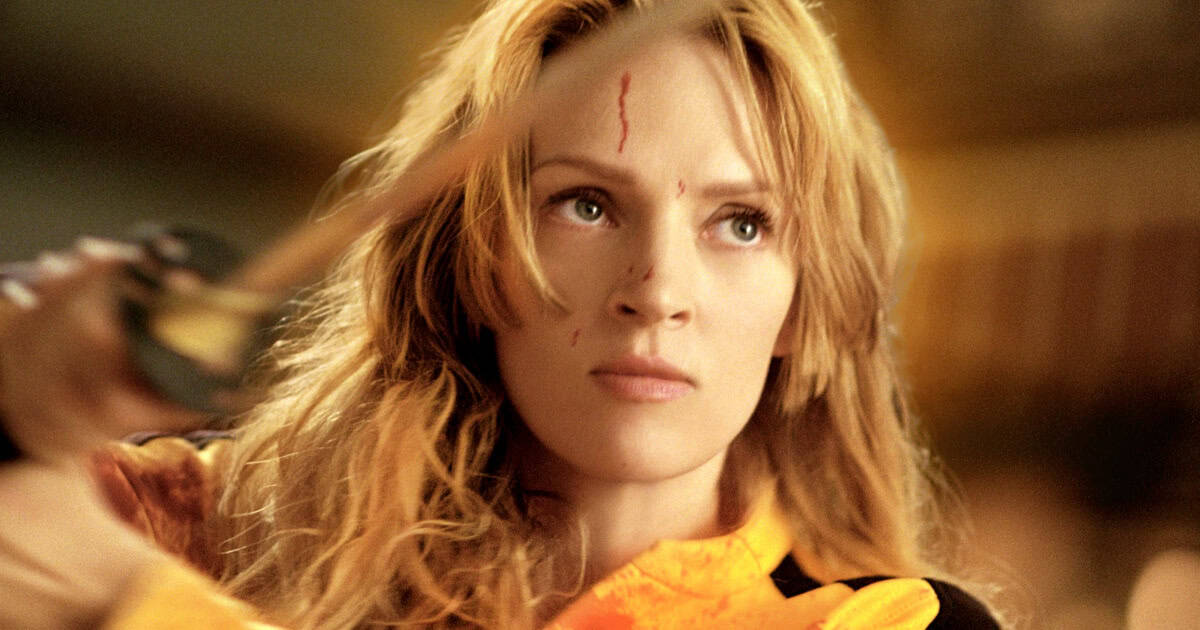
PLOT: After being ambushed on her wedding day and left for dead, The Bride (Uma Thurman) carves a deadly plan of revenge, with her ultimate goal being to kill her former employer/ love, Bill (David Carradine).
REVIEW: In the history of film, there have always been cinematic treasures that seem lost to time: Lon Chaney’s London After Midnight, the mythical three-hour cut of Planes, Trains and Automobiles, Jerry Lewis’s highly regrettable The Day the Clown Cried. And until recently, I assumed Quentin Tarantino’s Kill Bill: The Whole Bloody Affair was destined to become one of them.
Let’s be real, I love Tarantino’s work, but he has a history of promising projects that never come to fruition, like the Vega Brothers movie or his take on Star Trek. So when I heard that not only was this cut seeing the light of day but that it was coming to theaters, I was pleasantly surprised, to put it lightly. But does this fabled cut live up to the legend?
I grew up in the tail end of the Blockbuster Era. I had just turned 13 when Kill Bill Vol. 1 hit the shelves, and while I loved action films, I was only just starting to be allowed to rent the bloodier ones. I still remember that cover on the shelf — that striking yellow-and-black image of Uma Thurman with her katana, emblazoned with “The 4th Film From Quentin Tarantino.” I had no idea who that was, but over the course of that weekend, I lost myself in the blood-soaked revenge world he built. I ran that thing on a loop, and while I didn’t understand many of the references he was making at the time, I was unknowingly getting an education in ’70s kung fu cinema, samurai films, spaghetti westerns, and exploitation movies. I devoured it, and it became a favorite.
Volume 2 followed up and flipped the script from vengeful kung fu to contemplative western. At the time, the decision to split the film in two came down to not wanting to compromise the vision and cut the entire thing down to a two-hour version. But there was also such a clear divide between the tones and styles of the two volumes that it just made sense. They were parts of the same story, yes, but they sometimes felt like two different visions. So I always wondered what it would have been like to see the tale as one complete piece, the way Tarantino intended. I tried to replicate that with my DVDs, playing them back-to-back, but it always felt slightly off. I wanted to see it the way he meant it to be seen.
Cut to 22 years later, and I finally got to see that full vision: The Whole Bloody Affair. Now, I’m not reviewing the movie the way I would a new release. Let’s be honest, these films have been around for nearly a quarter century; you already know whether you like them or not. I’m more here to reflect on the new cut — the whole gory enchilada, as it were. So does it make a difference to sit down for four-plus hours and take the entire ride with the Bride? Hell yeah, it does. Because if the first two films were a meal, then this cut is a Vegas-style all-you-can-eat buffet.
The changes are often subtle: a few extra seconds of gore, a voice-over added where silence once reigned. Other times, they’re far more dramatic. The biggest example is the House of Blue Leaves showdown with the Crazy 88. Remember when the Bride plucks out an attacker’s eye and the fight switches to black and white? Not anymore. The rest of the fight plays out in a glorious full-color bloodbath. Because this cut? It’s unrated, and doesn’t have to contend with restrictions set down by the MPAA to make an R rating. So not only does Uma pluck the eye, she feeds it back to him. And when O-Ren takes her revenge on Boss Matsumoto, she doesn’t just stab him — she disembowels him. No punches pulled this time.
Speaking of O-Ren, her backstory benefits the most from the expanded runtime. The anime sequence breathes more, and it fixes one of my small but long-standing gripes. In this gorgeous anime sequence, we see the origin of Lucy Liu’s O-Ren Ishii unfold as she witnesses her parents being murdered by Boss Matsumoto and his henchman, Pretty Riki. In the original cut, she eventually takes her revenge on Matsumoto and rises to become the top assassin in her field. But it always bugged me that Riki, the guy who killed her father and burned down her home, got away. I wanted that grinning psycho to get his. Well, in this cut, he sure does — and man, is it satisfying to see after all these years. It makes O-Ren’s journey of revenge almost as gratifying as the Bride’s. Almost.
Another major shift you’ll notice comes at the end of Volume 1. It still wraps up with Bill interrogating Sofie Fatale, armless but alive by the Bride’s design. In the original cut, Bill ends with that fantastic cliffhanger: “One more thing, Sofie… is she aware her daughter is still alive?” Boom. Cut to credits and “The Lonely Shepherd.” It’s an all-timer of a hook, and man does it get you stoked for the final showdown. So imagine my surprise when that reveal was removed. At first, I wondered if that was a mistake, but by the end, I understood: if you’re watching this as a single cohesive film, that reveal hits so much harder when the Bride confronts Bill and her daughter appears. Without the episodic break, the story doesn’t need the cliffhanger. And moments like that prove why The Whole Bloody Affair matters. It’s the pacing, the slow burns, the crescendos, the carnage. It all finally flows the way it was meant to.
So is the experience worth it? That depends on you. If you’re a fan of these movies, grab an extra-large popcorn and the comfiest theater seat you can find ASAP. For more casual moviegoers, it might feel like an endurance test. But does the end justify the runtime? Oh yeah. One of the beautiful things about experiencing the film like this is how you’ll feel fully immersed in the Bride’s journey. Four hours later, when you rise from your seat and walk out of that theater, the world feels sharper, louder, and a little more dangerous — like you’ve been carrying the Bride’s blade yourself. I caught the movie on a rainy night in Boston and immediately had to hop a plane back to LA. I’m writing this on that plane, but as far as I’m concerned, I may as well be flying with a Hattori Hanzō sword riding shotgun, a sunset over Tokyo out the window instead of New England storm clouds, scribbling my revenge list instead of this review.
Let the lights go down, let the swords sing, and let Tarantino’s whole bloody affair wash over you. You’ll be glad you did.
The post Kill Bill: The Whole Bloody Affair Review – Is it Tarantino’s masterpiece? appeared first on JoBlo.