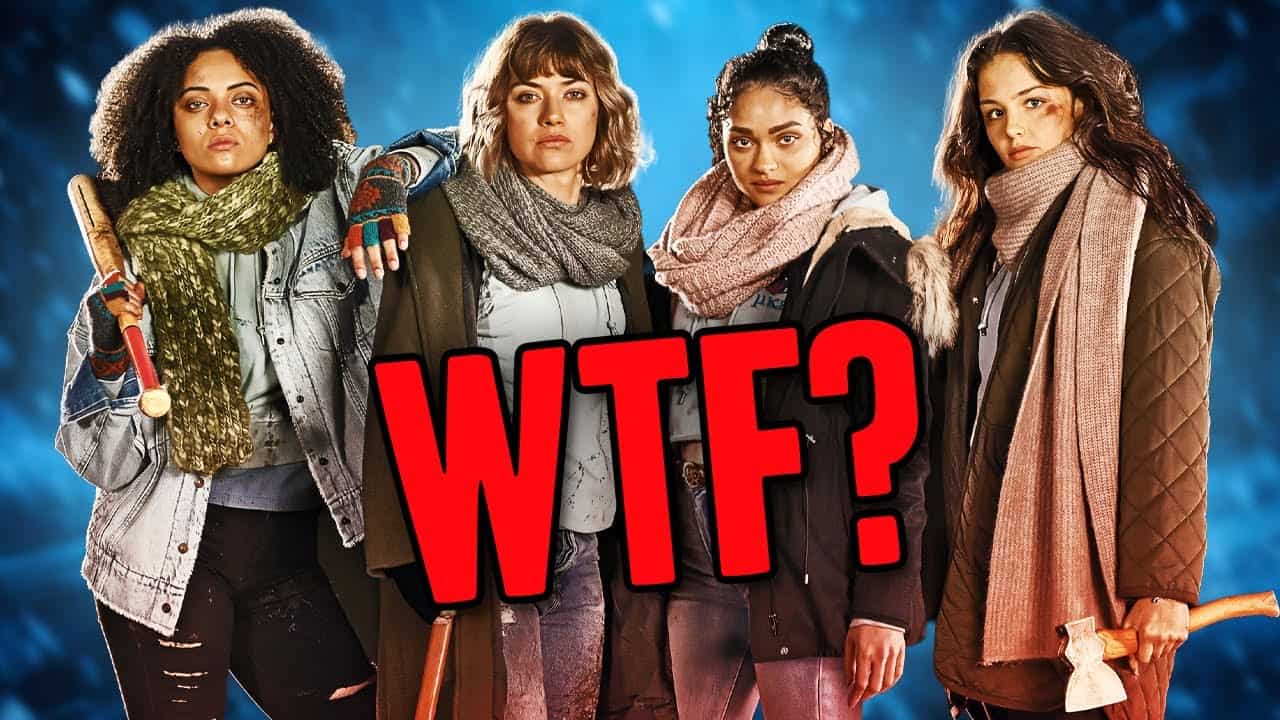
Black Christmas 2019: How a Horror Classic Went Off the Rails
Gather round, children, it’s time to open presents. But first, have you heard about the patriarchy? Today’s film is a remake of a seasonal slasher classic that changed the horror genre forever, yet somehow has almost nothing to do with the movie it shares a name with. I mean, it takes place on Christmas and it is technically a movie that exists on Earth. So there’s that. This is the Christmas tale born from Blumhouse trying to appease the angry masses of the internet after a Jason Blum interview went sideways. The result? Complete creative control handed to a director and writer far more interested in sexual politics than anything resembling a horror movie. The final bow on this gift? A rarely given D+ CinemaScore from theatergoers. There’s truly nothing better than taking a horror classic, remaking it in under a month on a minuscule budget, and stuffing the bloody beating heart of an angry subreddit into it, then disguising it as a fun holiday slasher. This is the story of what happened to Black Christmas (2019).
From Genre-Defining Classic to Holiday Content
The story of Black Christmas begins, of course, in 1974 with Bob Clark’s horror masterpiece, a film so influential it helped inspire Halloween itself. The 2019 version began very differently. Blumhouse called director Sophia Takal, whom they had previously worked with on the TV series Into the Dark, and offered her carte blanche to make her own version of Black Christmas. There were only two requirements:
It had to be titled Black Christmas
It had to be ready for release by December 13th
That’s it.
Takal has stated that she considers the original film perfect, but also felt it was necessary to push the remake deeper into themes of misogyny. She wanted to channel her anger that the Me Too movement wasn’t sticking the way she hoped, and that not just men but women weren’t doing enough. To help deliver that message, Takal brought on writer April Wolfe, whose writing credits at the time included a single short film (Widower, 2013). Since then, she’s added Clawfoot in 2023. Unfortunately for everyone involved, the writing credits for Black Christmas (2019) also include Roy Moore, the original writer of the 1974 classic, purely because the remake is technically based on his film.
Takal and Wolfe have said Blumhouse was completely supportive of their radical ideas and never asked them to tone anything down. And boy, did they not.
A Slasher Without Subtext, Only Text
The remake wastes no time distancing itself from the original. Gone are the terrifying obscene phone calls that made the 1974 film legendary. Instead, we get the most generic, embarrassing text message threats imaginable:
“I will bring you to your knees”
“I will make you beg for mercy”
Pig emojis. Yes, really.
The killers wear black hoods and Dr. Doom masks, because subtlety is for cowards.
The ending goes completely off the rails when it’s revealed that all the fraternity men are being empowered by the bust of an evil historical figure named Calvin Hawthorne, which bleeds black goo from its eyes. I am not exaggerating. By the moon and the stars and all the evil, evil guys, I swear this is real.
This culminates in an Avengers-style showdown where the women storm the fraternity house with bows and arrows. The final girl, Riley, smashes the evil bust while declaring, “We will never be broken!”… but not before apologizing to her hardcore feminist sister for not being militant enough against men from the start.
If you haven’t figured it out yet, the film’s biggest departure from the original isn’t the lack of creepy phone calls or memorable kills. It’s the complete absence of subtext.
A Message, Loud and Clear (Too Clear)
This movie has a message, and it is going to wrap it around your head like a plastic bag for 90 minutes. This suffocating approach completely overwhelms what could have been a genuinely compelling story: Riley, a survivor of sexual assault, processing trauma through the events unfolding around her. That story is there. It’s just buried under a megaphone.
Cast and Characters
The role of tortured final girl Riley went to Imogen Poots, who already had strong horror credentials with 28 Weeks Later, Fright Night, and Green Room. Backing her up is:
Aleyse Shannon as Kris, an over-the-top ultra-activist caricature
Brittany O’Grady as sorority sister Jesse
Lily Donoghue as Marty, the refreshingly level-headed friend who dies in an exceptionally slow and stupid way
Caleb Eberhardt as Landon, the only male character portrayed even remotely positively—mainly by cowering and whispering
Even Landon eventually falls victim to the film’s belief that male anger is an unavoidable disease. Then there’s the most notable face in the film: Cary Elwes. Doctor Gordon from Saw trades his stethoscope for tweed to play Professor Gelson, a role that practically screams “I’m the villain” from the moment he appears. Why? Because this is Black Christmas (2019), and he’s a man.
I don’t make the rules. I just watch them.
Production Choices and Rating Decisions
Filming began in June 2019 and wrapped just one month later in July. Shooting took place in New Zealand at the University of Otago.
Takal organized improvisation sessions where actresses created shared backstories and traumatic moments to foster a sense of sisterhood. The sorority house was designed to feel warm and safe, while the fraternity house, where men eat sandwiches loaded with mayo, was intentionally cold and menacing.
The film was deliberately given a PG-13 rating, not because of studio pressure, but because the director wanted it that way. Takal stated she didn’t want a movie where women were “expendable” or where their deaths were exciting. In a slasher movie.
She also suggested the original Black Christmas earned its R rating primarily due to offensive language, apparently missing literally everything else about why it was terrifying.
The Blumhouse Context
The budget came in at $5 million, making this another low-risk Blumhouse project. At the time, Jason Blum was under heavy criticism for the lack of female-directed films at Blumhouse. In October 2018, he sparked backlash after stating that there were “not a lot of female directors” interested in horror. He quickly apologized and promised to do better.
Black Christmas (2019) was released just over a year later on December 13th, right in the middle of the holiday season. It opened to $4 million, dropped nearly 60% in its second weekend, and ultimately made about $19 million worldwide, enough to still be considered a financial success.
Critics were largely forgiving, landing the film at around 41% on Rotten Tomatoes. Audience reaction, however, was brutal, with a D+ CinemaScore. Which, in CinemaScore terms, is basically Santa leaving something unpleasant under your tree.
Verdict: A Movie Buried Under Its Own Megaphone
There is a fun movie buried deep, deep, deep inside Black Christmas (2019). Holiday slashers are inherently fun. The mystery, the kills, the seasonal atmosphere, it’s all still here, technically. And if those joys can survive even this, then maybe someone should take another crack at the franchise someday.
Just make sure it’s someone who actually wants to make a Black Christmas movie.
And that’s what happened to Black Christmas (2019). It did not, in fact, slay.
A couple of previous episodes of this show can be seen below. For more, check out the JoBlo Horror Originals YouTube channel—and don’t forget to subscribe!
The post Black Christmas 2019: How a Horror Classic Went Off the Rails appeared first on JoBlo.