Star Trek Starfleet Academy TV Review: An introduction to the next generation of the franchise
Plot: A young group of cadets comes together to pursue a common dream of hope and optimism. Under the watchful and demanding eyes of their instructors, they discover what it takes to become Starfleet officers as they navigate blossoming friendships, explosive rivalries, first love, and a new enemy that threatens both the Academy and the Federation itself.
Review: For the first forty years of its existence, the Star Trek franchise consisted of six series, ranging from the 1966 Original Series through the prequel, Enterprise. Over the last nine years, we have produced five series, with the sixth, Starfleet Academy, poised to take Gene Roddenberry’s creation in an entirely new direction. Set in the 32nd century version of Federation introduced in the third season of Discovery, Star Trek: Starfleet Academy presents a vastly different perspective than we have seen from any other series or film in the franchise. Aside from the first half of J.J. Abrams’ 2009 reboot, we have never spent this much time exploring the educational and training aspects of Starfleet’s university. Connecting elements and characters with the rich canon history of the Federation,Star Trek: Starfleet Academy introduces a young, diverse ensemble of characters from across the galaxy who learn the rules and morals of the Federation while also navigating their burgeoning adulthood. Very different from the mature, adult characters from prior series, Star Trek: Starfleet Academy is designed to welcome a new generation of viewers to the franchise and manages to have some fun doing so.
Star Trek: Starfleet Academy opens with Nahla Ake (Holly Hunter) meeting young Caleb Mir (Sandro Rosta) as a child when he is separated from his mother (Tatiana Maslany) after she is captured by the Federation alongside Nus Braka (Paul Giamatti), a half-Tellarite and half-Klingon criminal. A decade later, Ake is reunited when Caleb is captured and offers him the chance to find his mother if he enrolls in Starfleet Academy, of which Ake is now Chancellor. Echoing Christopher Pike’s invite to James Kirk in 2009’s Star Trek, the rough-around-the-edges Caleb accepts and reluctantly joins the new class of cadets aboard the USS Athena, a ship that is also able to dock in San Francisco as the campus of Starfleet Academy. The school, which is run in parallel with Starfleet’s military school known as the War College, boasts staff including Klingon/Jem’Hadar cadetmaster Lura Thok (Gina Yashere), engineer Jet Reno (Tig Notaro), Voyager‘s 900-year-old holographic Doctor (Robert Picardo), and a digital Dean of Students (Stephen Colbert). Much like a teaching hospital, the USS Athena serves dual purposes as a fully operational vessel that facilitates field lessons in diplomacy and active engagement with adversaries. The campus environment feels like a blend of a school and a starship, with the hierarchy of officers mimicking the expected structure of past franchise vessels. Holly Hunter’s Nahla Ake is a unique leader in that she has a much softer touch than most past captains, owing to her extended lifespan due to being half-Lanthanite, the same species as Carol Kane’s Strange New Worlds character, Pelia. Hunter is fun but also commands authority, making her a natural leader and an interesting character to watch.
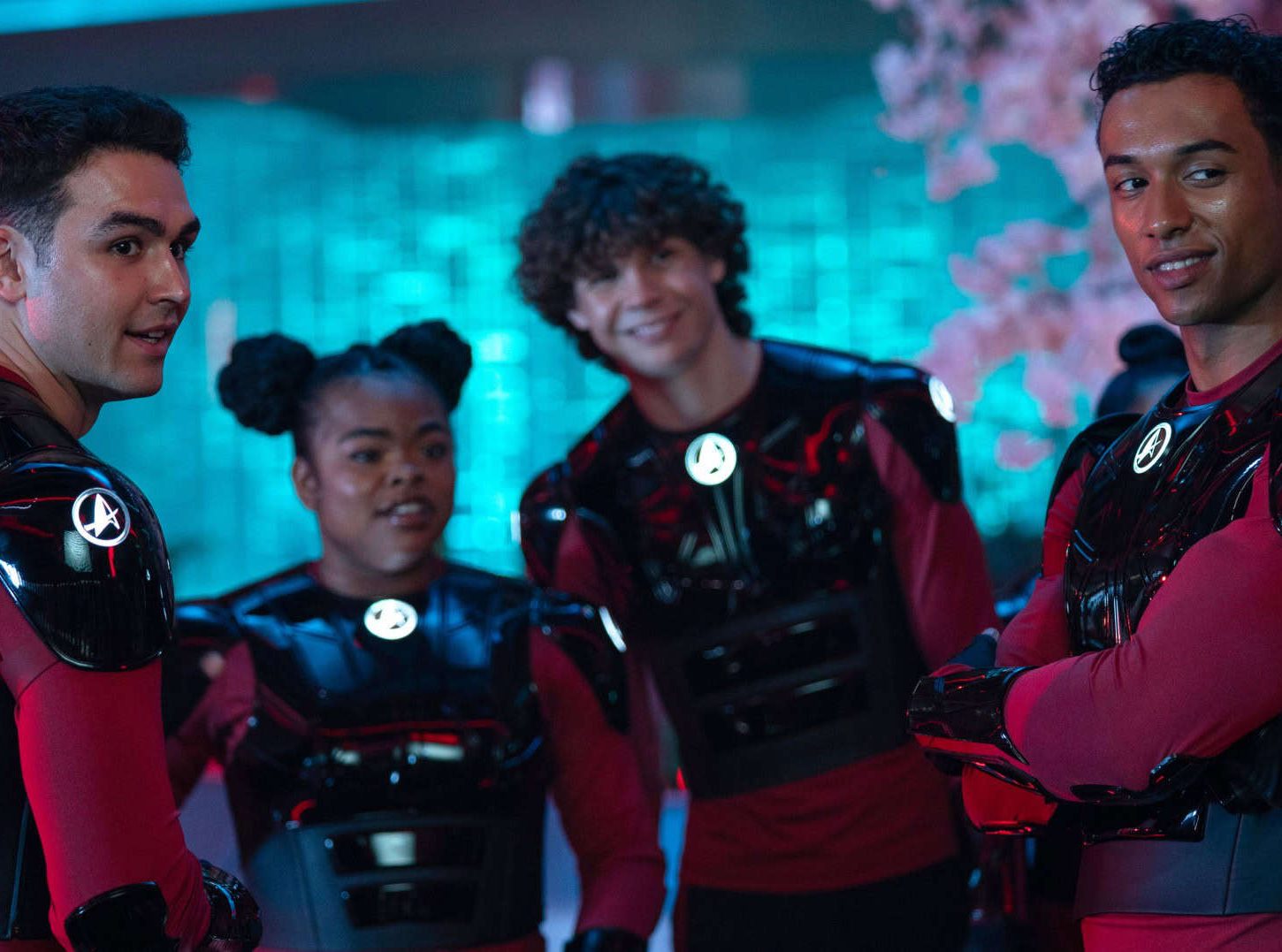
Diversity has always been paramount to the message at the core of all Star Trek shows, and there is no exception with Starfleet Academy. The students at the center of the cadet class whom Caleb befriends include Klingon cadet Jay-Den Kraag (Karim Diane), who eschews the violence of his species, Sam (Kerrice Brooks), the first member of the holographic species known as the Kasqians to join Starfleet, cocky Darem Reymi (George Hawkins), who is the first Khionian to join Starfleet and whose species has special abilities, and Genesis Lythe (Bella Shepard), a Dar-Sha cadet and daughter of a Starfleet admiral. The class is also joined by Bajoran siblings, including Tarima Sadal (Zoe Steiner), who develops a potential romantic relationship with Caleb. As Caleb tries to find clues to his mother’s whereabouts, he begins to accept his place at Starfleet Academy. In the six episodes made available for this review, the story opens with a mix of space battle action and an introduction to the school year, which often feels like the Star Trek equivalent of The Boys’ college spin-off, Gen V. Like recent Star Trek shows that came before it, Starfleet Academy does boast an episodic nature blended with an overarching season-long storyline. After the premiere episode introduces Caleb’s search for his mother, that plot takes a back seat to school-centric plots, ranging from prank wars to debate teams, with a heavy dose of complex diplomacy for good measure. Like classic Star Trek, these episodes are science-fiction twists on timely storylines and news subjects ranging from refugee displacement to war and its consequences.
If you have read this review up to this point and are wondering why I haven’t mentioned more about Paul Giamatti’s character, it is because his presence in the six episodes I have seen is minimal. A longtime Star Trek fan who lobbied for a role in the franchise, Giamatti’s approach to playing Nus Braka will feel very familiar to anyone who has been online over the past decade. A contentious believer in conspiracies and the threat of government, Braka is a brash sower of dissent who feels like a blend of Original Series antagonist Harry Mudd and the menace of Khan. Despite limited screen time, Giamatti is a great villain whose connection to both Caleb Mir and Nahla Ake serves as a central element to the entire series. The fact that Braka comes from two different alien species also contributes to the even larger melting pot of the newer Star Trek series, further blurring the lines between racial identity and morality, as well as belief. Despite Giamatti serving as a supporting player, the main ensemble is also augmented by appearances from Star Trek: Discovery characters Sylvia Tilly (Mary Wiseman) and Charles Vance (Oded Fehr), with an audio cameo from Brit Marling as the USS Athena computer. With each episode clocking in at an hour, there is a lot in every chapter that keeps the episodes moving along at a solid momentum and never feeling like it is pandering to the audience.
While Star Trek franchise showrunner Alex Kurtzman boasts credits for writing episodes this season, as well as directing, including helming the first two episodes, Starfleet Academy comes from a fresh creator, Gaia Violo. Violo previously created the series Absentia and offers a new voice in the Star Trek canon that helps this show feel fresh. Directors this season also include veteran franchise helmers Jonathan Frakes, Olatunde Osunsanmi, and Doug Aarniokoski, with writers Noga Landau, Jane Maggs, Alex Taub, Kiley Rossetter, Eric Anthony Glover, Kirsten Beyer, Kenneth Lin, and Star Trek: Lower Decks’ Tawny Newsome. While there are numerous references to various eras in Star Trek lore, including Easter eggs for Star Trek IV: The Voyage Home and Deep Space Nine, this series is written in a way that is inviting to both dedicated fans of the franchise and newcomers to Star Trek. There is less technobabble dialogue than we used to get with an easy use of contemporary language and a smattering of profanity that makes this series feel less rigid than older Trek, but still follows the same thematic formula that has worked for sixty years. Jeff Russo, who composed the music for Discovery, Picard, and Strange New Worlds, offers a stirring theme for Starfleet Academy that complements the modern sensibility this new chapter brings to the Star Trek saga.
For the first time since The Next Generation, we have a series that truly feels like a new iteration of characters in a unique setting than we have ever had before. While Star Trek: Discovery introduced audiences to the 32nd century setting, Starfleet Academy feels wholly designed in the new time period and mines the hopeful nature of Gene Roddenberry’s original series. Robert Kurtzman’s work on the 2009 J.J. Abrams film has a direct influence on how this new series is developing, and while I had wanted a lot more of Paul Giamatti, I was pleasantly surprised by how much I enjoyed the show. It is a different vibe than we have seen from the franchise before, but Starfleet Academy is wholly representative of what Star Trek is. A good amount of action and a touch of soapy melodrama are mixed into an innovative and rich portrait of the future and what it could hold, making Star Trek: Starfleet Academy a solid debut season that has the potential to become one of the strongest Star Trek series in the years to come.
Star Trek: Starfleet Academy premieres with two episodes on January 15th on Paramount+.
The post Star Trek Starfleet Academy TV Review: An introduction to the next generation of the franchise appeared first on JoBlo.