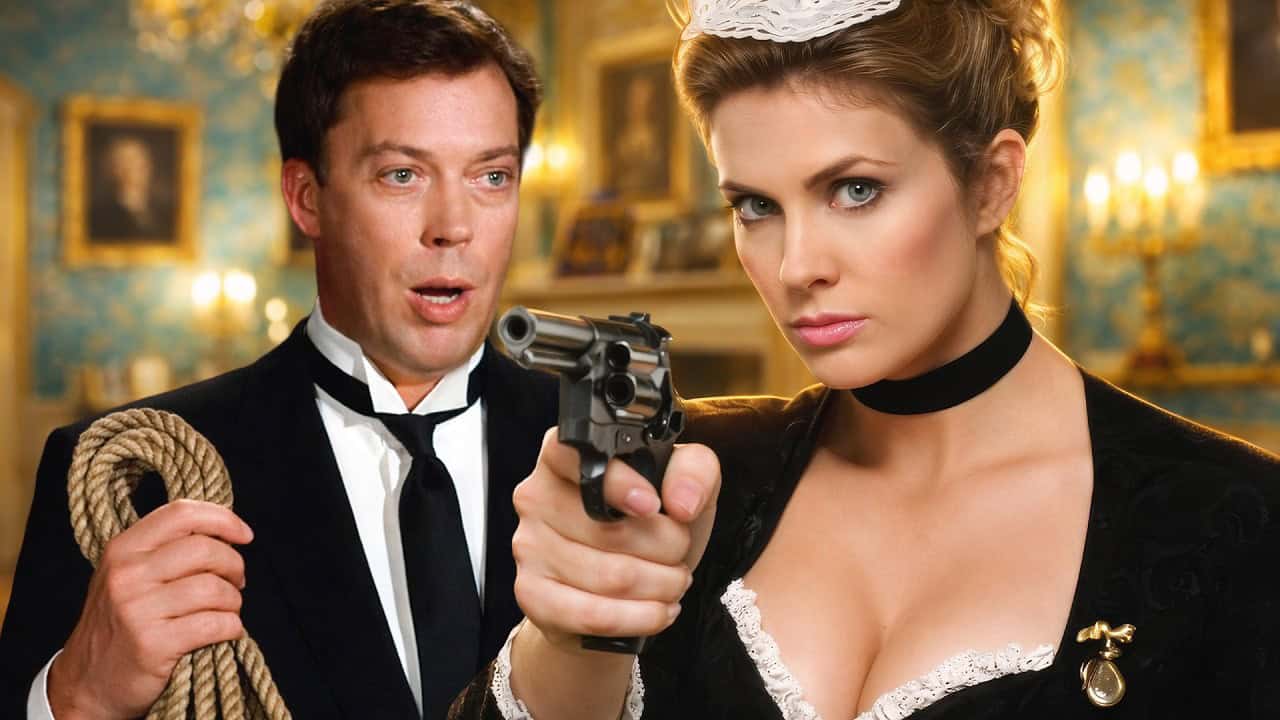
How Clue (1985) Helped Create the Modern Whodunit
Let me set a scene for you.
You’ve just received an anonymous letter inviting you to a dinner party at a remote mansion. The address is listed, but the sender and their reasons for inviting you remain unclear. When you arrive, you find yourself in the company of a handful of strangers who all seemingly received the same mysterious letter as you.
Shortly after the unusual dinner begins, one of the strangers is murdered.
The circumstances present many possibilities, but you know one thing for sure — the killer is among you, and you don’t know who you can trust. The key to your own survival hinges on one single question:
Whodunit?
In today’s episode, we take a loving look back at 1985’s Clue. We’re going to analyze the film and the board game that inspired it, and break down exactly how this cult-classic comedy helped inspire an entire sub-genre of murder mystery cinema. From Kenneth Branagh’s Poirot trilogy to Rian Johnson’s Knives Out films, this movie may be far more influential than you originally thought.
Let’s get into it.
The Board Game That Started It All
Before the age of eccentric detectives solving seemingly impossible murders became commonplace in our homes and theaters — and long before global phenomena like Among Us or Werewolf — a humble English musician named Anthony E. Pratt developed a board game that would go on to become one of the longest-standing game night staples in the world.
The game was originally called Cluedo, but we’d eventually come to know it simply as Clue.
The concept was simple. Six players are each assigned a character and a brief profile explaining who they are. When someone is murdered, you explore the game board — set in a giant mansion — searching secret passageways and various possible murder weapons.
Using the game’s clues, players try to identify who committed the crime, why they did it, and how they did it.
The game plays heavily on paranoia and suspicion as players race to figure out the killer before anyone else.
By the 1950s and 60s, the game was being sold in toy stores around the world in multiple formats. Over the years this continued, with Clue becoming a franchise of board games with several variations and a concept that clearly had huge financial potential.
Key to the game’s distribution was Parker Brothers, who produced the version most people know today. They distributed Clue from the late 40s until the early 90s, when the brand was purchased by Hasbro.
Turning Clue Into a Movie
In 1985, Hollywood took a chance on the game by adapting it into a live-action murder mystery film packed with iconic actors and actresses in a campy comedy that leaned into the mystery of the original format.
The plot follows the same basic idea as the game: a group of strangers show up at a mysterious dinner party where one guest is murdered, prompting the remaining characters to solve the crime while trying not to become victims themselves.
The film stars Tim Curry in one of his best roles as Wadsworth the Butler, and he’s joined by the likes of Christopher Lloyd, Eileen Brennan, Madeline Kahn, Michael McKean, Martin Mull, and Lesley Ann Warren.
Jonathan Lynn wrote and directed the film, with help on the story from John Landis.
When the movie was released in 1985, the reviews were mixed and skewed mostly negative. Much of the criticism focused on the thinly written script and the feeling that some characters had less to do in the movie than they seemed to in the board game.
But the film also had its champions — especially thanks to its iconic multiple endings.
The Multiple Endings
One of the movie’s most innovative ideas was its theatrical release strategy.
The film originally had three different endings, and which one you saw depended on the theater you went to.
This created conversations among audiences who would compare the endings they saw, only to realize their friends had experienced something completely different.
And this is where the movie really innovated — and where a lot of its eventual cult reputation comes from.
Ending One
In one ending, it’s revealed that Miss Scarlett (Lesley Ann Warren) is the killer.
She had been killing off anyone who knew about her secret business — she was essentially running a prostitution ring.
Ending Two
In another ending, Mrs. Peacock is the killer, motivated by a desire to protect both her reputation and her political standing.
Ending Three
And finally there’s the ending where multiple characters are killers.
In fact, everyone murdered someone except for Mr. Green, who turns out to be an undercover FBI agent.
Their motives were simple: they were all being blackmailed and trying to kill whoever was threatening to expose their secrets.
Why the Movie Works
All of these endings are good on their own, but together they created something more interesting — conversation.
They also showed Hollywood that a murder mystery works best when it constantly subverts expectations.
While stories like Murder on the Orient Express existed decades earlier, the cinematic approach here felt different. It played like a Hitchcock-style suspense story told through the lens of a farce, almost like something out of Abbott and Costello.
Every character feels like the main character in their own story, and the endings reflect that.
The Influence on Modern Murder Mysteries
The days of the whodunit were officially back.
Before long, other movies inspired by Clue began popping up. The film’s box office performance and critical reception meant the studio never made a sequel, but the creative DNA of the film clearly influenced future filmmakers.
In 1994, the comedy whodunit Radioland Murders came out and clearly took inspiration from Clue with its fast-paced dialogue and frantic filmmaking style.
More recently, films like the Knives Out series and Kenneth Branagh’s Poirot trilogy feel like modern reinterpretations of the same basic idea.
One key difference, though, is that those films feature a detective protagonist. We know characters like Benoit Blanc or Poirot didn’t commit the crime, so we’re given a clear perspective to analyze the suspects.
In Clue, it could literally be anyone.
We don’t have an innocent POV guiding us through the mystery — we’re inside the crime itself, and every character is a suspect.
The Classic Whodunit Formula
Many of the genre’s most recognizable tropes show up in Clue:
The crime happens in an isolated location
There’s an ensemble cast of suspicious characters
Everyone has their own hidden motives
There’s usually a mysterious host who brings everyone together
And at the end, someone delivers a long explanation revealing who did what and why
These elements have become staples of the genre.
And honestly — Tim Curry absolutely owns this movie. I could make a top five list of his best performances and this one would make it every single time.
A Cult Classic Is Born
Despite all of its clever ideas, Clue only made $14.6 million at the box office, which was less than it cost to produce.
Critics didn’t quite understand it at the time, and audiences weren’t sure what to make of the unusual ending structure.
But over time — especially through home video — the film developed a massive cult following.
Off the back of this weird, bold adaptation of a board game came the rise of one of Hollywood’s most beloved sub-genres.
Today, Clue deserves to be mentioned among the best murder mysteries ever made, and credited as one of the earliest examples of the modern cinematic whodunit.
The post How Clue (1985) Helped Create the Modern Whodunit appeared first on JoBlo.