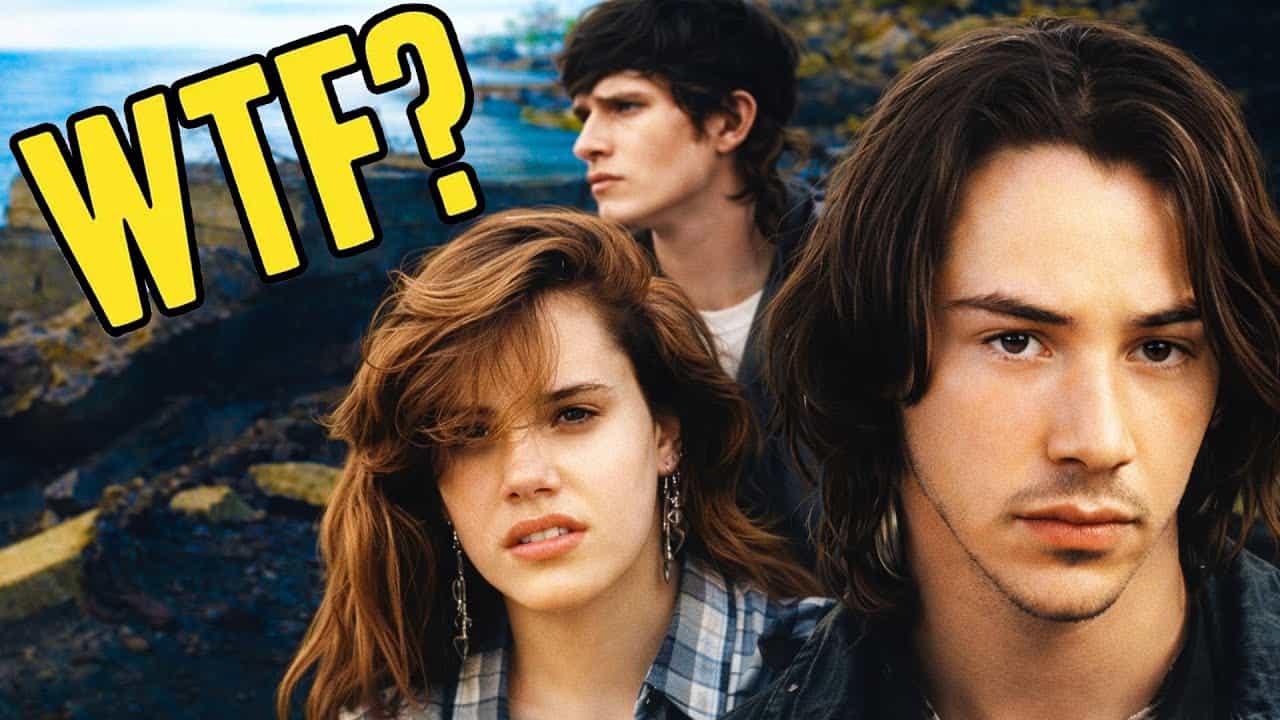
WTF Happened to River’s Edge?
If Blue Velvet is considered the most luridly shocking, controversially polarizing psycho-drama released in 1986, then River’s Edge is a very close second. Indeed, Tim Hunter’s unjustly overlooked masterwork of stark criminal realism shares the same cinematographer as the David Lynch classic and also stars Dennis Hopper, this time as Feck, an ultra-perverted monster of a man who could be considered the spiritual cousin of Frank Booth. With a grim, sobering sense of verisimilitude that plays like a homemade documentary film, River’s Edge was inspired by a bizarre real-life teenage murder that occurred in Northern California in 1981.
Yet, for as powerful a turn Hopper gives, the performances by Daniel Roebuck and Crispin Glover are equally unforgettable. With standout early work from Keanu Reeves and Ione Skye, the naturalistic acting in River’s Edge elevates the harrowing material to an unassailable level of greatness. Yet, even the most diehard fans of the vastly underrated crime drama may not realize that its writer, Neal Jimenez, wrote the script while taking screenwriting classes at UCLA. Jimenez was inspired by a similar murder case that he read about in a newspaper, using the real-life crime as a jumping-off point to make a statement about disillusioned, morally bankrupt youth in America. With the film celebrating its 40th anniversary in 2026, it’s time to drag the net and discover what the f*ck happened to River’s Edge!
Often considered the bleakest and most disturbingly honest teen crime drama of the 1980s, River’s Edge began as one of two acclaimed screenplays by creative writing student Neal Jimenez, along with Where the River Runs Black. While taking screenwriting courses at UCLA in the early 1980s, Jimenez was inspired to write River’s Edge after reading the horrific true story about a 14-year-old girl named Marcy Renee Conrad. On November 3, 1981, Conrad was savagely raped and strangled to death by a 16-year-old student named Anthony Jacques Broussard in his home in Milpitas, California.
Aside from the shocking nature of the homicide that shook suburban youth to its core, the strange details of Conrad’s murder were included in the script. For instance, after killing Conrad in cold blood, Broussard bragged about it and showed her corpse to as many as 13 people. Yet, the murder was not reported until two days after Conrad’s demise. When a student and an 18-year-old graduate reported the crime on November 5, 1981, Broussard was eventually arrested for the murder and sentenced to 25 years to life.
Although Jimenez has stated that Conrad’s shocking death was “merely an inspiration for the screenplay,” crime enthusiasts have also noticed parallels to the fatal June 1984 stabbing of 17-year-old Gary Lauwers at the hands of his friend, Ricky Kasso, while on LSD. That fatal incident took place in the Aztakea Woods of Northport, upstate New York. In both cases, the monstrous murderers bragged about their killings, and both murder victims were covered with leaves by accomplices.
As unpleasant as it is to revisit those murder cases, the point is that Jimenez purposely set out to write a story that reflected a contemporary culture of wayward youth losing a sense of value through drug-induced violence and the fear and paranoia that enraptured the nation afterward.
Once Jimenez completed the screenplay, he entered it in a screenwriting contest that was judged by one of his classmates. The classmate was interning at a production company where now-power producer Amy Pascal worked at the time, and gave her the script. Pascal relayed the script to Jimenez’s future agent, who passed it along to producers Sarah Pillsbury and Midge Sanford, who were fresh off making Desperately Seeking Susan. Pillsbury and Sanford began shopping the script around Hollywood at a modest $5 million. Yet, Hunter was so eager to direct the movie that he promised he could make it for $1 million.
After the script was sent around town and rejected by several studios for being too dark, the independent production company Hemdale Film Corporation expressed interest in producing River’s Edge. The small company behind The Terminator and Platoon agreed to finance and distribute the film, so long as the budget didn’t exceed $1.7 million and Tim Hunter would direct. A somewhat curious choice, as Hunter had only directed two prior PG-rated teen movies, including Tex in 1982 and Sylvester in 1984, neither of which was a Hemdale production.
With the script in shooting shape and the budget in place, the casting phase for River’s Edge proved to be one of the most vital aspects of the production. In addition to drawing on news headlines for the plot, Jimenez based most of the characters on his friends he had attended high school with in Sacramento.
Not only did the movie mark the first major movie roles for breakout star Daniel Roebuck, who plays the teenage killer Samson “John” Tollet with an ice-cold vacancy, but also Ione Skye, who made her film debut in River’s Edge as Clarissa. For his audition, Roebuck showed up regaled in full costume, including slicking his hair back with K-Y Jelly and rocking twin beer cans in the front pockets of his jacket. He sat in a corner and immediately cracked open a beer, noticing Hunter pick up his camera and begin filming his behavior.
As for Ione Skye, the Say Anything star won the role of Clarissa after a casting director saw her photo in L.A. Weekly while attending auditions with her brother, Donovan Leitch, named after their famous folk singer father.
Similarly, Danyi Deats, the unsung actress who plays the nude murder victim Jamie, was spotted in the audition waiting room and was given the role her friend was trying out for. About appearing nude for roughly 90% of her screen time, Deats stated: “I never considered any of the ramifications, like how horrified my family would be, or to have a theater full of people to see me naked at nineteen. But that’s the beauty of being nineteen: that you don’t look ahead.”
Meanwhile, casting director Carrie Frazier noticed how well-suited Keanu Reeves seemed for the role of the dishevelled, morally conflicted classmate Matt. Frazier knew Reeves, who hadn’t done much and didn’t have an agent at the time, had the exact energy needed for the character when he arrived at the auditions with mussed hair and his shoes untied as if painfully stuck in mid-transformation from adolescent to adult.
Before Joshua John Miller was well cast as Matt’s brother and the pre-teen eyewitness, Tim, the late Corey Haim was cast, costumed, and ready to play the part. However, Haim contracted pneumonia, showed up sick and unfocused on the first day of filming, and was replaced.
Of course, the wildest and most colorful performances belong to Crispin Glover as the manically histrionic Layne, and Dennis Hopper as the sexually devious maniac Feck. To no one’s surprise, Glover showed up to the auditions in full wardrobe, wig, and hat as a committed method actor after months of preparation, and was just as radically over-the-top as he is in the film. Hunter and the producers were taken aback and worried that Glover was going too far with the character, to the point of sheer absurdity, but trusted their instinct that he was right for the role.
Hunter and Glover discussed taking a more naturalistic approach like the rest of the cast, but ultimately decided that Glover’s heightened approach fit the movie well. It’s also worth noting that Glover originally auditioned for the role of the murderous Samson but believed he wasn’t a proper fit. At first, Layne was originally written as the moral center of the teenage group. However, when Glover auditioned with such a bonkers interpretation of the character, the moral compass was deliberately shifted onto Feck, which altered the film’s balance.
Before the legendary Dennis Hopper was cast as Feck, Hunter initially envisioned John Lithgow in the role. When Lithgow declined due to the morbid material, Hunter offered the part to the late great Harry Dean Stanton, who declined but passed the script to his old buddy Dennis Hopper. When Hemdale balked at Hopper’s acting fee, Hunter threatened to cast The Killing’s Timothy Carey, a volatile actor known for veering way off script. Carey auditioned and strayed so far off book by droning on and on about farting that Hunter’s ploy worked. Hemdale was so mortified at the prospect of dealing with Carey’s rash improvisation that they ponied up and increased the budget to retain Hopper’s services.
For as doped-up and drugged out as Feck is in the film, Hopper had quit every addictive vice except for cigarettes in real life by the time the film was made. According to his castmates, Hopper was completely present during filming and went out of his way to rehearse extensively with the young cast, who greatly idolized him. Between takes, he’d entertain them with outlandish stories about making Apocalypse Now and poke harmless fun at actors like Roebuck for missing his mark during a shot.
Made for $1.7 to $1.9 million following just four months of pre-production, River’s Edge commenced principal photography on January 20, 1986, and wrapped in March. Believe it or not, the film was shot by cinematographer Frederick Elmes, in his very first project after shooting Blue Velvet for the late great David Lynch. Between Elmes’ distinct visual tableau and Hopper’s deranged performances in both Blue Velvet and River’s Edge, the two films will forever be intrinsically linked as the two most disturbing and divisive psychodramas of 1986.
Although Hunter originally intended to film River’s Edge in Los Angeles, he decided to move the production to Sacramento, a more suitable region for the screenplay, and where Jimenez grew up. The river scenes, including the bridge and Jamie’s corpse along the banks, were shot along the American River near Sacramento and Carmichael, California.
However, a massive winter storm flooded the area, forcing the crew to evacuate and relocate to Sunland-Tujunga, a small foothill above Burbank, California. For instance, the opening liquor store and the houses of Feck, Clarissa, Tim, and Matt were all located in Tujunga, while the liquor store where Samson buys beer for Layne and the hardware store where Samson steals bullets were filmed in Sunland. According to Hunter: “I settled on Tujunga for the major locations…It was an area where people with tuberculosis could come to sanatoriums for the clean air. By the time we shot River’s Edge, it had become a smog pocket—but it was full of river rock houses that gave it a ‘land that time forgot’ feeling.”
When the cast and crew returned to Sacramento to complete the river scenes, Hunter remembered that: “Coming off the heels of the storm and flood, the water had that wild, raging, marvelous quality that it didn’t have before.”
Beyond the awesome, unpredictable whims of nature being the biggest production challenge, the film shoot went relatively smoothly. However, the rocky reception of the movie following its festival premiere is what delayed a wide theatrical release until May 1987.
Once the editing phase was finished, River’s Edge premiered at the Toronto International Film Festival on September 10, 1986. The polarizing reception ranged from wildly enthusiastic to downright mortified, with some small-time executives refusing to look the filmmakers in the eyes afterward. Following the divisive premiere screening, the film did not get picked up for distribution for quite a while.
The controversial reception continued for months until the movie’s fortunes turned around at the Sundance Film Festival in January 1987. Luckily, the head of Island Pictures, Russell Schwartz, championed the film like no other, vowing to do whatever it took to market the movie for a successful theatrical run. Although the film ended up grossing two-and-a-half times its budget, it did not play well in Milpitas, California, where the Conrad murder took place. Although the locals were incensed to relive the painful horrors again onscreen after five years had passed, administrators in the school district and police department commended Hunter for getting the accurate depiction of the troubled teenagers spot on.
After Island Pictures acquired River’s Edge for distribution, the movie was eventually released in U.S. theaters on May 8, 1987. The film grossed $4.6 million domestically, turning a moderate profit, before becoming more popular on VHS. Not only did the film draw critical plaudits, but it was also named Best Picture at the 1986 Independent Spirit Awards.
Famed film critic Roger Ebert described River’s Edge as “The best analytical film about a crime since The Onion Field and In Cold Blood,” while his review partner Gene Siskel named it the seventh-best film of 1987. Three decades later, Salon called River’s Edge the “darkest teen film of all time,” in its 2015 retrospective.
It’s true. Looking back 40 years after it was made, River’s Edge holds up as one of the most unflinchingly honest portraits of aimless, amoral, disaffected youth ever recorded. The film was made during a period when much safer, more pleasant depictions of teens were popular in John Hughes and Brat Pack movies. As such, River’s Edge taps into a nihilistic despair that stands apart through its hyper-realistic tone and authentic, naturalistic performances.
Tonally, there’s a stunning, trancelike earnestness here that’s almost clinical in the way the events unfold like a documentary film. Hunter sustains such a solemn tenor that even when the juvenile characters behave in silly ways like Layne, the gravid austerity hovers over the film like a haunting specter. And yet, without a single ghost, ghoulish monster, or supernatural scourge to be found, the film plays like the most riveting horror film, thanks to its harrowing authenticity.
Amplifying the stark realism and sense of teenage alienation is the punk-rock and thrash-metal soundtrack and unsettling score by German composer Jürgen Knieper. Whereas most ‘80s teen films featured mainstream Top 40 pop needle drops, River’s Edge reinforced its disturbed teenage outcasts by incorporating hardcore metal songs by Slayer, Agent Orange, Hallows Eve, Fates Warning, and Wipers, the latter of which’s song, “Let Me Know,” was personally requested by Hopper.
Beyond the film’s lasting durability and swirling controversy, River’s Edge will always be regarded as putting its young future stars on the map. Of course, Keanu Reeves and Dennis Hopper would famously reunite in Speed the following decade. Meanwhile, Daniel Roebuck, Ione Skye, and Crispin Glover would go on to have long, productive acting careers. Yet, Hopper remains especially fond of his time playing the role of Feck alongside his youthful cast members, once declaring: “River’s Edge, I’m really proud of. Whether I’m in it or not, I think it’s a great movie.”
A great movie indeed. After basing the script on a real-life murder case that rocked the community, naming the proper director, finding the perfect cast of mostly young newbies, getting Dennis Hopper to anchor the green ensemble, overcoming inclement weather while filming, and surmounting a sea of controversy upon its release, that’s what the f*ck happened to River’s Edge 40 years ago!
The post WTF Happened to River’s Edge? appeared first on JoBlo.