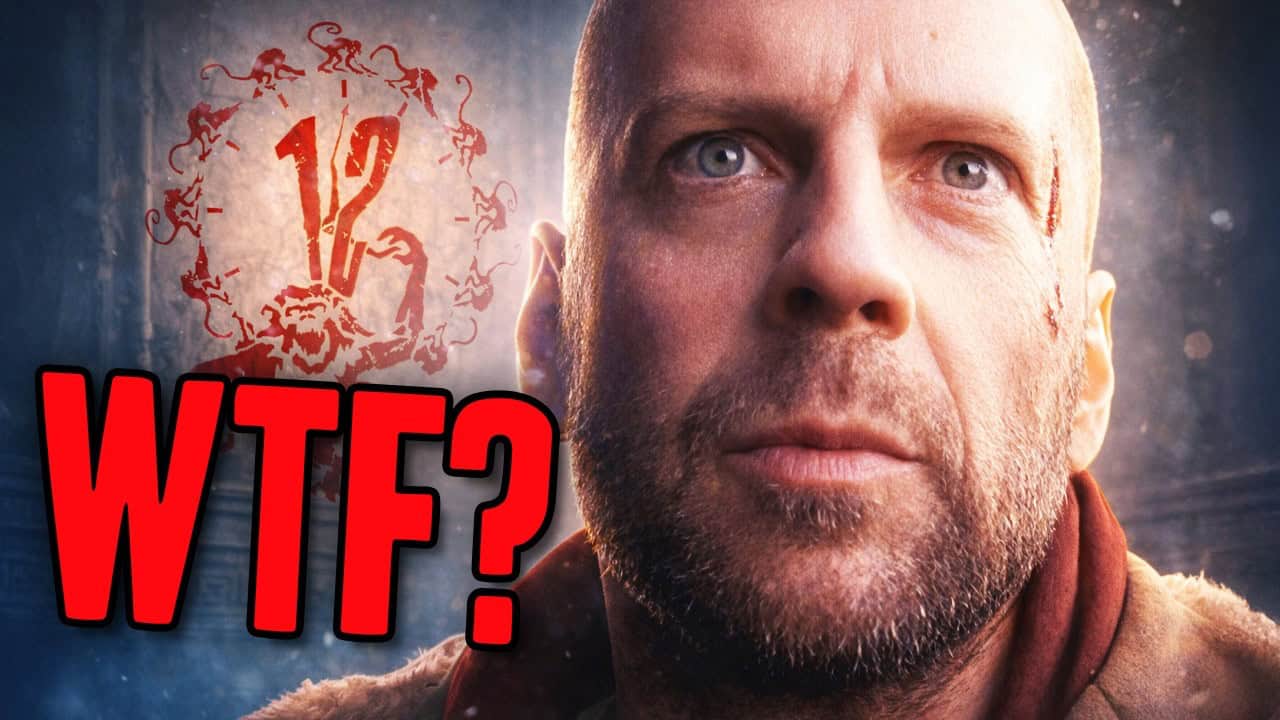
The Untold Story of 12 Monkeys: Terry Gilliam’s Time-Travel Masterpiece
The idea of a virus coming along and wiping out 99% of the population isn’t exactly the most difficult thing to imagine these days. In fact, it hits pretty close to home. But the ’90s were a different time, and films needed more than just intriguing plots. They needed movie stars. And you couldn’t get much bigger than Bruce Willis and Brad Pitt.
But which actor did the casting director have to convince director Terry Gilliam was right for the role? Who had to be replaced shortly after filming their first scenes? And why did a gerbil waste an entire shooting day?
Let’s go back in time and find out what happened to 12 Monkeys.
The Surprising Origin of 12 Monkeys
There’s really nothing quite like a Terry Gilliam picture. From Time Bandits to Brazil, Gilliam has always had a completely unique voice, creating films unlike anything else in cinema. But surprisingly, 12 Monkeys didn’t originate from Gilliam’s imagination.
The story actually comes from the French short film La Jetée by Chris Marker, which also deals with time travel and an attempt to save the world. Calling it a “short film,” however, might be generous. La Jetée is mostly made up of black-and-white still images, with only a single brief sequence of moving footage.
Producer Robert Kosberg asked Marker for permission to pitch an adaptation to Universal Pictures. The studio bought the rights and hired David and Janet Peoples to write the script.
The writers were nervous about adapting La Jetée, since they viewed it as a perfect film. Instead of remaking it directly, they chose to take its core ideas and build an entirely new story around them.
Terry Gilliam Takes the Helm
At the time, Terry Gilliam was preparing an adaptation of A Tale of Two Cities when producer Charles Roven approached him about directing 12 Monkeys. Roven believed Gilliam’s unconventional storytelling style made him the perfect director for the film’s nonlinear narrative.
Gilliam was hesitant at first. He didn’t want to be a hired gun on someone else’s project. But the script intrigued him enough to sign on, even though he believed the story was so complicated it might never actually get made.
Originally, Gilliam wanted Nick Nolte and Jeff Bridges for the lead roles. Universal disagreed. The studio suggested Nicolas Cage and Tom Cruise, but Gilliam rejected both choices. Instead, he became interested in Bruce Willis, whom he had met while casting for The Fisher King. Universal liked the idea. Willis was one of the biggest stars in Hollywood and could help guarantee box-office success.
Ironically, to deliver what many consider the greatest performance of his career, Willis had to take a major pay cut. Because he really wanted to work with Gilliam, Willis essentially worked for almost nothing upfront, choosing instead to earn his salary through backend profits.
Gilliam didn’t want Bruce Willis the action star. He wanted Bruce Willis the actor.
Casting Brad Pitt as Jeffrey Goines
Gilliam also had great confidence in Madeleine Stowe, whom he had met while casting A Tale of Two Cities. He believed she would be perfect as Dr. Kathryn Railly, the psychiatrist who acts as the audience’s surrogate throughout the story.
But the most surprising casting choice came with Brad Pitt. Casting director Marjorie Simkin had to convince Gilliam that Pitt was right for the role of Jeffrey Goines. At the time he was cast, Pitt wasn’t quite the megastar we know today. But during production and before the film’s release, he suddenly exploded in popularity thanks to films like Interview with the Vampire, Legends of the Fall, and Se7en. By the time 12 Monkeys hit theaters, Pitt was a full-blown movie star.
His performance in the film is wildly eccentric and stands out in his entire filmography. Even though he doesn’t have a huge amount of screen time, every moment leaves an impression.
Gilliam even took Pitt’s cigarettes away during filming, which resulted in the actor’s nervous energy and rapid-fire speech patterns seen in the movie.
The Complicated Story of 12 Monkeys
The story itself is famously complex. In the year 2035, a deadly virus has wiped out 99% of humanity, forcing the survivors to live underground while animals reclaim the surface.
Prisoner James Cole is offered a pardon if he travels back in time to 1996 to gather information about the virus. But time travel isn’t an exact science.
Cole ends up jumping through different time periods, and the constant disorientation slowly fractures his mind. Along the way he seeks help from psychiatrist Dr. Kathryn Railly, who eventually joins him on his mission.
It’s the kind of story that often requires multiple viewings to fully grasp.
Filming on a Tight Budget
Despite the film’s ambitious concept, the budget was kept relatively small: about $29 million.
Universal allowed Gilliam final cut, but only under strict conditions: the film had to receive an R rating and could not exceed two hours and fifteen minutes.
Filming took place in Philadelphia and Baltimore from February through May of 1995.
As you might expect from a high-concept sci-fi film directed by an uncompromising auteur, the shoot was anything but smooth.
The Gerbil That Stopped Production
At one point Gilliam envisioned a shot involving a hamster (or gerbil) running in a ball next to Bruce Willis while he sat inside a strange contraption. It sounded simple enough. But the animal refused to cooperate.
What should have taken five minutes ended up consuming an entire day of filming.
That’s the price you sometimes pay when working with a director who has a very specific vision.
Recasting Young James Cole
Another challenge came during the airport flashback scene, which required 500 extras and an extremely tight shooting schedule.
Gilliam originally cast a young actor to play young James Cole, chosen mainly for his striking eyes. But after filming began, Gilliam realized he had made a mistake. Thankfully, a producer had already prepared a backup actor, who stepped in and completed the role.
Stress on Set
The set of 12 Monkeys was often tense. Crew members struggled with the demanding schedule and the complexity of Gilliam’s ideas. At one point, Gilliam even told the producers they might want to replace him with another director.
The film’s futuristic sets were built from everyday objects, reflecting what survivors might realistically cobble together while living underground.
To save money, the production frequently reused sets, filming in abandoned warehouses and modifying them for different scenes.
Even the weather caused problems. Baltimore turned out to be too warm for scenes set in the frozen future, forcing the crew to bring in fake snow.
The Infamous TV Ball Prop
One of the most impressive props in the movie was the TV Ball, a massive spherical structure covered in television screens that resembled something like a Death Star made of monitors. It looked incredible on camera. Unfortunately, it was also a nightmare to operate.
The hydraulics frequently failed, and the device broke down during countless takes. It quickly became infamous among the crew.
Terry Gilliam’s Horseback Accident
Perhaps the scariest moment during production happened away from the set. To relieve stress, Gilliam would often go horseback riding. During one ride, the horse suddenly bucked him off and nearly trampled him.
Thankfully, Gilliam escaped with only cuts and bruises. He returned to work a little shaken, worried the accident might affect his creative vision. But he pushed through.
Delivering the Film Early
Despite all the chaos, Gilliam accomplished something extremely rare in filmmaking: He delivered 12 Monkeys one week early and under budget.
Release and Box Office Success
12 Monkeys premiered on December 29, 1995. The film earned nearly $170 million worldwide, an enormous success considering its modest budget.
Critics and audiences responded positively, and the film currently holds an 88% rating on Rotten Tomatoes.
The Lawsuit Over the Set Design
In February 1996, architect Lebbeus Woods filed a lawsuit against Universal. He claimed one of the film’s set designs closely resembled his project “Neomechanical Tower (Upper Chamber)” and had been used without permission. When the images were compared side by side, the similarities were difficult to ignore.
Woods ultimately won the lawsuit. Universal faced the possibility of removing the scenes entirely. Instead, Woods accepted a six-figure settlement, allowing the scenes to remain in the film.
Brad Pitt’s Oscar Nomination
Brad Pitt’s unusual performance paid off. He received his first Academy Award nomination for Best Supporting Actor.
Costume designer Julie Weiss also received a nomination.
Neither ultimately won, but the recognition helped cement the film’s reputation.
Bruce Willis’ Underrated Performance
In hindsight, Bruce Willis may have delivered the best performance of his career in 12 Monkeys. It was a complete departure from the tough-guy roles audiences associated with him. Instead, he portrayed a deeply vulnerable and psychologically fractured character.
It remains one of the most unique performances in his filmography.
The Film’s Legacy
Over time, 12 Monkeys has become one of the most celebrated entries in Terry Gilliam’s filmography.
The movie even inspired a television series adaptation in the 2010s on the Syfy Channel, starring Aaron Stanford and Amanda Schull, which ran for four seasons.
More recently, Arrow Video released a highly praised 4K restoration, packed with special features exploring the film’s production.
Why 12 Monkeys Still Matters
More than 30 years later, 12 Monkeys remains a fascinating and ambitious exploration of dystopia, time travel, and fate.
It offers a version of time travel that feels gritty and unsettling, one that doesn’t rely on a DeLorean or flashy science-fiction spectacle.
With standout performances from Bruce Willis and Brad Pitt, it’s easy to see why the film continues to resonate with audiences today.
And that, my friends, is what happened to 12 Monkeys.
A couple of previous episodes of this show can be seen below. For more, check out the JoBlo Horror Originals YouTube channel—and don’t forget to subscribe!
The post The Untold Story of 12 Monkeys: Terry Gilliam’s Time-Travel Masterpiece appeared first on JoBlo.