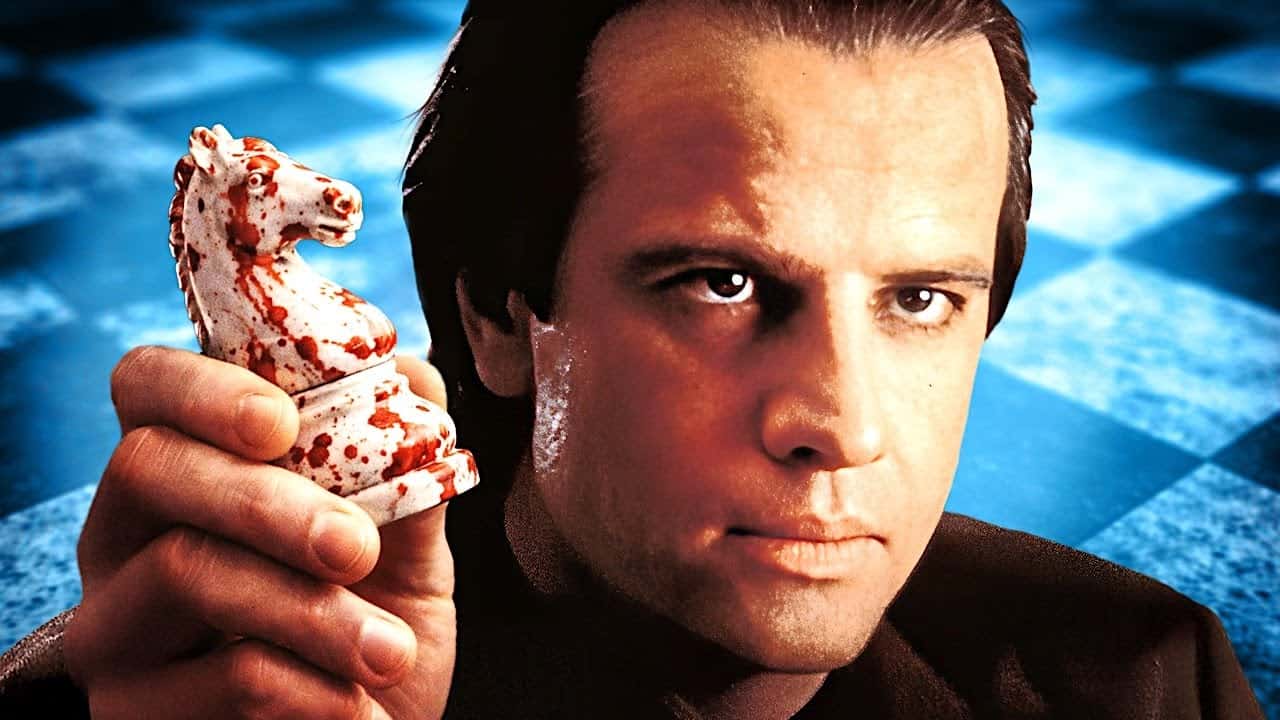
Knight Moves (1992): The Erotic Thriller That’s Secretly a Giallo
Knight Moves (1992) arrived at exactly the right time for almost everyone… well, maybe not U.S. audiences. It gave rising star Christopher Lambert a showcase at the height of his American popularity, paired him with his then-wife Diane Lane, and delivered director Carl Schenkel his biggest commercial hit. And yet, more than 30 years later, the film has mostly disappeared. It’s rarely available on streaming. Physical media copies are hard to find. So what happened?
Did it blur the line too finely between an erotic thriller and a giallo, missing both audiences? Was the acting too stiff for mainstream viewers? Should American audiences have received the longer international cut? The answers are subjective, but the film itself is far more interesting than its reputation suggests.
What we got with Knight Moves is a strange, stylish hybrid: part early ’90s erotic thriller, part 1970s Italian giallo. It’s fun, sleazy, dramatic, and almost certainly the black sheep of Christopher Lambert’s career.
Check, and checkmate.
Not That Knight Moves
No, not the Bob Seger song. Not the 1975 Gene Hackman neo-noir. This is the 1992 chess murder thriller starring Christopher Lambert, and it’s far more fascinating than most people remember.
When Knight Moves was released, Lambert was still at his U.S. peak. The Highlander sequels were still being made (this film landed between parts 2 and 3), and he still had Fortress, Gunmen, and Mortal Kombat ahead of him.
Though he’d been acting since 1979 and was already huge overseas, Lambert broke into the American market with Greystoke: The Legend of Tarzan, Lord of the Apes (1984), a box office hit that earned three Oscar nominations. A year later came Highlander, cementing his pop culture status. (Though let’s be honest, if you were 10 years old in 1995, you might argue his most important role was Raiden.)
Lambert was more versatile than he gets credit for. Yes, he made genre favorites like Highlander, Fortress, and Mortal Kombat. But he also tackled drama (The Sicilian, To Kill a Priest), comedy (Why Me?), and yes, sleazy thrillers like this one. And in 1992, this was absolutely his movie.
A Cast Before They Were Icons
Lambert’s star power dwarfed much of the supporting cast at the time.
Daniel Baldwin plays the angry half of the good cop/bad cop duo—and briefly feels like a possible suspect.
Tom Skerritt brings veteran presence, though by 1992 he wasn’t overshadowing anyone.
Diane Lane, married to Lambert at the time, was still years away from her Oscar nomination and leading-lady peak.
Katharine Isabelle, now horror royalty (Ginger Snaps, Freddy vs. Jason, Hannibal), appears here as a child prodigy somehow playing Super Mario Bros. 3 on a PC, where it absolutely did not exist.
Behind the camera, director Carl Schenkel would never have a bigger hit. Screenwriter Brad Mirman debuted here and later collaborated with Lambert five more times, including Highlander III and the underrated Resurrection (arguably Lambert’s best pure genre film).
But the most interesting thing about Knight Moves isn’t the cast.
It’s that the movie is secretly a giallo wearing the mask of an erotic thriller.
A Giallo Disguised as a ’90s Erotic Thriller
On the surface, the setup screams early ’90s thriller:
A troubled male protagonist with a dark past
Multiple romantic entanglements
A series of murders
The hero as a prime suspect
But look closer and you’ll see something else entirely: a throwback to Dario Argento-style Italian giallo and early Brian De Palma.
The Black-and-White Opening
The film opens in black and white with chess-themed title cards. Two boys play chess as ominous music swells, blended with car crash sounds for extra unease.
One boy stabs the other’s hand with a pen after losing.
We’re told the unstable child must stay away from chess. His father calls him crazy. His mother attempts suicide. The boy calmly retrieves his chessboard and pours himself milk.
If you stumbled into this cold, you’d assume you were watching a lost 1970s Italian thriller:
Stylized black-and-white opening? Check.
Childhood trauma setting up a future killer? Check.
A time jump meant to misdirect the audience? Check, check, and check.
Sleaze, Style, and De Palma Energy
Once we hit the present, the sleaze arrives quickly.
Lambert’s character, Peter Sanderson, visits his lover for a late-night rendezvous. Shortly after, she’s murdered in a bizarrely convoluted sequence:
A distorted voice calls.
A flashbulb pops.
She’s found staged in bed with a slashed wrist.
A cryptic message appears on the wall.
It feels like someone fed an AI a stack of classic giallo scripts and early ’90s thrillers, and I mean that lovingly.
The film slowly introduces potential suspects:
Sanderson himself
The hot-headed cop (Baldwin)
The blind chess mentor
Rival players
The psychologist who assigns Diane Lane’s character to the case
Visually, the influence of De Palma shows up in:
Top-down camera angles (notably in the sauna scene)
Stylized tournament sequences
Carefully choreographed suspense shots
Meanwhile, the black gloves, staged murders, trauma-driven motive, and misdirection scream Italian giallo.
Performance Issues and the International Cut
There is a longer international version that restores extended dialogue and backstory, especially regarding Sanderson’s past and his wife.
Would it fix everything? Not entirely.
Some performances feel stiff. These are talented actors, so the uneven moments likely fall on direction rather than ability. That’s unfortunate, because visually the film often looks fantastic.
Interestingly, Lambert and Diane Lane, married in real life, have surprisingly little on-screen chemistry. You’d expect more spark, but they mostly play their parts straight.
The Killer Reveal: Pure Giallo Logic
The second major murder leans fully into Italian influence:
A disfigured red-herring suspect
Black gloves
A signature method
A thematic connection to childhood trauma
The film even follows the classic giallo rule:
The killer’s identity is shown before the Scooby-Doo-style unmasking.
It’s not Sanderson. Not his blind mentor. Not Baldwin’s cop. Not even the awkward psychologist. It’s the helpful chess IT guy introduced around the 38-minute mark.
We probably should’ve suspected him when he managed to install Mario on a PC.
He even helps the investigation at one point, a classic genre move.
Box Office and Legacy
Knight Moves grossed $31.5 million worldwide, almost entirely from international markets where Lambert remained a major draw.
In the United States, it barely registered, earning roughly half a million dollars in limited release and finishing 15th in its opening weekend. That explains its disappearance. But it deserves rediscovery.
This is exactly the kind of film begging for a boutique 4K restoration from a label like Vinegar Syndrome.
Final Thoughts: The Best Giallo Italy Never Made
Yes, Knight Moves borrows heavily from better-known films. Yes, it blends genres awkwardly. Yes, it’s messy. But it copies with love.
It’s mean. It’s sexy. It’s stylish. It’s a strange love letter to the kind of Italian thrillers America mostly missed in the late ’70s and ’80s.
It may be the black sheep of Christopher Lambert’s career, but it’s also one of the best giallos Italy never made. Checkmate.
A couple of the previous episodes of The Black Sheep can be seen at the bottom of this article. To see more, head over to the JoBlo Horror Originals YouTube channel – and subscribe while you’re there!
The post Knight Moves (1992): The Erotic Thriller That’s Secretly a Giallo appeared first on JoBlo.