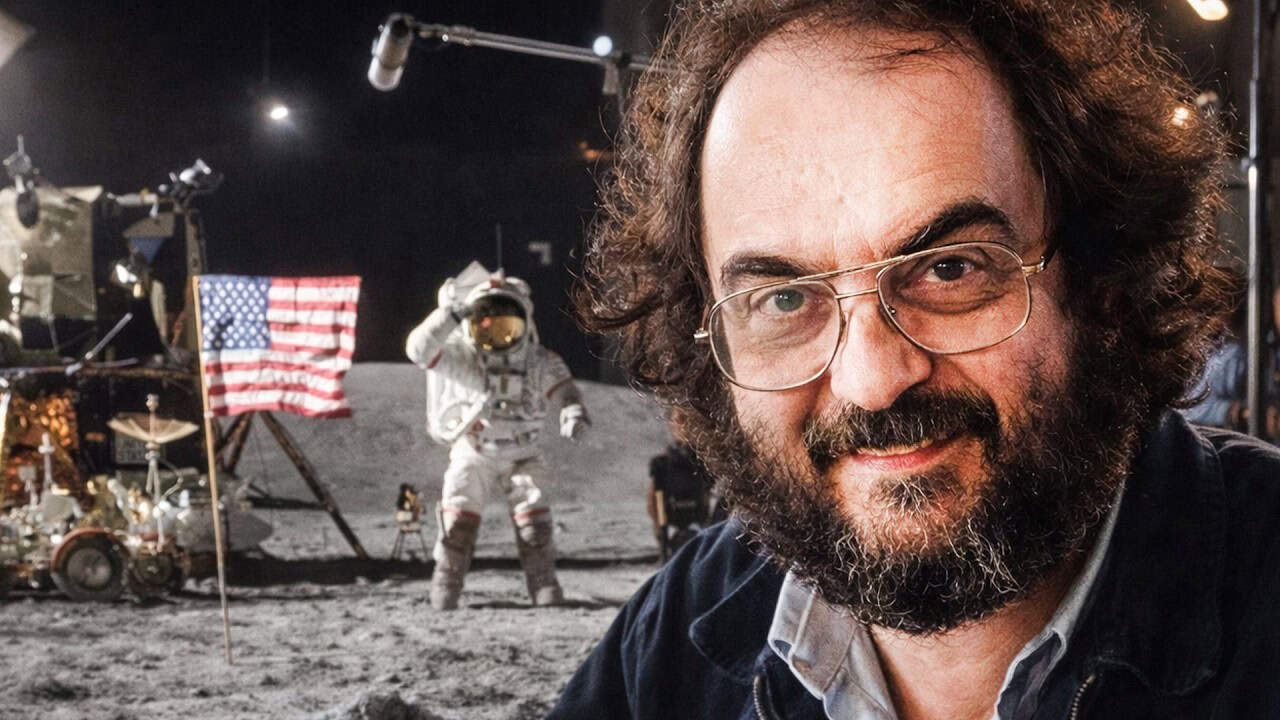
Why do people think Stanley Kubrick faked the moon landing?
It’s July 20, 1969. Families across the world gather around the nearest television they can find to witness what may be the greatest accomplishment in the history of humankind. Eyes are glued to the screen, taking in every moment—the wonder, the amazement, the sheer impossibility of it all. A literal out-of-this-world experience. And somehow, every Earthling with a television has a front-row seat.
Thanks to the brave men and women whose hard work and determination made this possible. Thanks to the technology that carried them there. So yes—thank you, rockets, and thank you, cameras, for letting the whole world see it.
The whole thing feels so cinematic. Like you’re watching a Stanley Kubrick movie.
After all, Kubrick had already given audiences some incredibly convincing space imagery in 2001: A Space Odyssey. He even had connections to NASA, which later allowed him to use one of its specialized lenses while filming Barry Lyndon. Then there are the supposed clues that people claim he left behind in The Shining. Not to mention the dark, dirty themes of power and secrecy people see in Eyes Wide Shut.
And if we’re already going down this rabbit hole, then let’s just say it: Stanley Kubrick died 666 days before January 1, 2001.
Now, I’m not exactly sure what that means… but according to the internet, it must mean something.
Or maybe—just maybe—Stanley Kubrick’s work is so unbelievably brilliant that the only way our puny little monkey minds can process it is by turning it into mythology. Talent so extraordinary that it generates conspiracy theories. In a world that often feels corrupt and dishonest, it becomes easier and easier to believe almost anything.
And that’s how many people have come to the conclusion that master filmmaker Stanley Kubrick helped fake the moon landing.
The Basic Theory
So let’s go over the basics.
The theory claims that the Apollo 11 moon landing in 1969 was faked and secretly filmed with the help of Stanley Kubrick. But why Kubrick?
Because he had just released 2001: A Space Odyssey, a film featuring incredibly realistic depictions of outer space, only one year before the Apollo 11 mission. The timing lines up, and the visuals still hold up. Those scenes from 2001 still look better than a lot of the silly moon movies we get today.
According to the conspiracy, NASA recruited Kubrick because he had already proven he could create revolutionary space imagery while also striving for scientific realism. He had the talent, the obsessive attention to detail, and access to the most advanced filmmaking technology of the era.
In other words, if you were going to fake the moon landing, Stanley Kubrick might be the perfect guy for the job.
Almost too perfect.
Barry Lyndon and the NASA Lens
After failing to get his massive Napoleon biopic off the ground, Kubrick shifted his focus to another historical epic: Barry Lyndon.
Released in 1975—just a few years after the moon landing, just saying—the film was praised, like so many Kubrick films, for its extraordinary cinematography. I mean, just look at that lighting. How did he do it?
Well, this time Kubrick had a new cinematic weapon in his arsenal: a lens.
Not just any camera lens, but a special ultra-fast lens originally designed by NASA for low-light photography. These lenses were developed for photographing the far side of the moon during the Apollo missions.
And for some reason, NASA allowed Stanley Kubrick to use one.
Kubrick used the lens to film parts of Barry Lyndon, especially the now-famous candlelit scenes. No studio lights. No tricks. Just candle flames illuminating the frame.
The result? Some of the most beautiful images ever captured on film—all made possible by technology that came from NASA.
Why the Theory Sticks
The reason this theory has stuck around for so long is because, on the surface, it doesn’t feel completely impossible.
Hollywood, the space program, the military, and the government have all worked together—sometimes openly, sometimes in secret—for a variety of reasons: education, experimentation, propaganda, and wartime projects. History has shown us that governments and powerful institutions are certainly capable of secretive, and sometimes sinister, actions.
But the real question is this: would Stanley Kubrick have participated in something like that?
For me, the strongest evidence that this whole story is nonsense comes from someone who knew Kubrick better than almost anyone—his daughter, Vivian Kubrick.
She worked closely with her father on numerous projects and was incredibly close to him. Vivian understood his character, his values, his beliefs, and the things he deeply cared about. She has repeatedly said that her father would never have taken part in a deception of that magnitude. He would never knowingly betray the truth.
But of course, the mystery never ends there.
Because the counterargument is always the same: what if he was forced? What if he was threatened?
And that’s where the theory takes its most fascinating turn.
If Kubrick had been forced to fake the moon landing, what would his only option be to reveal the truth without endangering himself or his family?
Well, according to believers, the most Kubrickian answer would be simple: he would hide the truth inside his films, burying it beneath symbolism, imagery, and carefully planted clues—a cinematic confession, or maybe even an apology.
Which naturally leads us to the film conspiracy theorists love the most…
The Shining as Confession
Of course, we have to mention the infamous documentary Room 237, which explores a number of theories about Kubrick and his true intentions while making The Shining.
One of the most popular interpretations suggests that Kubrick used the film as a kind of confession, secretly revealing the truth about the moon landing through clues and symbols scattered throughout the movie.
The most famous example is Danny Torrance wearing an Apollo 11 sweater.
Then there’s the mysterious hotel room number 237, which is suspiciously close to the roughly 237,000 miles between Earth and the moon. Some people claim the carpet patterns resemble launch pads. Others point to the presence of Tang—every astronaut’s favorite powdered orange drink. Some even insist one of the hotel guests looks strangely similar to John F. Kennedy, the president who initiated the Apollo program.
And yes, there’s even some straight-up satanic imagery in the mix, because of course there is.
And once you get that deep into conspiracy land, somebody’s going to suggest that aliens are really demons from Hell—and that maybe that’s what we found on the moon.
So… there’s that too.
These are just a few of the “clues” believers point to. Most scholars, critics, and skeptics argue that these interpretations are simply examples of extreme symbolic overreading. But once you learn about these alleged clues, it becomes very hard not to see them—and almost impossible to watch The Shining the same way again.
Which, honestly, is not necessarily a bad thing.
Kubrick as Prophet
Kubrick always seemed to be trying to tell us something.
His films can be experienced on multiple levels, and conspiracy-minded viewers have had a field day with that fact for decades. A Clockwork Orange gets read as MK-Ultra commentary. Full Metal Jacket supposedly contains clues about who really killed Kennedy. Eyes Wide Shut is often framed as a warning about elite corruption and Epstein-like abuse long before that sort of thing entered mainstream public discourse. You could even make that argument about Lolita, if you wanted.
Even early Kubrick films feel like warnings about bureaucracy, violence, and bloodthirsty leadership—Paths of Glory, Spartacus, and, most blatantly, Dr. Strangelove.
And speaking of Dr. Strangelove, it brushes up against real-world history by echoing the shadowy legacy of Operation Paperclip—the secret U.S. government program that brought former Nazi scientists to America after World War II to work with NASA and other military projects.
So when people start connecting Kubrick to government secrets, you can at least understand how the dots begin to form.
The Reputation That Fuels the Fire
Kubrick’s legendary reputation only adds rocket fuel to the theory.
He was notorious for perfectionism, obsessing over every detail in every frame of every film. He embraced technical innovations whenever possible. He was intensely private. He rarely ventured too far from home—which is one reason Full Metal Jacket was shot in England. He was known to be unusually cautious when it came to safety, travel, and health.
To some, that behavior reads as the habits of a man in hiding. A man fearful for his life. A man being watched. A man making sure he never let the truth slip out.
Maybe a NASA assassin—a “Nas-sassin,” if you will—was lurking around every corner, just waiting to strike.
And then there’s his death, which came not long after he finished Eyes Wide Shut—a film many believe was altered after he died.
So who knows what else he was trying to tell us?
Why Fake It?
But let’s step back for a second.
Why fake the moon landing in the first place?
Today it sounds ridiculous. But you have to remember the context of the late 1960s. The United States was deep in the Cold War with the Soviet Union, and a major part of that conflict was the Space Race. Reaching the moon wasn’t just about science. It was about national pride, technological dominance, and proving which superpower was truly on top.
Planting a flag on the moon would be the ultimate symbol of superiority—a power move so massive it would be nearly impossible to top.
But what if the United States couldn’t meet the deadline? What if the technology simply wasn’t ready?
In that scenario, America risked looking weak, embarrassed, even inferior in the eyes of its greatest rival. And when nations feel that kind of pressure, desperate times can lead to desperate ideas.
So maybe—just maybe—somebody thought faking it would be the easiest solution. Boost morale. Scare the Soviets. Kick off a new Space Age.
All they would have to do is beam the footage into every living room on Earth and burn the image into our collective consciousness.
A kind of global A Clockwork Orange brainwashing.
My Monkey Brain Has Questions
Now look—I’m not saying I don’t believe the moon landing happened.
And I’m not not saying that I don’t don’t don’t believe it either.
I’m just saying my monkey brain has monkey questions.
Because none of this makes any sense to me anymore.
But then again, life rarely does.
Maybe life itself is just one big Stanley Kubrick movie. Confusing. Mysterious. Slightly terrifying. But still beautiful.
So yeah… somebody please explain this to my monkey brain.
How exactly did we get up there?
Sure, the movement of the flag looks strange. The shadows seem odd. The absence of stars raises questions that feel hard to explain. But more than anything, it’s the feeling people get while watching the footage—that strange, uncanny reaction where our primal monkey brains start whispering that something is off. That humans shouldn’t be up there, and that if they were, it shouldn’t look like that.
But then again… how would we know what it’s supposed to look like?
Most of us have never been anywhere near the moon.
If the moon even really exists.
And if I’m being honest, I don’t have enough faith in my own eyes—or my own government—to fully trust either one.
Watching History Like It’s a Movie
We live in a culture deeply shaped by movies. For more than a century, film has helped us imagine the impossible and make sense of the world. Many of us instinctively process reality through a cinematic lens.
At the same time, we live in an era where institutions that were once trusted have repeatedly been exposed as corrupt, or at the very least dishonest.
So when something as monumental as the moon landing appears on a television screen, it’s almost inevitable that some people will start wondering:
Are we watching history?
Or are we watching a Stanley Kubrick movie?
Kubrick’s films often leave us with unanswered questions. And maybe because of Kubrick, we’ve started to look at the real world the same way.
We search for symbols. We hunt for hidden meanings. We stare at strange images that both amaze and unsettle us.
And once you start looking at the world through that lens, the questions never stop.
Why did NASA erase the original raw moon landing tapes?
Why did the astronauts look so strange when they returned?
Why did Buzz Aldrin supposedly tell a little girl that we didn’t go to the moon?
Why does some of the footage look like it has a green-screen glitch?
Why does flipping “Neil A. Armstrong” backward spell “ALIEN”?
Why is there what looks like an Eyes Wide Shut mask on Mars?
And what the hell is that giant baby doing floating in space?
Because once Kubrick gets inside your head… everything starts to feel like a Stanley Kubrick movie.
The post Why do people think Stanley Kubrick faked the moon landing? appeared first on JoBlo.