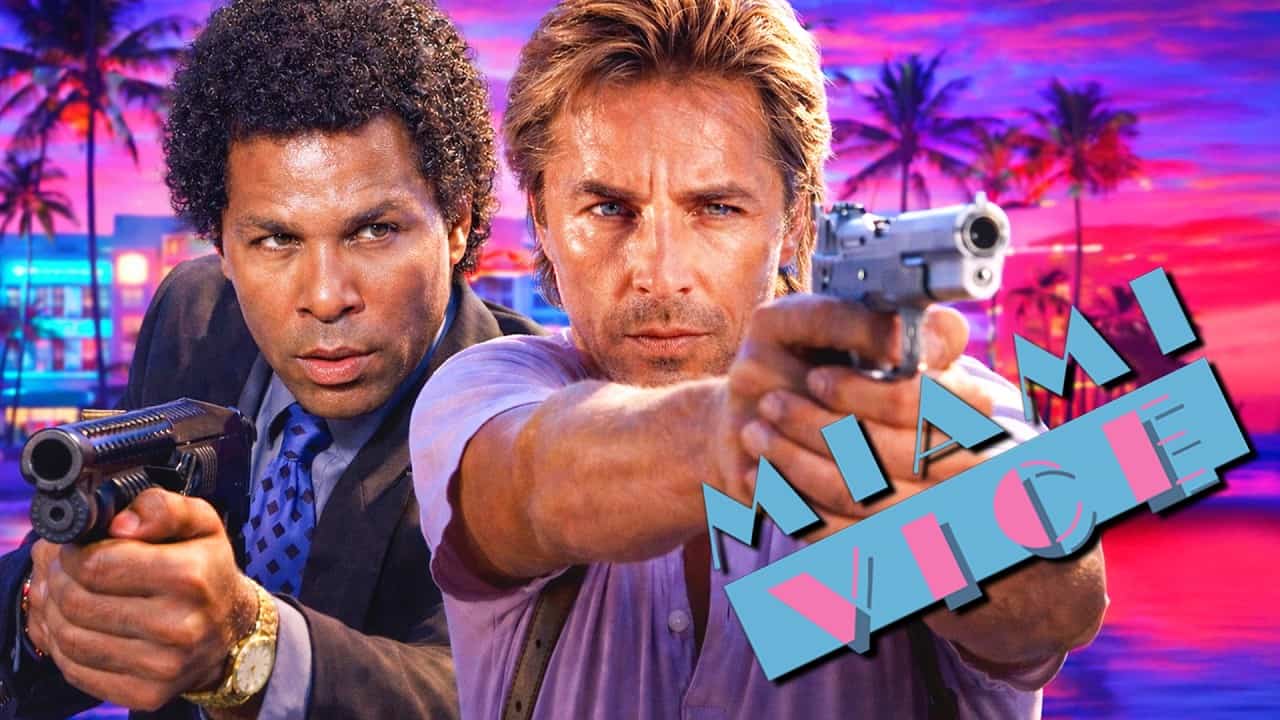
How Miami Vice Changed Television Forever (And Why It Still Matters Today)
Few moments in television history have ever been as cool or as influential as the opening sequence of Miami Vice. In the pilot episode, Don Johnson’s Sonny Crockett and Philip Michael Thomas’s Rico Tubbs cruise the neon-lit streets of Miami in Crockett’s Ferrari Daytona Spyder while Phil Collins’ “In the Air Tonight” builds on the soundtrack. With almost no dialogue, the scene plays like pure cinema: moody, stylish, and tense as the two cops head toward a deadly showdown. Today, cinematic television is everywhere, but in the mid-1980s, network TV had never looked or felt anything like this. But how exactly did Miami Vice revolutionize television?
How Did MTV Influence Miami Vice?
Urban legend has it that the phrase “MTV Cops” scrawled on an NBC memo by Brandon Tartikoff was how Miami Vice was born. While partially myth, there’s truth behind the story. In 1984, MTV dominated the airwaves. Before its 1981 launch, music videos were mere promotional tools for established acts. MTV made them essential, shaping both pop culture and music marketing overnight.
The rapid-fire editing, stylized visuals, and emphasis on image over substance influenced both film and television. Movies like Flashdance and Footloose became “MTV blockbusters,” integrating music and visual style in ways that mimicked music videos. It was only a matter of time before this aesthetic influenced TV, and Miami Vice would be its flagship.
From Concept to Pilot
Anthony Yerkovich, a Hill Street Blues writer-producer, conceived Miami Vice after reading about asset forfeiture laws, which allowed police to confiscate criminals’ property for official use. He envisioned a show about vice cops pursuing drug traffickers in Miami, a city then overwhelmed by cocaine and violent turf wars, a theme later immortalized in Brian De Palma’s Scarface.
Music was central from the start. Yerkovich insisted that the series use contemporary, hip tracks, licensing them to enhance the action and mood, unlike any other TV show of the era. Michael Mann, fresh off Thief, became executive producer with creative control. He named the show Miami Vice and helped shape its iconic look and feel.
Casting the Stars
The leads were inspired by 48 Hrs., pairing a white and Black cop.
Sonny Crockett (Don Johnson): A burnt-out undercover vice cop living the high life in luxury cars and designer fashion, with a pet crocodile, Elvis.
Ricardo Tubbs (Philip Michael Thomas): A New York detective tracking his brother’s killer to Miami, forced to team up with Crockett.
In the pilot Brother’s Keeper, Tubbs goes undercover to catch the drug lord Calderone, meeting Crockett, who is already embedded in Miami’s underworld. Their partnership, grudging at first, becomes one of TV’s most iconic duos.
Supporting Cast and Ensemble Dynamics
Other key characters:
Gina and Trudy (Saundra Santiago, Olivia Brown): Female vice cops operating undercover in the sex trade.
Switek and Zito (Michael Talbott, John Diehl): Initially comic relief, later more competent and tragic figures.
Noogie (Charlie Barnett) and Izzy (Martin Ferrero): Informants who added depth and humor.
Costume designer Jodie Tillen ensured Crockett and Tubbs dressed like the criminals they pursued, favoring lightweight pastels in Miami’s heat. Johnson’s pushed-up sleeves, sockless shoes, and constant five o’clock shadow became iconic ’80s trends.
Cinematic Style and Direction
Michael Mann mandated young directors to give episodes a cinematic feel. Compared to contemporaries like Magnum P.I. or Knight Rider, Miami Vice’s visual style was unprecedented. Locations, lighting, and camera movement created a more immersive, movie-like experience.
Why Was Music So Important to Miami Vice?
Music was central, both licensed tracks and Jan Hammer’s original compositions.
Licensed hits: Rockwell’s Somebody’s Watching Me, Cyndi Lauper’s Girls Just Want to Have Fun, Phil Collins’ In the Air Tonight.
Jan Hammer’s synth scores became a hallmark, including the iconic Miami Vice Theme and Crockett’s Theme.
The pilot’s music turned Collins’ 1981 single into a global hit, forever tying him to the show’s legacy.
Music wasn’t just background; it commented on the narrative and heightened tension, setting the standard for future TV series.
Early Popularity and Breakout Stars
While initially modest in ratings, reruns in summer 1985 catapulted the show to pop culture prominence. Don Johnson emerged as a brooding action hero, while appearances on the show boosted the careers of guest stars like Bruce Willis and Dennis Farina. In the role of Lieutenant Castillo, Edward James Olmos was just as cool as Crockett and Tubbs. Maybe even cooler.
Why Did Miami Vice Decline After Season 2?
Season two was Miami Vice at its peak: high-profile guest stars, complex storylines, music-driven episodes, and critical acclaim. Season three marked Mann’s reduced involvement, darker plots, and mixed reception. Ratings slipped, and seasons four and five struggled with overstuffed storylines, budget cuts, and reduced music licensing, leading to a decline in popularity.
Season-by-Season Breakdown
Season One
Pilot establishes Crockett/Tubbs partnership.
Focus on Miami drug trade and stylish visuals.
Music-driven storytelling introduced.
Key episodes: Brother’s Keeper, Evan, Rites of Passage.
Season Two
Show peaks: stunt casting, expanded guest stars, music integration.
Episodes like The Prodigal Son bring NYC and crossovers.
Castillo’s backstory explored in Golden Triangle.
Season Three
Michael Mann’s involvement reduced; Dick Wolf takes over.
Darker plots, clothing shifts to dark neons, use of deep-cut music (INXS, Depeche Mode).
Key episodes: Stone’s War, Theresa, The Afternoon Plane.
Season Four
Attempts to recapture audience with lighter pastels.
Overstuffed plots and gimmicks (Missing Hours, Cows of October).
Sheena Easton subplot; Crockett’s Burnett storyline begins.
Season Five
Budget cuts, less licensed music, Jan Hammer replaced by Tim Truman.
Focus shifts to Castillo and Switek.
Series finale: Freefall, Crockett and Tubbs take down a Latin American dictator, resign from the force.
Legacy and Cultural Impact
Despite its uneven later seasons, Miami Vice remains one of television’s greatest achievements, blending style, music, and narrative in a way that still resonates decades later. The show:
Influenced the Golden Age of Television
Inspired Grand Theft Auto: Vice City
Led to a 2006 Michael Mann film starring Colin Farrell and Jamie Foxx
2025 IMAX remake announced with Austin Butler and Michael B. Jordan rumored to star
Rediscovered through Cocaine Cowboys and original soundtrack releases
Even today, the series remains a reference point for style, music, and cinematic storytelling in television.
FAQ
How long did Miami Vice run?
Miami Vice aired for five seasons on NBC, from 1984 to 1989, with a total of 111 episodes.
Who starred in Miami Vice?
The series starred Don Johnson as Sonny Crockett and Philip Michael Thomas as Ricardo Tubbs, alongside Edward James Olmos as Lieutenant Castillo.
What was Miami Vice about?
The show followed undercover vice detectives in Miami as they investigated drug trafficking, organized crime, and other criminal activity during the height of the 1980s drug trade.
When did Miami Vice become popular?
While it debuted in 1984, the show became a major hit during the summer of 1985, when reruns expanded its audience and turned it into a cultural phenomenon.
Why was Miami Vice so influential?
Because it combined cinematic visuals, licensed pop music, and stylized storytelling in a way network television had never done before. It treated episodes like mini-movies, influencing everything from editing and fashion to modern prestige TV.
The post How Miami Vice Changed Television Forever (And Why It Still Matters Today) appeared first on JoBlo.