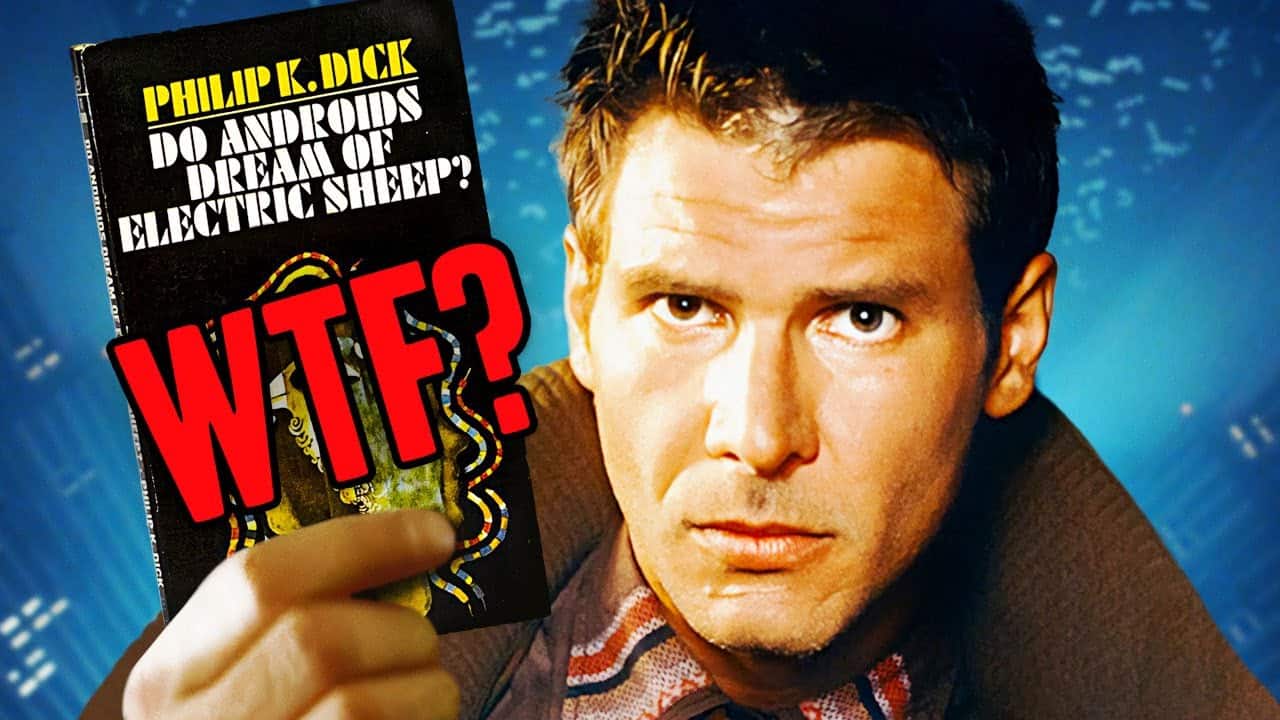
Blade Runner (1982) – WTF Happened to This Adaptation?
It’s funny how some of the most important and beloved movies of all time can come from stories that aren’t quite as celebrated or well read, and I’m not just talking about movies from 1982. The Thing certainly falls under that category because while Who Goes There is certifiably a great sci-fi story and there have been at least 3 movies based on it, The Thing and John Carpenter will live on far longer than Who Goes There and John W. Campbell. While that certainly doesn’t extend to all famous authors, Stephen King’s name is etched into history and 75% of his adaptations will either be forgotten or redone multiple times over, there’s also that middle ground. Phillip K. Dick has more than his fair share of adaptations out there, but his adaptations typically turn out higher profile than the author or his original works. Blade Runner is no different in that regard, or should I say Do Androids Dream of Electric Sheep. While the movie bombed at the time, it has since become one of the most respected and beloved sci-fi films of all time. Let’s fire up the Voight-Kampff test and see what happened to this adaptation.
The Movie
The development of a film adaptation of Do Androids Dream of Electric Sheep began almost immediately after its release in 1968. Martin Scorsese of all people was extremely interested in it but never ended up optioning the title and instead the first real effort came from producer Herb Jaffe in the early 1970s. The script was to be written by Jaffe’s son and was terrible when presented to both the author and Herb. Allegedly the father asked his son Robert if he should beat him up at the airport or wait until they got back to the apartment. It would be nearly 10 years after the original publication in 1977 that the story was optioned properly with a screenplay by Hampton Francher being picked up by producer Michael Deely who was able to convince future Alien director Ridley Scott to direct. If you think this was on the fast track, then take a look at the release date and realize this still has a ways to go.
Scott had just dropped out of helming a film version of Dune and was looking for a faster paced production to get his mind off the recent death of his older brother. The budget was pushed to 15 million after he officially began in 1980 and wanted changes to the script which focused more on environmental issues than the books focal points of humanity and religion. They didn’t think the books title would be a hit either, so they changed it to Blade Runner which was a title purchased from a draft of another film that was struggling to get into production. The script rewrite was handed off to David Peoples with Francher leaving production over differences before eventually coming back to add in additional help with the final screenplay.
Casting for the movie, Deckard in particular, took a while to come to fruition. The original screenplay was written with Robert Mitchum in mind including dialogue geared directly towards him as the character. A quite frankly ridiculous lineup of A-list talent was thrown around to play the part including Sean Connery, Burt Reynolds, Nick Nolte, Gene Hackman, Clint Eastwood, and a handful of other comically talented names. Dustin Hoffman sat down multiple times over a couple months with Scott and the producers but had a different vision in mind for the project and eventually left as well. While he was the closest for a while, Harrison Ford was eventually chosen and agreed after his work in Star Wars and Steven Spielberg giving high praise while working with the actor on Raiders of the Lost Ark. Ford was ready for a part with more dramatic range and this was his opportunity.
Roy Batty was a much easier decision with Rutger Hauer being cast without Scott even meeting him. He loved his performances in Paul Verhoeven’s earlier pre-RoboCop work and he ended up being a perfect choice. Much like many of the other actors in the film, Ford included, this was Hauer’s favorite film he did, and we got his famous tears in the rain speech only due to Rutger rewriting it himself and getting approval from Scott before the scene. While the production ended up with lesser-known actors like Sean Young and Daryl Hannah, the roles were originally for Barbara Hershey and Debbie Harry respectively. The cast is rounded out by the likes of James Hong, M. Emmet Walsh, William Sanderson, Edward James Olmos, Joe Turkel, and Brion James. The budget would eventually balloon to 30 million and Blade Runner was shot over 4 weeks in the Spring of 1981. It would get fairly high praise and end up with an eventual box office run of just under 42 million.
The Story
We talked a little bit about Phillip K. Dick the man when we compared his previous work in Total Recall, but Dick had a very strained and interesting final stretch of life. After the extraction of a wisdom tooth and very much still on the effects of sodium pentothal, Dick had a delivery from a young woman with a fish pendant. He says that the sun hit the pendant just right and a pink beam transfixed him and made him believe that it even gave him wisdom and clairvoyance. He claimed that he was able to see that his infant son was sick, a diagnosis which was confirmed when he rushed the child to the hospital. He would go on to hallucinate geometric shapes, ancient Rome, and even Jesus Christ. He originally chalked this up to the medications he was on but later said it couldn’t have lasted that long just on those. He felt he was living two lives, one as Phillip K. Dick the 20th century author and one as Thomas who was a persecuted Christian man. Interestingly enough, it’s during this time that his VALIS trilogy was written before his death.
He only saw an early version of Blade Runner but found that they captured the look perfectly and especially Roy Batty was exactly how he envisioned him. While the story has since been overshadowed by the film, Do Androids Dream of Electric Sheep was instantly praised and analyzed by critics and continues to be today. It is massively influential and ended up with a few other pieces of media as well. First off is the 1997 video game adaptation by Westwood Studios of the same name. it is a classic point and click adventure that follows a different protagonist named Ray Macoy, but Deckard is mentioned and even seen in the story at points. It wasn’t super well received at the time but Nightdive Studios, bless their hard-working hearts, made a remaster and the game can run now on modern consoles. More surprisingly is that there are 3 sequel novels written by a friend of Phillip K. Dick named K.W. Jeter. They follow Deckard and attempt to bridge the gap between novel and film but unfortunately have normal sequel names like Blade Runner 2: The Edge of Human instead of Blade Runner 2: Electric Boogaloo or The New Batch.
What is the same?
Okay, to make this a little simpler, we will just pick ONE of the SEVEN different versions of the film. Really, we will just use the stuff that appears in most iterations rather than get too into the weeds on differences. Rick Deckard is tasked with hunting down rogue Nexus 6 androids on Earth and visits the place where they are produced first. He gives an empathy test to prove that they are indeed androids, and it turns out that Rachel, one of his hosts, is actually an android. Rachel and Deckard eventually fall in love, and she helps him in a few ways. There is confusion on whether Deckard himself is possibly an android, but no confirmation is ever made. Deckard is successful in his mission to retire the Nexus androids after a final battle in a run-down building.
What is different?
Quite frankly, a lot, which is definitely what happened when a movie is in production as long as it is but also just a trend where most movies end up slightly, or largely, different from their source material. While Deckard is the main character in both and his main mission is to hunt down the rogue androids, much of the rest of the story changes. It moves from San Francisco in the book to Los Angeles in the film. While there is still clearly a dystopian feel to the movie, the book focuses much more on the environmental damage of the Earth including the fact that most animal species are either extinct or close to it and are very much a rich person commodity. Deckard is also happily married in the book and instead of fleeing with Rachel at the end, goes back to her and presents her with a frog thought to be real but turns out to be an android. There are 6 androids in the book vs. the 4 in the movie and the Tyrell company are the ones producing them. Rachel is known to be a replicant much earlier and also is more of a tool of sabotage in the book vs. the film.
The replicants in the book are interesting enough but don’t have the same personalities as they do in the movie. There is this whole great scene in the book where Deckard goes to retire an opera singer android only to be arrested and the whole police station turns out to be a scam where two of the replicants are trying to frame and kill Deckard and another bounty hunter named Resch. Both Resch and Deckard administer the test on themselves to see if they are human but both pass. The apartment building in the book also houses a mentally handicapped man who was damaged by radiation. This is close to William Sanderson’s character but differs as the man in the apartment has nothing to do with the androids. Another similar plot point are dreams that Deckard has. The movie has the images of the unicorns while book Deckard sees a prophet getting hit by falling rocks, something that happens to him off the coast of Oregon after he has completed his mission.
Legacy
I actually really enjoyed Do Androids Dream of Electric Sheep but its just simply not the cultural sci-fi cornerstone that its movie counterpart is. While some of the iterations of the movie fall flat, there is still a nearly perfect vision out there that combines its look, sound, and most importantly feel into one cohesive masterpiece. Both are worth seeking out but the movie is just a better time. Completionists can also seek out the comic series from BOOM, and the previously mentioned sequel novels and video game. Thankfully neither the book nor the film will be lost to time like tears in the rain. Make sure to check out both so you can say “I’ve seen things you people wouldn’t believe” and enjoy one of the best to ever do it.
A couple of the previous episodes of WTF Happened to This Adaptation? can be seen below. To see the other shows we have to offer, head over to the JoBlo Horror Originals YouTube channel – and subscribe while you’re there!
The post Blade Runner (1982) – WTF Happened to This Adaptation? appeared first on JoBlo.