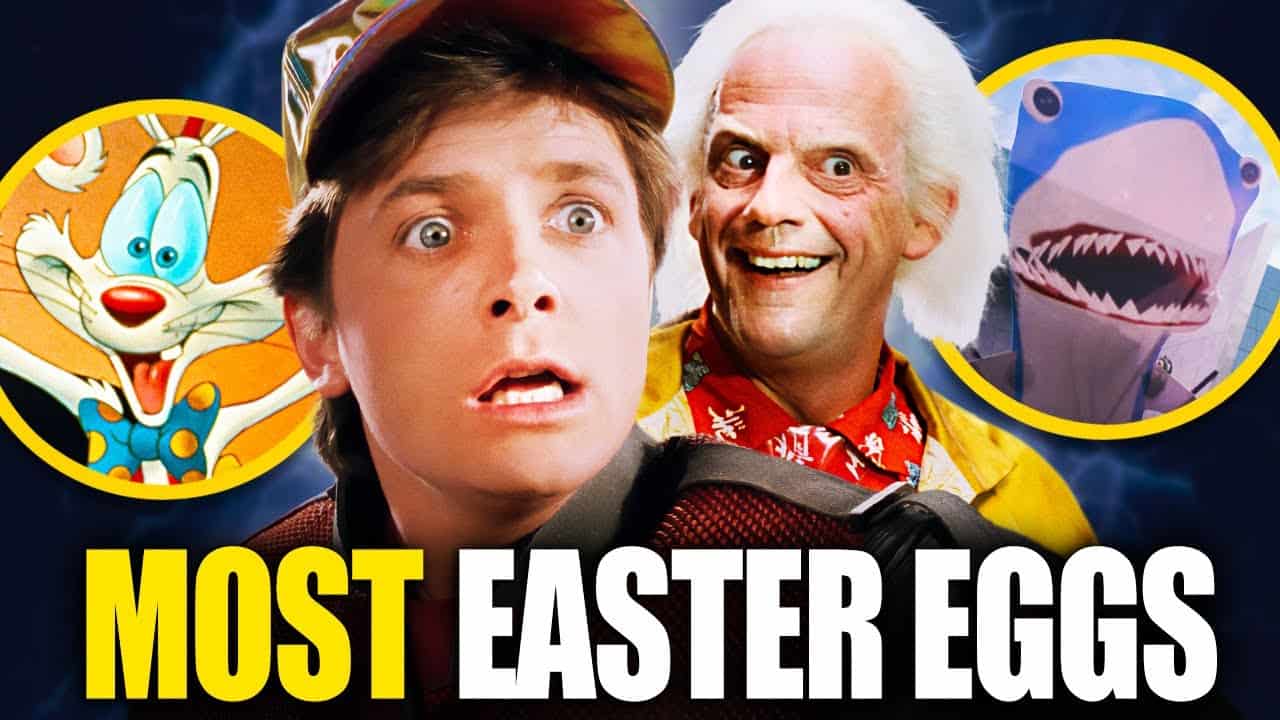
Back to the Future 2: Easter Eggs You Might Have Missed!
When thinking about the most successful and entertaining cinematic sequels on record, Robert Zemeckis’s Back to the Future Part II instantly leaps to mind. Filmed back-to-back with Back to the Future Part III after two years of scriptwriting and set construction, the grand irony is that Zemeckis never initially intended to make a sequel, much less two, to his landmark 1985 teen time-travel adventure. Looking back, it’s hard to imagine the success of one franchise entry without the other, with Back to the Future ranking as arguably the finest movie trilogy ever made. Of course, just as we did with the first film and plan to do with the last, it’s only right that we go back in time to pore through Back to the Future Part II and take you guys and gals on a hidden Easter Egg hunt. You know what to do. Fire up the hover board, strap on the Nike MAGs, shotgun a Pepsi Perfect, and throw on the futuristic Doc Brown goggles; we’ve got some heavy digging to do!
Okay, so by now, it’s fairly common knowledge that the opening of Back to the Future Part II, which recreates the ending of the original movie as Doc Brown, Marty McFly, and Jennifer Parker fly off in the DeLorean, had to undergo a frame-by-frame reshoot. This was done to replace Claudia Wells, who originally played Jennifer Parker, with Elisabeth Shue. Wells had to decline reprising the role after her mother became ill with cancer. While the painstaking efforts to completely mirror the original ending in the sequel cannot be overstated, most fans of the franchise are aware of Shue replacing Wells. However, most fans probably do not realize that the shots of the DeLorean flying through the stormy clouds as the credits roll in Back to the Future Part II were filmed for Clint Eastwood’s 1982 film Firefox; the first of many Eastwood connections to the franchise that we’ll touch on later.
Once Doc tells Marty and Jennifer that their children are in danger of becoming criminals and need a future intervention, they whisk off to the year 2015. One of the first things viewers may easily miss is the newfangled floating Hill Valley sign welcoming visitors. Notice how Goldie Wilson’s son, Goldie Wilson Jr., has followed in his father’s footsteps and become the town Mayor. The skyway sign also features the taglines, “A Great Place to Live” and “Please Fly Safely – Ejector Seats Save Lives,” both of which recall the original movie, indicating how flying cars have become a common sight.
As Marty wanders around Hill Valley in 2015 and adjusts to his new surroundings, some of the most detailed Easter Eggs can be found. One of the funniest in-jokes comes when Marty walks past a movie theater advertising Jaws 19 featuring a cartoonish cutout of Bruce the Shark. This is not only a sly jab at Hollywood’s greedy “sequelitis,” it’s also a reference to Steven Spielberg, who not only directed Jaws but produced the Back to the Future trilogy through Amblin Entertainment. Look closely and you’ll notice the marquee for Jaws 19 reading, “Directed by Max Spielberg,” a shoutout to Steven’s real-life son. Notice the ridiculous tagline, “This time, it’s REALLY, REALLY personal,” a play on Jaws IV: The Revenge’s absurd premise and silly marketing hook. Funnier yet, Marty grumbles, “Shark still looks fake” as he walks by, a riff on Spielberg’s notorious dissatisfaction with how often Bruce broke down while making Jaws. Of course, Lea Thompson, who plays Lorraine, starred in Jaws 3-D.
As Marty continues to tour Hill Valley in 2015, one of the biggest treasure troves chock-full of Easter eggs appears in the Blast from the Past antique storefront window. Surrounding the 1950-2000 Sports Almanac are several video games and VHS movie boxes for other Universal Pictures releases. There is VHS artwork for National Lampoon’s Animal House and Dragnet, the latter of which stars Zemeckis’s longtime future collaborator, Tom Hanks. In the bottom left corner, the boxes for the Jaws and Jaws 2 video games can be seen. Both Jaws games were designed by LJN, the company that later produced video games based on Back to the Future Part II, Part III, and Who Framed Roger Rabbit? To the right of the Almanac, a talking plush toy doll of Roger Rabbit stands out as an overt nod to the classic movie Zemeckis made between the first and second Back to the Future movies.
Speaking of Roger Rabbit, the actor who voiced the character is Charles Fleischer. Fleischer makes a cameo in the 2015 timeline as the car mechanic who wishes he had bet on the Cubs winning the World Series. Fleischer also plays the 1955 version of the same character, and also voices Biff’s grandmother, Gertrude, who is heard off-screen. As for future predictions, the movie was one year off prophesying the Cubs’ World Series win. In real life, the team won the World Series in 2016, their first victory since 1908.
Far harder to spot in the window are two significant links to the original movie. A JVC TV and JVC camcorder can be found, recalling the video camera Marty uses to interview Doc at the start of the first film. Harder yet to find is Marty’s classic denim jacket from the first film, replete with the “Art in Revolution” pin. It can be seen at the top of the screen on the left, behind the “Do Your Thing” sign. Lastly, below the TV set, a bust of JFK can be seen, a reference to the street John F. Kennedy Drive in the original Back to the Future. Speaking of U.S. Presidents, an image of Ronald Reagan and his videotape Stand-Up Reagan can be seen, linking back to the hilarious joke about the actor-turned-politician in the first movie.
If the Blast from the Past memorabilia shop wasn’t a fun enough challenge, fans have had a field day devouring the cornucopia of juicy Easter Eggs inside the Cafe 80s nostalgia shop in Hill Valley. First off, the store is the same place as Lou’s Cafe in 1955 and Lou’s Aerobic Fitness Center in 1985 from the first film, combined to create a futuristic amalgam of both. Secondly, several ‘80s TV shows are played in the cafe, including Taxi, the sitcom starring Christopher Lloyd, and Family Ties, the sitcom starring Michael J. Fox.
Thirdly, notice the extras riding stationary bikes in the cafe, a nod to Lou’s Fitness Center in the alternate 1985 timeline. Moments later, when Marty plays the arcade game Wild Gunman, one of the little boys he interacts with is none other than a young Elijah Wood in his first feature film appearance. The Paul Reed Smith electric guitar hanging on the wall above the Wild Gunman game is the same instrument Marty plays later in the film when he riffs on Huey Lewis and the News’ “Power of Love.”
In the cafe, the Pepsi menu displays four varieties of soda. They include Original, Diet Pepsi, Pepsi Max, and Pepsi Perfect. Although it didn’t exist when the movie was released in 1989, Pepsi Max became a real product introduced in Europe in 1993 and America in 2007. As for the bizarre video avatars of Michael Jackson, Ronald Reagan, and Ayatollah Komeni, they’re done in a visual style reminiscent of The Max Headroom Show, a 1985 TV faux talk show that was all the rage by the end of the decade.
Once Marty and Marty Jr. cross paths in the cafe, one way to tell their identical appearances apart is their eye color. Marty has blue eyes, while Marty Jr. has brown eyes.
As Marty Jr. exits Cafe 80s and runs away from Griff, the Star Car from Universal’s 1984 teen sci-fi movie The Last Starfighter can be seen. Parked on Second Street, next to Courthouse Square, the black Spinner vehicle from Ridley Scott’s Blade Runner is also present when Marty evades Griff’s goons on the hoverboard.
Following the hoverboard chase, Marty passes by the Hill Valley Courthouse. Notice how the clock tower remains broken since it was struck by lightning at 10:04 P.M. in 1955. The ledge on the tower’s parapet is also still broken, indicating it has not been fixed since the alternate 1985 timeline that returned Marty home safely.
Moments later, when Marty reunites with Doc and picks up his copy of USA Today, several hilarious, easy-to-miss headlines appear briefly. The more amusing ones include “Thumb Bandits Strike,” “Man Killed By Falling Litter,” “Swiss Terrorist Threat,” “Shredding For Charity,” “President Says She’s Tired,” “Pitcher Suspended For Bionic Arm Use,” and perhaps the funniest, “Jaws Without Bite,” suggesting that Jaws 19 wasn’t all that toothy this time around. Not for nothing, but the paper also refers to Princess Diana as Queen Diana twice in stories preparing for her visit to Washington, D.C.
Once Marty escapes from Biff and Biff obtains the almanac, the movie finds Jennifer at the future McFly house. For the few who don’t know, Marty’s future daughter, Marlene McFly, is played by Michael J. Fox.
After Biff pilfers the DeLorean and goes back to 1985, Doc and Marty follow him to find a much darker, dystopian version of Hill Valley. Using the almanac, Biff has turned the quaint little town into a corrupt, crime-ridden hellscape where gambling has been legalized. Emphasizing how nightmarish this timeline has become, Marty walks past a vandalized welcome sign that reads Hell Valley instead of Hill Valley. Similarly, Marty strolls past Hilldale’s welcome sign, which has been spraypainted to read “The Address of Suckers,” instead of “The Address of Success.”
Parked next to Marty’s 2015 house is an old wrecked 1955 Citroen DS car with a red body and white top. This is the same Luxor Taxi Cab that old Biff used to find the DeLorean, with the colors altered.
Once Marty visits George McFly’s grave in the Oak Park Cemetery, the tombstone reveals that George was born on April Fools Day, and died on March 15, The Ides of March, a date most commonly associated with the assassination of Julius Caesar. Whether this is a nod to George being a foolish goofball since birth, and star Crispin Glover backstabbing the production by refusing to appear in the sequel and filing a lawsuit for using his likeness, is anyone’s guess.
Marty stumbles into Biff’s Pleasure Paradise Casino and Museum, which was purposefully patterned after Donald Trump’s gaudy gaming parlors. When he wanders into the museum, you’ll notice the hilarious, on-brand sign to the left reading “Smoking Required,” with the semiotics suggesting you could be thrown out of the museum for not smoking.
Attentive viewers will spot a black-and-white image of Buford “Mad Dog” Tannen on a TV monitor in the casino. This is the character Tom Wilson portrays in Back to the Future Part III. The reason Mad Dog looks slightly different from the way he does in that film is that the image seen in Biff’s casino was taken from a make-up test Wilson underwent in pre-production. Not only was Biff’s personality modeled after Trump, but the dystopic version of Lorraine was inspired by Tammy Faye Bakker.
Also alluding to the events depicted in Part III, when Marty confronts Biff in the hot tub, the movie playing on TV is Sergio Leone’s A Fistful of Dollars, starring Clint Eastwood. Remember, the opening footage of Back to the Future Part II was taken from the Eastwood movie Firefox. In Back to the Future Part III, Marty uses Clint Eastwood as an alias when he travels to the Old West in 1885.
Speaking of movies, hawk-eyed fans may also notice Biff’s kinky pornography fetishes, as a copy of Black Taboo and Playing With Fire can be seen on the counter next to the penthouse bar as Marty and Lorraine interact. Pretty heavy, I know.
In the dystopian 1985 timeline, Doc holds up a newspaper in his mansion, with a large headline reading “Emmett Brown Committed.” Much more difficult to see is the headline below to the right, reading, “Nixon to Seek Fifth Term,” with plans to end the Vietnam War in 1985. The implication being that in this horrific version of a future America, the U.S. President has disregarded the Constitution and sought to stay in power for 20 years. Thankfully, this doesn’t sound too familiar in 2025.
Okay, so when Marty retrieves the almanac, leaves the terrifying version of 1985, and returns to 1955, a more subtle Easter egg comes as Biff chases Marty through the tunnel. Filmed at Mt. Hollywood Tunnel in Griffith Park, this is the same tunnel that functioned as Eddie Valiant’s entrance to Toontown in Who Framed Roger Rabbit?
One of the most brilliant parts of Back to the Future Part II is how it ends in 1955, masterfully recreating the Enchantment Under the Sea Dance. Filmed from an entirely different perspective, Rashomon style, the events are now seen through Biff’s eyes. With new information not provided in the original movie, Biff is seen spiking the punchbowl at the dance with alcohol. Putting two and two together, that means that George McFly, who we saw drink from that very punch bowl in the first movie, was more than likely intoxicated at the dance. Far from an oversight, this makes far more logical sense, as George suddenly found the courage to dance by himself as if no one was watching, and had the nerve to get into a physical altercation with Biff in the parking lot. Food for thought, if nothing else.
Another word on the reframed school dance. To accurately recreate the dance, Zemeckis wanted to recycle the original costumes from the original movie. Unfortunately, two of the three dresses made for Lorraine went missing and couldn’t be located during production. Just when Zemeckis was about to freak out, Lea Thompson remembered that she kept one of the dresses in her closet as a souvenir. She’s the only one in the cast who wore her original costume from the first film in the sequel.
As for Doc’s snazzy, Hawaiian-style shirt worn throughout most of the movie, it not only turns into his rough-hewn bandana in the movie’s finale, but it also foretells what Doc and Marty will experience in Back to the Future Part III. Notice how the shirt features images of a horse being chased by a locomotive in an Old West setting. Remember, Back to the Future Part II and Part III were filmed back-to-back, so this is more of a deliberate story-building clue planted by Zemeckis and fellow screenwriter Bob Gale.
So there you have it. Back to the Future Part II has no shortage of discoverable Easter Eggs, subtle references, hidden clues, and overt homages that tie into the overarching franchise. The movie became the third-highest box office earner of 1989 and arguably remains the best second entry in a cinematic trilogy on record.
The post Back to the Future 2: Easter Eggs You Might Have Missed! appeared first on JoBlo.