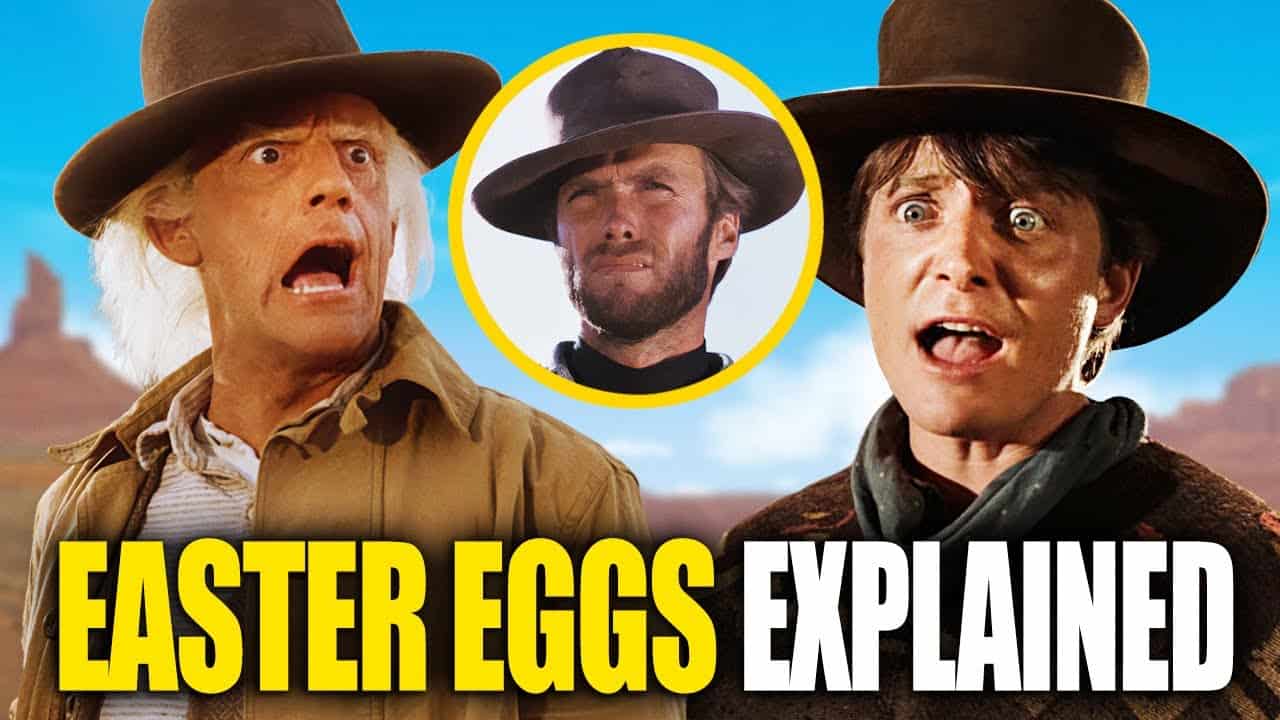
Back to the Future 3: All the Easter Eggs You Might Have Missed!
If you had an Old West six-shooter pressed to your temple and were forced to answer honestly, what would you say is your favorite Back to the Future installment? Believe it or not, franchise mainstays Michael J. Fox, Christopher Lloyd, Lea Thompson, and Tom Wilson have all publicly stated that Back to the Future Part III is their favorite and most amusing entry in what is still considered one of the greatest cinematic trilogies committed to celluloid. Famously filmed back-to-back with Back to the Future Part II during eleven laborious months, director Robert Zemeckis worked tirelessly filming Part III while editing Part II to ensure that both films would be viewable within six months of each other. Of course, with such impeccable attention to detail and diligent efforts to connect all three movies at a cellular level, Back to the Future Part III has plenty of cool call-backs and nuanced references to its predecessors, overt and covert nods to classic movie Westerns, and a slew of buried Easter Eggs worth excavating as the film celebrates its 35th anniversary this year. Sound good? Great F*cking Scott! We’re firing up the DeLorean one more time, rushing back to 1885, and discovering all the hidden treasure we can find in Back to the Future Part III!
The Opening and Doc’s Mansion
At the end of Back to the Future Part II, Doc Brown mentions how he always wanted to travel to his “favorite historical era, the Old West.” Before Doc travels 70 years into the past and arrives in Hill Valley in 1885 as the town is being built, one of the first Easter egg baskets can be found inside Doc’s mansion. Notice the four black and white images hanging above the fireplace as the credits roll. These portraits of Isaac Newton, Benjamin Franklin, Thomas Edison, and Albert Einstein were hung in the same place in Doc’s mansion in the first film’s 1955 timeline. Speaking of the original 1955 timeline, when Doc stumbles past a bathroom in the mansion, viewers can spot the clock hanging on the wall above the toilet. This is the same clock that Doc described to Marty when they first met. Remember, Doc tried to hang the clock, but slipped, fell, and hit his head, which gave him the revelation of the flux capacitor and made time travel possible. Additional iconography from the first two films in Doc’s mansion can be spotted, including the fire extinguisher Doc used to put out the car-model fire, the large brain wave analyzer Doc uses to predict Marty’s thoughts, the “crude” model of Hill Valley, the hoverboard, Doc’s saxophone hanging on a pillar, dual wristwatches on Doc’s arms, etc. Perhaps most importantly, the letter Doc wrote is seen drying above the fireplace.
Jules Verne, Clara Clayton, and Literary Connections
Upon visiting the cemetery, Doc and Marty dig up the DeLorean and repair it for Marty to return to 1985. While walking through the underground tunnel, Doc mentions his favorite author, Jules Verne, who famously wrote the book referenced in the movie, Journey to the Center of the Earth. Later, when Doc meets and falls in love with Clara Clayton, a part specifically written for Mary Steenburgen, they get married and have children named Jules and Verne. Clara also mentions being a fan of H.G. Wells, which recalls Steenburgen’s role in the 1979 time travel movie, Time After Time, in a story that finds H.G. Wells travelling through time to catch Jack the Ripper. When Clara purchases train tickets, the salesman mentions that San Francisco is the final destination. In Time After Time, much of the plot took place in San Francisco. Meanwhile, Clara Clayton is based on Clara Clemens, the daughter of Samuel Clemens, aka Mark Twain, who famously almost lost her life when a horse threw her carriage off a 50-foot cliff, paralleling Clara’s near-fate in Back to the Future III.
Mad Dog Tannen and Classic Western Influences
After spotting Doc’s tombstone and learning from the inscription that he was shot to death by Biff Tannen’s great-grandfather, Buford “Mad Dog” Tannen, we get our first glimpse at series stalwart Tom Wilson. Fans will recognize Mad Dog from his brief cameo in Back to the Future Part II, when he appears on a TV screen inside Biff’s Pleasure Palace Casino. However, Mad Dog’s visage is slightly different in Part II, as the image was taken from a makeup test. As for Mad Dog’s physical appearance, Wilson patterned his look after Lee Marvin’s title role in The Man Who Shot Liberty Valence. As we’ll see, most of the cinematic references in Back to the Future Part III relate to classic westerns, many of which star the legendary Clint Eastwood. Remember, Clint Eastwood is the alias Marty uses in 1885, something that pleased the iconic actor after he granted the production permission to use his name.
Just before Marty informs Doc of who Clint Eastwood is, the two study old records and photographs. One includes an image of the newly constructed tower clock that appears throughout the franchise. Doc poses next to the clock in the photo, with the time reading 8:08, a sly reference to 88 Miles Per Hour, the speed required for time travel. Later, when Doc and Marty pose for a photo beside the clock reading 8:08, the photographer is played by cinematographer Dean Cundey, who shot all three films in the trilogy.
Clint Eastwood Film References
Once Marty vows to rescue Doc from sudden death in 1885, the two soon attend the Pohatchee Drive-In movie theater in 1955 to fix the DeLorean. Marty mentions Clint Eastwood, whose name flies over Doc’s head. “Clint who?” asks Doc, with Marty responding, “That’s right, you haven’t heard of him yet.” Just as Marty says that, he points to two movie posters advertised on the wall. The posters he points to are for the 1955 sci-fi B-movies Tarantula and Revenge of the Creature, both of which starred a pre-famous, 25-year-old Clint Eastwood. Later, the drive-in marquee advertises a triple feature, including Francis in the Navy, another early Eastwood film released in 1955. This not only ties into the multiple Eastwood references in Back to the Future Part II but also lays the groundwork for several more to come in Part III.
For instance, the location used for Hill Valley in 1885 is the same one in Clint Eastwood’s 1985 western, Pale Rider. Namely, both movies were filmed at Railtown 1897 State Historic Park, Jamestown, California. When the clock used for the iconic Hill Valley Clock Tower is unloaded from the traincar in 1885 as Doc and Marty speak to the conductor, sharp-eyed fans will notice that it’s the same clock that was unloaded similarly in Pale Rider. Interestingly enough, Pale Riderwas the #1 movie at the U.S. Box Office in July 1985 until it was supplanted by Back to the Future, which went on to become the highest-grossing movie of the year.
A bevy of nods to Eastwood’s 1976 western The Outlaw Josey Wales can be found in the film as well. When Marty is served a drink at the Palace Saloon under the name Clint Eastwood, the actor playing Chester, the bartender, is Matt Clark. Even though Marty asks for ice water, Chester tells him the bar only serves whiskey. Clark also portrayed Kelly, the bartender, in The Outlaw Josey Wales, in which he tells Clint Eastwood’s character that the saloon does not serve whiskey. This is not only a riff on Josey Wales but also a callback to Marty’s difficulty ordering a drink in Lou’s Cafe in 1955. It’s also worth noting that the Palace Saloon is the same location used for Lou’s Cafe in 1955, Lou’s Aerobic Fitness Center in 1985, and the Cafe 80s in 2015.
Easter Eggs, Running Gags, and Cameos
For hardcore Western fans, the three old timer saloon patrons may look familiar. Rather than casting random bit players, Zemeckis paid homage to the genre by casting Pat Buttram, Harry Carey Jr., and Dub Taylor, three actors who played supporting characters in countless westerns throughout their careers. After Marty leaves the saloon and is roped by Buford’s gang, Michael J. Fox was often pulled and dragged off-screen by the Benny the Cab Go-Kart featured in Who Framed Roger Rabbit, the movie Zemeckis made before Back to the Future Part II and III. Finally, the train engineer in Back to the Future Part III is portrayed by Bill McKinney, the same actor who portrayed the villainous Captain Terrill in The Outlaw Josey Wales.
As for more classic Eastwood western references, notice how Doc shoots Marty down from Buford’s lynching rope in the same manner as Eastwood’s Man with No Name does for Tuco in The Good, the Bad, and the Ugly. Speaking of Sergio Leone’s Dollars trilogy, Biff watches A Fistful of Dollars while in the casino hot tub in Back to the Future Part II. In the clip shown, Eastwood sports a ramshackle bulletproof vest. Later in Back to the Future Part III, Marty does the same thing by using an iron stove door to stop a bullet from puncturing his torso.
Of course, the sign for Clayton Ravine displayed early in the movie is altered to Eastwood Ravine by the end. Speaking of, when Doc and Marty first mention Clayton Ravine while studying the map at the train station, Clara Clayton can be seen in a hat and a violet dress behind Marty with her back turned, standing beside the tower clock on the train. Notice how the clock reads 10:04, the time the clock tower will be struck by lightning 70 years in the future.
Just before that, when Marty first enters Hill Valley’s construction in 1885, a sign for a horse trader named Joe Statler is displayed. This refers to the Statler Toyota sign on the pickup truck that Marty ends up with in the first film, and the Statler Motors Studebaker sign spotted on a building by the theater in the second film. In the Back to the Future universe, the Statler family has been a prominent fixture in the automotive business for at least a century. Moments later, Marty strolls past a manure wagon with the name A. Jones stamped on the side. This is an overt nod to the D. Jones sign printed on the side of the manure truck in the original movie, which, itself, was a shoutout to Unit Production Manager Dennis E. Jones. Like the Statlers with transportation, the Joneses have been hauling manure in Hill Valley for a 100 years.
Repairing the DeLorean, Music, and Guns
As Doc begins courting Clara, and he and Marty try different methods to repair the DeLorean, night falls in Hill Valley. Following the fireworks display to celebrate the clock tower’s unveiling, a band begins playing festive music. The band is none other than real-life rock band ZZ Top. According to legend, ZZ Top was asked to hang around the set and play music in between shots. When a camera broke and required repair, Michael J. Fox asked the band to play their song, “Hey Good Lookin’.” The band obliged and played for the cast and crew for the next two hours. When asked if the camera was fixed, Zemeckis told them it had been repaired for quite some time, but didn’t want to ruin the party-like atmosphere the band created on set. As such, Zemeckis asked ZZ Top to be in the movie, and the rest is history.
As a funny aside, ZZ Top’s manager tried to get the band’s famous “CadZZilla” Cadillac as the time machine in Back to the Future III. Of course, Zemeckis declined due to the DeLorean. Even so, CadZZilla appears in the Back to the Future III-themed music video for the ZZ Top song “Doubleback.” Later at night, Marty stumbles past a gun show and demonstrates his quick-draw skills, nodding to the Wild Gunman arcade game he played in the Cafe 80s in Part II. In both instances, the gun is referred to as a baby toy.
Once Buford’s posse rolls into town, viewers meet Marshal Strickland, played with much more hair by James Tolkan. Strickland emphasizes the word “Discipline” to his son, which refers to the sign on Principal Strickland’s office in Part II. In underscoring the thematic motif of history repeating itself, Strickland and his lineage have been strict disciplinarians in Hill Valley for at least a century. Sticking with Strickland, one of the most significant editorial changes in Back to the Future III concerns his demise. Originally scripted and filmed was a scene in which Buford shoots Strickland to death in the back. Strickland’s death was originally referenced by a lawman set to arrest Buford for the killing. However, the dialogue was altered to “Buford Tannen, you’re under arrest for robbing the Pine City stage.” To hide the redubbed line, the camera cuts to Doc and Marty as the officer states the charge. In the end, Strickland’s death was altered to avoid a dark and depressing reaction from an otherwise enjoyable family film.
The Ending and Final Touches
Speaking of endings, as Doc and Marty hop on the train, fans may notice the bandana Doc wears is made from the same shirt he wore in Part II. The clothing featured two horseback riders chasing a locomotive, hinting at the events to come in Part III. As for the train track, it’s the same one used in High Noon, another affectionate ode to a classic 1950s western. Meanwhile, the poncho Marty wears as he returns to 1985 is very much inspired by Clint Eastwood’s Man with No Name, which is noticed by Marty’s brother, Dave.
One last thing about the ending. When Doc, Clara, and their sons Jules and Verne arrive in 1985 inside the flying, time-traveling train, a strange moment occurs with one of the boys. When Doc tells Marty that the future has not been written yet, the younger, blonde-haired boy can be seen making what appears to be a lewd gesture to the camera. He makes a come-hither gesture before smiling and pointing directly to his junk, which makes it look like the toddler is soliciting fellatio from the crowd of onlookers, for god’s sake. In reality, the boy was signaling to his mother standing offscreen that he needed to urinate. Somehow, this oversight was left in the final cut and has been pointed out by several fans as a hilarious rewindable moment.
A few more obvious lines of dialogue connecting to the first two franchise entries aside, those are the most notable Easter eggs in Back to the Future Part III. The sixth-highest-grossing movie of 1990, the third and final entry, brilliantly concludes what remains arguably the most entertaining movie trilogy ever made. Never mind the short–lived animated series that lasted for two seasons. We should all thank our lucky stars that Robert Zemeckis and co-writer Bob Gale have promised never to permit a reboot, sequel, or remake of Back to the Future as long as they’re alive. Great F*cking Scott indeed!
The post Back to the Future 3: All the Easter Eggs You Might Have Missed! appeared first on JoBlo.