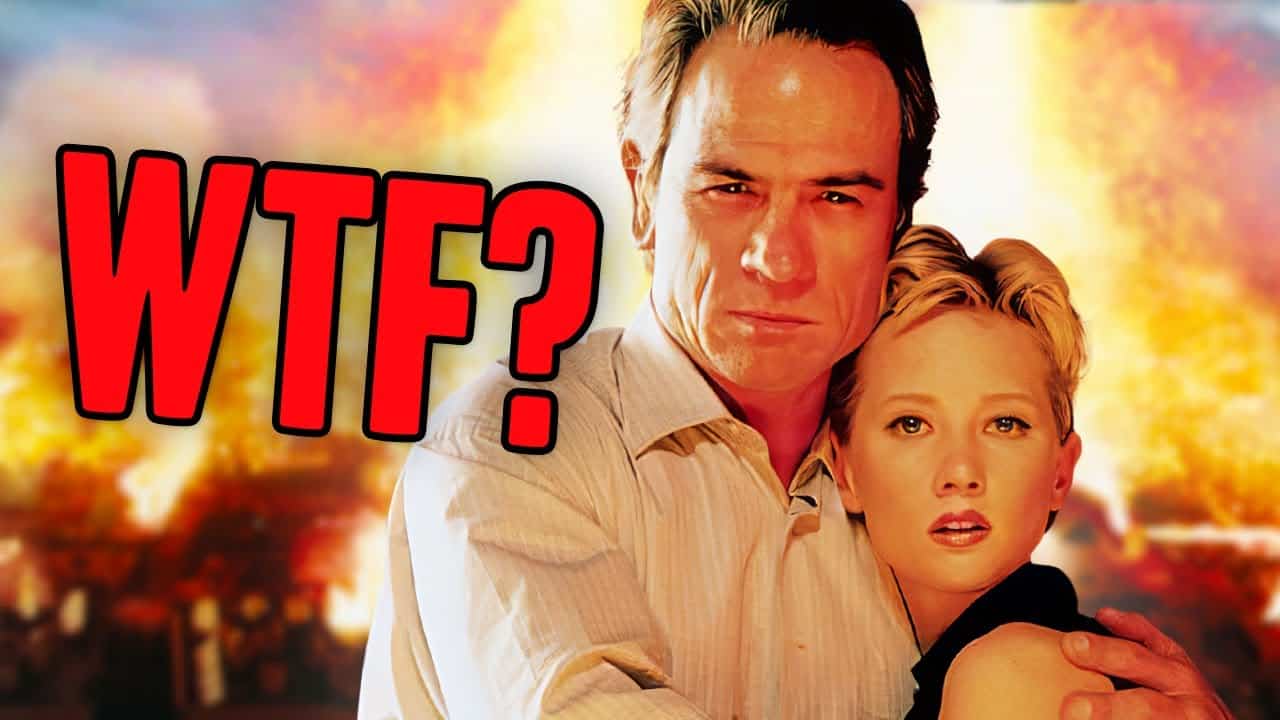
Volcano (1997) – What Happened to This Disaster Movie?
The What Happened to This Horror Movie episode on Volcano was written by Jaime Vasquez:
Disaster movies were having their moment in the spotlight during the 1990s. With bigger budgets, advancing CGI, and A-list actors willing to be upstaged by tornadoes, meteors, and alien invasions, shaky B-movie territory suddenly became an A-list goldmine. 1997 saw the release of not one, but two blockbusters with volcanoes as their primary villains: Dante’s Peak and today’s film, the aptly titled Volcano. It stars a calmer-than-usual Tommy Lee Jones and a fresh-faced Anne Heche, both with the ground literally scorched and torched beneath them as lava tears through the streets of Los Angeles. Volcano premiered to box office success, but the road to glory wasn’t without its own eruptions. Dante’s Peak didn’t just come out the same year; it hit theaters a mere two months before Volcano. So, just how close was the battle between these two rivals, and how do their legacies stack up today? Who was almost cast in the lead role? And what real-life event sparked the story in the first place? Join us as we trek through downtown L.A. to uncover What Happened to Volcano.
Jerome Armstrong, whose sole writing credit is today’s subject, penned the original story for Volcano. He teamed up with writer Billy Ray to turn the large-scale tale into a screenplay. Ray is best known for writing the 2013 Tom Hanks thriller Captain Phillips, which earned him acclaim and even an Oscar nomination for Best Adapted Screenplay. Back in the late ‘90s, he was sharpening those blockbuster instincts, with Volcano being one of his earliest writing credits. On the other hand, director Mick Jackson had already proven he could terrify audiences without ghosts, monsters, or jump scares. In 1984, he directed Threads, a British film about the aftermath of nuclear war. The film had an unflinching, documentary-style approach, and to this day, it’s still considered one of the most disturbing films ever made. Which is especially amazing considering that it was a made-for-TV movie, and it wasn’t intended to be a horror film. A few years later, Jackson switched gears to something more commercial with 1992’s The Bodyguard, the Whitney Houston vehicle that earned global success despite getting lukewarm reviews. The film became the ‘90s blueprint for turning a singer into a movie star, paving the way for other musicians to enjoy cinematic success. On the other hand, it might’ve also inspired glitter-drenched misfires like Spice World and, well, Glitter.
After The Bodyguard, Jackson kept a low profile until Volcano came along and reignited his interest. Upon reading the script, he was drawn to the story’s vast possibilities. He’d already shown he could capture mass devastation with chilling realism in Threads, and deliver mainstream success with The Bodyguard. Volcano gave him the chance to bring those two components together.
Writer Billy Ray explained that at the heart of Volcano’s story is “a city that’s divided on a lot of levels in terms of race and class. People have to put that aside in order to battle a much greater common enemy.” Lofty but admirable goals for a lava movie. Producer Andrew Z. Davis took a more gleeful approach, calling L.A. “a place everybody loves to hate,” and adding, “It’s a great opportunity to see Los Angeles get trashed.” Honestly, it’s a shame that quote wasn’t used as a tagline.
According to IMDb, both Bill Pullman and Ed Harris were offered the lead role, which eventually went to Tommy Lee Jones. Pullman spent the decade running the country during a UFO invasion and living with ghosts. Maybe he needed a breather before he took on a giant crocodile in the following year’s Lake Placid. The studio also considered Bruce Willis, Arnold Schwarzenegger, and even John Travolta for the same part. For the female lead, Sandra Bullock and Gillian Anderson were reportedly among the names mentioned. It’s hard to say how far those conversations went; whether Gillian was yanked off The X-Files set for a screen test, or if someone just yelled “Arnold!!” during a loud meeting. And if Willis had taken the role, well… Die Hard with a Volcano would’ve written itself.
Now pivoting from Hollywood fantasy to real-life events, the story of Volcano was inspired by an actual eruption in 1943. Farmer Dionisio Pulido and his wife Paula reported hearing strange hissing sounds and smelling what they thought were rotten eggs, but ended up being sulfur. The land split open, and within 24 hours, a volcano, now known as Parícutin, had risen 164 feet from the ground, which is about the height of a five-story building. Over the years, it grew to about 1,400 feet tall, roughly the height of One Vanderbilt in New York City, home to the Summit observatory. The eruption lasted nine years, with lava slowly flowing in multiple directions and reshaping the landscape. Three deaths were recorded, surprisingly not from lava, but from lightning triggered by the volcano’s pyroclastic activity. While tragic, the damage was remarkably small compared to what could’ve been, given that entire villages were buried in lava and ash by the following August. Fortunately, residents quickly evacuated after the initial eruption. Parícutin is now considered the youngest of the Seven Natural Wonders of the World, due to its status as the first volcano that scientists studied from birth to its dormancy.The real-life eruption gets a direct mention in the film, when Anne Heche’s character Amy, uses it to challenge the skepticism of Mike, Tommy Lee Jones’s character. Amy’s assistant Rachel defends her theory that the activity beneath the city could be lava. The scene highlights how Amy and Rachel are comfortable hypothesizing while Mike, ever the pragmatist, needs cold, hard facts before he can take action. Which is exactly the kind of role Tommy Lee Jones nails to perfection.
Jones stars as Mike Roark, the head of L.A.’s Office of Emergency Management. Even with a solid ensemble around him, Jones completely owns the movie, delivering a no-nonsense performance sprinkled with just enough warmth that doesn’t veer into Hallmark territory. It’s a nice reminder of why he was one of the most in-demand leading men of the ’90s. Anne Heche plays Dr. Amy Barnes, a perceptive seismologist from the totally real-sounding California Institute of Geological Sciences. While most of the cast is constantly yelling orders and dodging lava, the actress has a standout presence. She does a lot of staring at seismographs and warning people almost a tad too late, but somehow, Heche shows real star potential here. Gaby Hoffmann plays Kelly Roark, Mike’s bad-tempered 15-year-old daughter, who spends the first act of the film figuratively spitting out lava and the rest of the film literally running from it. And there’s some emotional growth stuff.
Long before joining the MCU, Don Cheadle was putting out fires via telephone as Emmit Reese, Mike’s assistant director. Cheadle manages to be funny while keeping his voice of reason intact, proving that in a disaster of volcanic proportions, you want this guy on your side. John Carroll Lynch plays Stan Olber, the quick-witted chairman of the Los Angeles MTA. He makes the most of his brief screen time, bringing emotional levity to the chaos. Amy’s assistant Rachel, played by Laurie Lathem, also gets an intense emotional scene that was tough to film for multiple reasons. Rachel and Amy crawl through the sewers in oxygen suits looking like trick-or-treaters in astronaut costumes. As it turns out, they might as well have been wearing Halloween costumes. Anne Heche revealed she began to hyperventilate from the heat inside the suit, as they didn’t come with the temperature regulation that actual oxygen suits normally have.
Meanwhile, the crew stayed cool (and safe) in Nomex suits, made with the same flame-resistant material used in firefighter gear. About 30 to 40 of these suits were kept handy so everyone could work comfortably in the intense heat.
The main action unfolds on a recreated Wilshire and Fairfax intersection, built at 80% of its original size, and stretching out to 1,700 feet. Constructed on a former McDonnell Douglas plant in Torrance, it was billed as the largest urban set ever built for a film. Some sources also cite San Bernardino International Airport, most likely for interior shots and effects. Either way, after 12 weeks of rebuilding, the crew was ready to burn L.A. to the ground.
The replica was impressively detailed; complete with buildings, lampposts, traffic lights, and just about everything you’d find on the actual intersection. Director Mick Jackson even admitted it was sometimes eerie watching the fake version go up in flames, given how closely it mirrored the real location. Landmarks like the Craft and Folk Art Museum (now known as Craft Contemporary), LACMA, the Petersen Automotive Museum, the May Company building (which is now the Academy Museum), and Johnny’s Coffee Shop (a Googie-style diner that’s still used for filming) all made appearances. And who could forget the La Brea Tar Pits, where the tar starts to bubble and all hell breaks loose.
Mechanical effects coordinator Marty Bresin shared how the crew brought the tar pits to life, without the actual tar. For safety reasons, they used water instead, poured into a hole they dug into the pavement. To mimic the bubbling effect, they relied on an air compressor and a few clever DIY rigs hidden beneath the surface.
Special effects and mechanical effects coordinator Clay Pinney said the goal was simple: create a dangerous world where fire came at the characters from all angles. The essence of the volcano, at least in this movie, was undoubtedly the lava. Getting it right was a process of trial and error, to the point where the crew set up what they called the “lava kitchen.” Basically, it was a makeshift lab where they cooked up test batches until they concocted a camera-ready molten villain. The crew ultimately settled on methyl cellulose; a water-based substance used to thicken fast-food milkshakes. They mixed in dyes and pigments to give it that lava glow, then used lighting tricks to make it look believably hot on camera. The ash was mostly made up of ground-up newspaper, which you can spot clinging to the actors’ hair and clothes in several scenes.
To literally bring the heat, the crew put more than 100,000 feet of piping beneath the set, rigged to ignite flames on cue and pump propane to every window through a precise ignition system. Add in hundreds of pounds of black powder and over 20,000 pounds of propane, and you’ve got a highly impressive man-made inferno. The fire burned so hot that production designer Jackson DeGovia said they had to go back and retrofit the buildings with extra fireproofing; so they could survive multiple rounds of incineration.
Once filming wrapped, the battle was on. Universal Pictures moved up the release date of Dante’s Peak after hearing that Fox was filming the similarly themed Volcano. The tactic paid off: Dante’s Peak landed in theaters first in February 1997, raking in $178 million. Volcano followed two months later, pulling in a still-respectable $123 million. Oddly, most of its earnings came from other territories, with an international total of $73 million, while earning $49 million in the US and Canada. Critically, Volcano outperformed its competitor. While Dante’s Peak sits at a rocky 30% on Rotten Tomatoes, Volcano managed to score a 49%. Not exactly glowing praise, but in disaster movie terms, that’s practically a standing ovation.
Critics may have leaned toward Volcano upon its release, but in the long run, Dante’s Peak stole the spotlight. If you Google Volcano, you’ll find a surprising amount of Dante’s Peak content, with audiences generally favoring the small-town thriller. Volcano benefits from its iconic Los Angeles backdrop, but that real-world setting also came with the pressure of accuracy, while Dante’s Peak had the freedom of a fictional town to play with. Plus, the story benefits greatly from its small community setting, as the danger feels more personal and the stakes feel higher. The central relationship also feels more organic. Pierce Brosnan and Linda Hamilton have a clear will-they-won’t-they arc, whereas the chemistry between Tommy Lee Jones and Anne Heche is left vague. Maybe they’ll grab a drink after the pesky volcano situation, maybe not.
In an early scene, when the chaos is just getting warmed up, a dog is trapped in a burning building. The owners panic as the fire is too intense to run back in and save him. Tension builds and then the dog quickly runs out of the doggy door, and all is well, at least in the scene. In a way, that scene sums up the movie: a taste of danger, a quick escape, and no time sweating the details. Even the film’s stab at tackling race follows that same breezy formula. A racist cop and a Black man settle their differences mid-crisis in a way that’s not exactly cheesy, but it’s in the same ballpark as cheesy. That being said, that low-stakes, crowd-pleaser energy is actually part of what makes Volcano a fun time.
Did anyone walk into Volcano expecting Oscar bait? Probably not. And the movie knows it. It keeps the pace snappy, lets the news reporters dump most of the exposition, and wisely puts the action front and center. In the end, Volcano is a well-oiled disaster machine that didn’t deserve to live in Dante’s Peak’s shadow just because they happened to be released in the same year. Both movies hit similar story beats while managing to be entertaining, and both earn their spot in the glorious pantheon of ’90s disaster flicks. And that, my friends, is What Happened to Volcano.
A couple of the previous episodes of this show can be seen below. To see more, head over to our JoBlo Horror Originals YouTube channel – and subscribe while you’re there!
The post Volcano (1997) – What Happened to This Disaster Movie? appeared first on JoBlo.