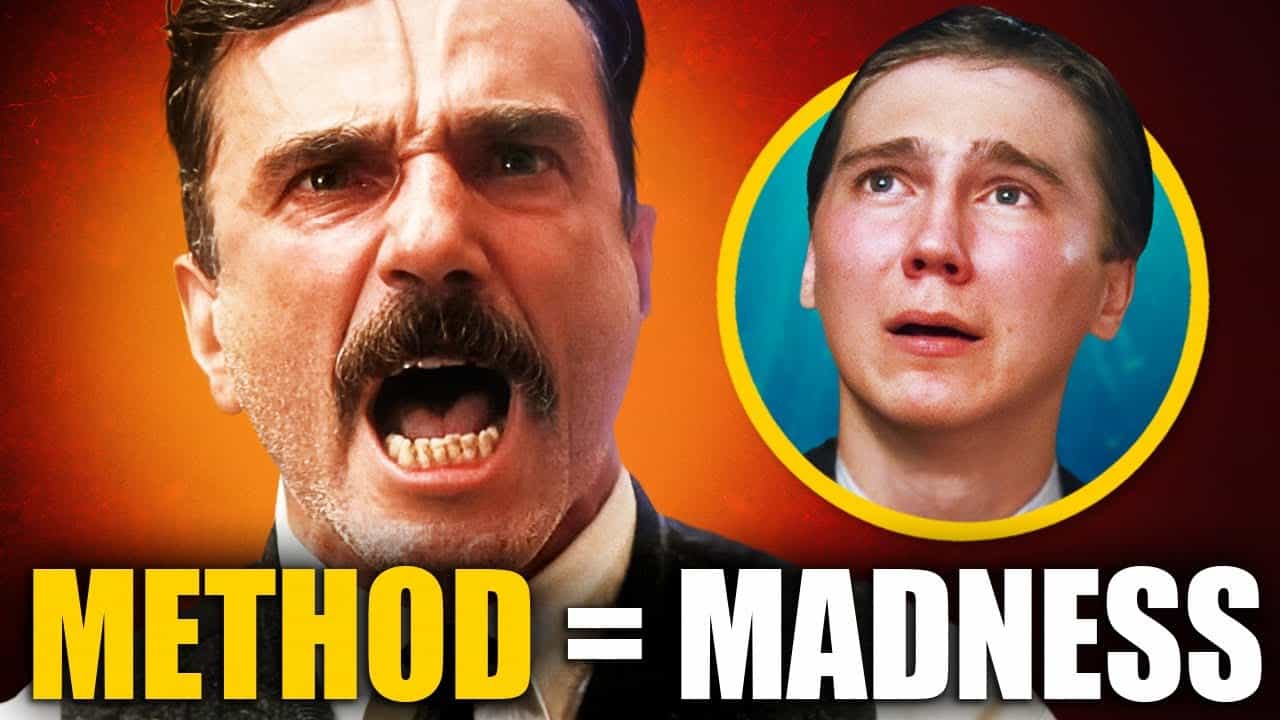
Daniel Day-Lewis: A Dozen Wacky Examples of His Method Acting
Imagine you’re a crew member on a big movie production. It’s your first day on the job, and you’re eager to start your film career. You might carry some cables, move some lights… and spoon-feed or wipe the crumbs from the face of some actor who insists on “going method.” You’ll spend all day catering to his every whim, simply because he refuses to break character—literally refusing to move. Sounds kind of annoying and unnecessary… until you see the results. Many of us would gladly wipe the crumbs off Daniel Day-Lewis’s face, knowing that each crumb would contribute to a masterclass of raw, primal, beautiful cinema. He lives by the mindset that the body must suffer for the soul to speak… or scream. Daniel Day-Lewis has played many men—but in truth, he’s been disappearing one role at a time. Each film takes a piece of him. His story is one of sacrifice and the relentless pursuit of truth. To discover that truth, he has to vanish—like an exorcism, a possession, an untamed shapeshifter devouring himself to create art. It makes you wonder… is there even a “real” Daniel Day-Lewis behind the magnificent, monstrous mosaic of his characters? Tonight: the wild, strange metamorphoses of Daniel Day-Lewis—a man who got so into character that he was once haunted by his father’s ghost during a stage production of Hamlet.
Early Roles & Rise
Many first noticed him in a small scene from Gandhi and a supporting role in The Bounty. But it was My Beautiful Laundrette and A Room with a View—released on the same day—that made the world pay attention. Two films, two totally different characters. In one, he was a punk-rock free spirit full of confidence; in the other, an uptight, awkward Victorian gentleman. On the set of My Beautiful Laundrette, he lived in London’s working-class neighborhoods to absorb his character’s authenticity. In A Room with a View, he refused to break character, maintaining his prim, proper demeanor between takes—a small preview of what was to come. Then came The Unbearable Lightness of Being, for which he learned fluent Czech. And just to show range, he even tried comedy with Stars and Bars.
My Left Foot (1989)
To portray Christy Brown, an Irish writer born with cerebral palsy, Daniel refused to “pretend.” He stayed in a wheelchair even when cameras weren’t rolling, as if he were borrowing the real Christy’s body. The crew carried him, spoon-fed him, and moved him across set hazards. He slumped in his chair between takes, refusing to break the illusion. The result? Broken ribs from maintaining a contorted posture—and an Oscar for Best Actor… back when they actually mattered.
The Last of the Mohicans (1992)
To prepare, he vanished into the wilderness. He learned to hunt, track, skin animals, and build canoes. He refused to eat anything he couldn’t hunt himself. It wasn’t preparation—it was time travel. He even attended family Christmas dinner in character as Hawkeye. After filming wrapped, he reportedly had trouble returning to reality, plagued by Mohican-themed hallucinations.
In the Name of the Father (1993)
For Jim Sheridan’s prison drama, Day-Lewis voluntarily lived in solitary confinement in a real, abandoned prison. He endured real interrogations from real police—some lasting up to nine hours—and encouraged the crew to shout and berate him to replicate the psychological torment of wrongful imprisonment. He slept on a cold cell floor, refused proper meals, and lost 50 pounds in the process. The pain was real—and so was the performance. That same year, he starred in The Age of Innocence, wandering the streets of New York in full period costume like a 19th-century ghost of romance past.
The Crucible (1996)
He refused to bathe, built his character’s house with 17th-century tools, and actually lived in it. Daniel Day-Lewis got so into character that he married the playwright Arthur Miller’s daughter.
The Boxer (1997)
He trained for two years with professional boxers, earning praise from real fighters who claimed he could’ve gone pro. He took real punches, broke his nose, and even got real tattoos. The experience drained him so deeply that he stepped away from acting altogether. After The Boxer, he disappeared from the profession—only to resurface years later in Florence… as a cobbler, making shoes instead of movies.
Gangs of New York (2002)
Martin Scorsese and Leonardo DiCaprio coaxed him out of retirement for this one. Day-Lewis became Bill the Butcher. He apprenticed with real butchers, mastered knife-throwing, and sharpened blades between takes. He even picked fights with strangers on the streets to stay in character. He wore period clothing at all times and refused modern medicine—almost dying from pneumonia in the process. His loyalty wasn’t to comfort, but to suffering. The only modern thing he allowed himself? Listening to Eminem to channel his rage.
The Ballad of Jack and Rose (2005)
Directed by his wife Rebecca Miller, DDL lived alone in a seaside hut, eating tiny vegan meals and isolating himself to understand his character’s loneliness.
There Will Be Blood (2007)
Rumor has it he scared off the original actor playing Eli Sunday, who was replaced by Paul Dano (apparently, Paul could take a real beating—and real bowling balls being thrown at him). Day-Lewis studied turn-of-the-century mining techniques, pored over diaries and photographs, and spent months in isolation to summon Daniel Plainview’s soul. His gravelly voice—a mix of John Huston and oil-soaked greed—was the result of obsessive experimentation. The result? His second Oscar… if you’re still keeping score at home.
Nine (2009)
After all that blood and darkness, Daniel did a musical—for fun! He trained in singing and dancing for five hours a day. I give his performance an 8½.
Lincoln (2012)
He initially turned down the role but eventually vanished into history once again—this time as President Abraham Lincoln. He spent a year preparing: reading over a hundred books, perfecting Lincoln’s voice, posture, and walk. On set, no one called him “Daniel.” Everyone addressed him as “Mr. President.” Even text messages were written as if from Honest Abe himself. It wasn’t cosplay. It wasn’t roleplay. It was reincarnation. And yes—another Oscar.
Phantom Thread (2017)
Good old Danny Lew helped design the wardrobe himself. He apprenticed under a master tailor for a year, learning to cut, stitch, and sew garments by hand. He even recreated a Balenciaga dress from scratch. It wasn’t just acting—it was craftsmanship. He stitched the character together with his own blood, sweat, and thread.
Anemone (2025)
Directed by his son, Ronan Day-Lewis, this film reportedly took four years to develop. The collaboration allowed father and son to connect both artistically and spiritually. Daniel’s motivation this time? Family. Now, maybe he can really, truly retire. But if not—come back anytime, Mr. Day-Lewis. Or, if it makes you happy, keep on cobbling. Bless our right and left feet with finely made shoes… and bless both sides of our brains with finely made films.
The post Daniel Day-Lewis: A Dozen Wacky Examples of His Method Acting appeared first on JoBlo.