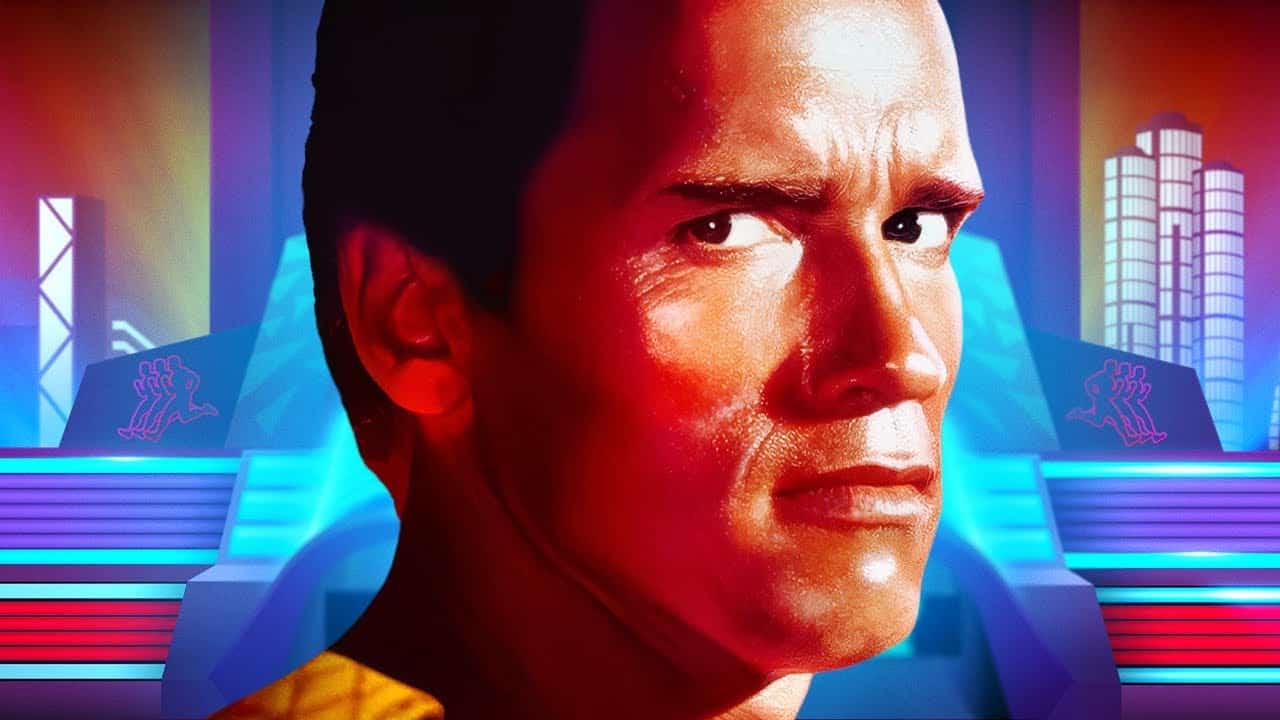
How The Running Man Became An Iconic Action Role for Arnold Schwarzenegger
Picture this: flashing neon lights, roaring crowds, and the clang of steel on steel. Into the chaos strides one man, not just any man, but the man. That man is Arnold Schwarzenegger, and the movie is The Running Man. Released in 1987, this dystopian action- satire fused exploding collars, spandex gladiators, and game-show cynicism into one gloriously bonkers slice of Reagan-era sci-fi mayhem. And with a new Running Man remake/sequel on the horizon, directed by none other than Edgar Wright, it feels like the perfect time to dust off the VHS, crank up the synth score, and revisit one of the most underrated and strangely prophetic entries in Arnold’s filmography.
But what if I told you the real story of TheRunningMan— both on and off camera — is even stranger than the movie itself?
Why does The Running Man matter so much in the evolution of Schwarzenegger’s career? Because it sits right at the crossroads between his “unstoppable muscle-machine” phase and his “self-aware superstar” era. By the time The Running Man hit theaters, Arnold had already conquered the world as Conan the Barbarian, terrified audiences as The Terminator, and squared off with an invisible alien in Predator. TheRunningMan wasn’t just another body-count showcase, this was something stranger, smarter, and more cynical. It gave him a chance to play a wrongfully accused cop, framed for a massacre he didn’t commit, forced into a brutal televised death match where convicts fight for their lives. Instead of pure muscle fantasy, the movie gave Arnold something he’d rarely had before: vulnerability. It was the first real hint that he could carry a story that commented on the spectacle instead of just being..well the spectacle.
Set in the far-off dystopia of 2017 (which, hilariously, no longer feels like the future), TheRunningMan envisions a society numbed by TV violence and state-controlled propaganda. Ordinary citizens watch gladiator matches instead of news, cheering as convicts are hunted down by over-the-top “stalkers” The satire is broad, sure, but also scarily ahead of its time. Long before Survivor, The Hunger Games, or TikTok livestream stunts, The Running Man predicted a world where entertainment and punishment merge into one. And anchoring it all is Arnold’s Ben Richards, a man caught between propaganda and public perception: a reality-TV hero before reality TV even existed.
But let’s be kind and rewind even further for a second and talk about how this fever dream actually came together. Believe it or not, The Running Man started as a Stephen King novel, or rather, a Richard Bachman novel. King wrote it in a single week under his pseudonym, imagining a desperate man competing in a deadly game show to earn money for his sick daughter. The movie, though, barely resembles the book. It takes King’s grim despair and injects it with a full dose of neon-lit 1980s insanity.
Behind the scenes, the production was almost as chaotic as the show within the film. The movie cycled through multiple directors before finally landing on Paul Michael Glaser. Ya know, the guy who played Starsky on Starsky&Hutch. Glaser was brought in late and had to wrestle a massive, effects-heavy shoot into shape. The original director, George P. Cosmatos, left over creative differences, leaving Glaser with just sixteen weeks to shoot and deliver the film. Arnold wasn’t thrilled about that; in later interviews, he complained that Glaser shot the movie like a TV show, which is ironic, given the subject matter. But in a weird way, that quick- cut, over-lit, slightly trashy aesthetic fits the world of The Running Man.
Casting, as always, was a saga of its own. Believe it or not, producers originally courted both Patrick Swayze and Christopher Reeve for the lead role. But ultimately, the studio realized only one man could anchor a premise this insane: Arnold Schwarzenegger. By then, his name alone could sell tickets, and the script was rewritten to better fit his persona. It gives him more one-liners and amping up the physicality. The final result turned what could’ve been grim dystopia into something closer to a gladiator-game rock concert.
And then there’s the movie’s secret weapon: Richard Dawson. Casting the real-life Family Feud host as the sleazy, manipulative showrunner Damon Killian was nothing short of genius. Dawson had spent years smiling at contestants and kissing grandmas on daytime TV, and now here he was weaponizing that charm into pure, oily villainy. He improvised many of his lines, reportedly terrified the crew with his temper, and ultimately delivered a performance so perfectly smug it stole every scene. You believe this man could manipulate an entire nation through television. In a way, he already had. Dawson later admitted he based much of Killian on real network executives he’d known, which just makes the satire hit harder.
Behind the camera, the production was a grab bag of last-minute fixes and creative patchwork. The sets were built fast and reused across sequences. The costume team leaned into garish, logo-covered jumpsuits that now feel like something Balenciaga would sell ironically. And the score, by Harold Faltermeyer, of Beverly Hills Cop, Top Gun fame, pulsated with electronic menace. It’s one of those soundtracks that feels both ridiculous and legitimately great.
And if you think the madness stopped once the cameras rolled — think again. What happened behind the scenes was a show all its own.
One of the coolest trivia bits involves the stalkers. The film’s over-the-top assassins were mostly inspired by wrestling gimmicks and real stunt performers. Jesse Ventura plays Captain Freedom, a retired stalker pulled back into the fray, and you can practically smell the spray-tan and ego. Subzero, played by Professor Torū Tanaka, was an actual professional wrestler. Fireball, portrayed by Jim Brown, was a former NFL legend. It’s The Expendables for people who grew up believing Rollerball was the evening news.
Yet for all its camp, The Running Man actually says something. Beneath the neon, the movie’s got a surprisingly sharp social critique. It skewers the media’s obsession with ratings, the public’s apathy toward truth, and the government’s weaponization of entertainment. Watching it now, it’s disturbingly relevant. The line between news and showbiz has blurred so far it’s practically erased. And when Ben Richards grabs that camera at the end and broadcasts the truth, it’s not just a victory over Killian, but a rare burst of honesty in a world addicted to spectacle.
When it was released in theaters, the movie didn’t make a massive splash. Released in November 1987, it earned modest box- office numbers and lukewarm reviews. Critics called it “loud,” “goofy,” and “uneven.” Arnold himself later dismissed it as one of his weaker efforts. But time has been kind to TheRunningMan. Like so many cult classics, it aged into relevance. Today it plays like an accidental prophecy. Reality TV? Check. Corporate manipulation of truth? Check. Audiences desensitized to suffering? Triple check. What once seemed over-the-top now feels uncomfortably accurate.But what about Arnold? This was the movie that quietly cemented his brand, meaning the ability to turn pure chaos into crowd-pleasing fun. It proved he could be both larger-than-life and self-aware, a hero who knew how absurd his circumstances were but still played them straight. That tightrope walk between sincerity and satire would go on to define his next decade.
There are plenty of juicy behind-the-scenes tidbits that make the film even more fascinating. We’ve previously mentioned that the movie was shot on a tight schedule. It would also have daily script rewrites and constant tension between Arnold and Glaser. Plus, the original ending was darker, Killian’s death was less cartoonish. The studio pushed for a more explosive payoff. And Arnold’s yellow spandex suit? It was so tight he had trouble breathing between takes. Yet somehow he still manages to deliver one of his most iconic send-offs: “Here is Subzero, now plain zero.” It’s dumb. It’s perfect. It’s peak ’80s!
Of course, not everything aged gracefully. Some of the effects are gloriously cheap. The matte paintings shimmer and some of the dialogue occasionally dips into straight parody, excluding Arnie’s perfect one liners. But hey, that’s part of its charm. What’s impressive is how earnestly it commits to its world. The cheesy graphics, the roaring crowd, the fake commercials, they all add up to a universe that feels lived-in, absurd, and disturbingly plausible.
And that brings us back to today because The Running Man is running yet again. In a time when nostalgia reboots are as common as Marvel cameos, this one actually feels earned. Edgar Wright, the kinetic mad scientist behind ShaunoftheDead, HotFuzz, and Baby Driver, is officially developing his new adaptation for Paramount, and film fans everywhere are cautiously optimistic. After all, we’ve seen what happens when studios try to repackage 80s lightning in a 4K bottle…Total Recall, anyone?
But Wright is a different beast. This is the guy who made Scott Pilgrim vs. the World. He’s a filmmaker who understands rhythm, tone, and irony better than almost anyone working today. Every frame of his movies moves to its own beat, and more importantly, every joke or visual flourish serves a purpose. Early word suggests his RunningMan will be closer in spirit to Stephen King’s original Bachman novel. Which means darker, more paranoid, more grounded in its depiction of an oppressive future.
That’s exactly what The Running Man needs in 2025: a story about media manipulation, and the cost of spectacle, told by someone who gets that we’re all contestants now. Our likes, clicks, and followers are the new audience votes. The dystopia TheRunningMan once warned us about? We’re living it, but with better Wi-Fi.
Maybe that’s the real twist — the game never ended. We just stopped noticing the cameras.
Of course, the biggest question on everyone’s mind is: could anyone, specifically Glen Powell, fill Arnold’s shoes? We’d like to believe so. When he steps into that jumpsuit, he won’t just be competing with nostalgia, but be facing down an entire era of moviemaking. Today’s stars might be more versatile, more human, maybe even better actors, but none of them command the screen the way Arnold did simply by existing. But maybe that’s the point. Wright’s version doesn’t need another bodybuilder in a spandex suit; it needs a soul. Someone who can embody that mix of frustration, defiance, and reluctant heroism that made Richards so compelling beneath the muscles.
So as the new version gears up, let’s just hope it remembers what made the original tick. Keep the heart, keep the humor, and please, movie gods…nobody needs a sterile, CGI-filtered remake of something that was already perfectly weird. Thankfully, with Edgar Wright in charge, it feels like The Running Man is in good hands.
So here’s to the original, The Running Man, a movie that started as pulp, evolved into prophecy, and might just be reborn in the hands of a director who understands both. Because in the game of cinematic survival, not every remake deserves a second chance. But this one? This one might just run all the way to glory.
The post How The Running Man Became An Iconic Action Role for Arnold Schwarzenegger appeared first on JoBlo.