WTF Happened to Face/Off?
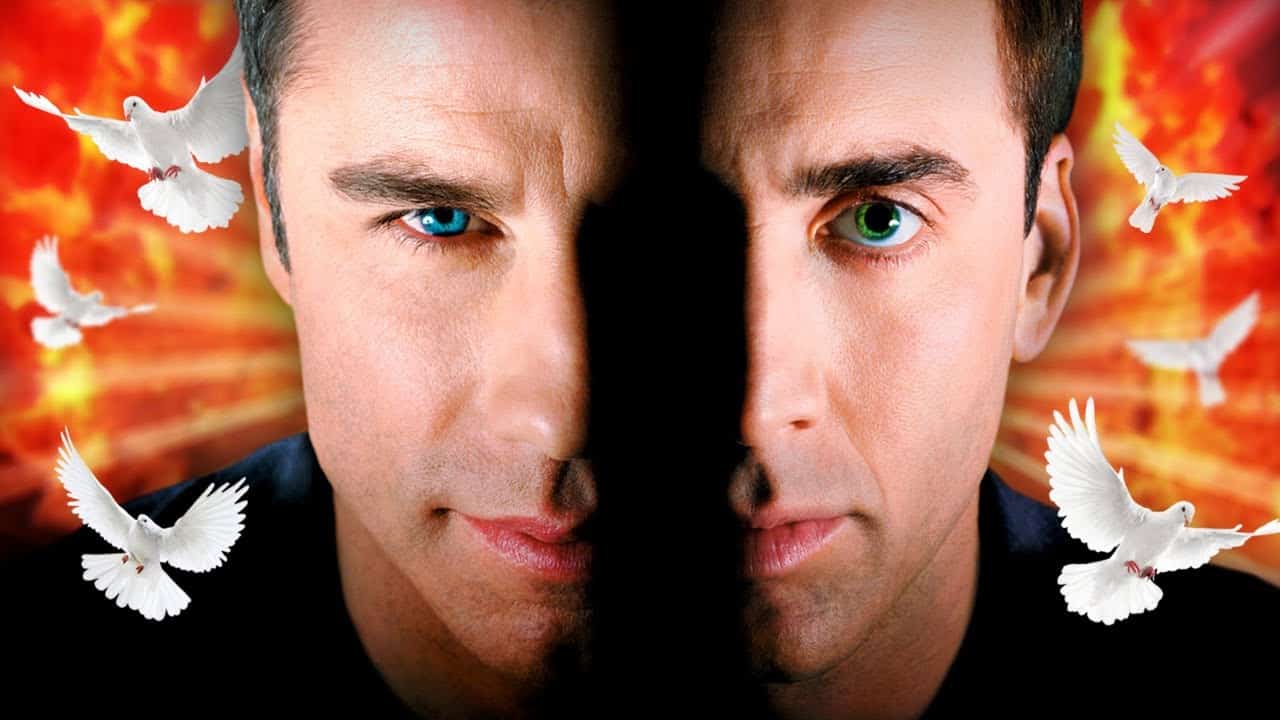
Folks, today we’re talking about Face/Off. In this 1997 action flick, John Travolta plays a federal agent named Sean Archer, who has made it his life’s work to catch his son’s killer and notorious career psychopath Castor Troy — played by Nicolas Cage.
What follows is a game of cat and mouse, but with a twist — Cage and Travolta have stolen each other’s faces using futuristic technology and are on a collision course of epic proportions. But who are we kidding? We expect epic when it comes to John Woo.
But folks, what if I told you that this bombastic spy-vs-spy showdown was the result of a long and rocky road to production that began years before the cameras even started rolling? Because this awesome — if admittedly not perfect — popcorn flick is riddled with roadblocks and behind-the-scenes uncertainty.
So, in today’s episode, we take a look at Face/Off and tell you the story of how this hit movie rose from the ashes and succeeded against all odds. Let’s get into it.
Alright, so Face/Off was released in 1997, but the story of its creation actually starts all the way back in 1990, in Hollywood, California.
Two friends and fellow writers, Mike Werb and Michael Colleary, were shocked to hear that a mutual friend had been rushed to the hospital for surgery after a horrible hang-gliding accident that left him in need of severe facial reconstructive surgery. They learned during this process that surgeons would need to remove their friend’s face to reconstruct the bone underneath — before putting it back on. While Mike and Michael were obviously concerned, their friend ended up being okay — and his story left them with a spark of inspiration.
They decided to write a spec script together that would hinge on the two leads of the story switching faces. The original version of the script even took place far in the future to justify the technology. They also knew they needed an element of action, inspired by White Heat, where an inmate survives a prison riot — something that definitely happens in this movie. Interestingly, that sequence feels the most futuristic in an otherwise fairly grounded film.
With fresh ideas in their heads, they drafted the script and started shopping it around town, hoping they’d written something unique enough to catch a major studio’s interest.
And folks, a major studio they got. In 1991, just months after writing the script, famous producer Joel Silver optioned the rights for Warner Bros.
But there was a problem.
The initial drafts weren’t exactly what WB wanted, so they asked Mike and Michael to rewrite it — adding new elements and removing others. And this went on for years. So long, in fact, that by 1994, after a reported 30 drafts, WB defaulted on the rights, and the Michaels once again found themselves looking for a studio.
Don’t worry — Paramount scooped it up immediately, giving the film an $80 million budget, which was considered high for the ’90s.
Paramount snatched up the rights and pushed the film into pre-production. They were going to make this movie.
They looked at several directors, at one point considering Rob Cohen — but he couldn’t do it because he was working on Dragonheart at the time. By 1996, Paramount found their director in John Woo, a filmmaker clearly capable of handling the material.
Now, when it comes to casting… whew. Sit back and relax, dudes. This is a wild list.
Pairings considered for the Sean Archer and Castor Troy roles (respectively):
• Sylvester Stallone and Arnold Schwarzenegger
• Michael Douglas and Harrison Ford
• Alec Baldwin and Bruce Willis
• Johnny Depp and Nicolas Cage
• And my personal favorite — Mick Jagger and David Bowie
In the end, Cage made the cut as Castor Troy and delivered an absolutely insane performance. The role of FBI agent Sean Archer went to John Travolta, who was enjoying a career resurgence after Pulp Fiction in 1994.
Part of the fun of these two onscreen together is the way they play each other. Because of the face swap, the audience needs to be convinced that John Travolta is not John Travolta — he’s Nicolas Cage inside a John Travolta mask. And Cage is doing the reverse.
So seeing John Travolta trying to give a Nic Cage performance, and Cage giving his best Travolta impression, is equal parts funny and, at times, surprisingly dramatic.
But folks, that’s not all. The performances needed to be there, for sure — but what about the visuals? This is where things had to push boundaries.
SFX maestro Kevin Yagher (who you may know from a little something called A Nightmare on Elm Street) was hired to create some insane practical effects to sell the film’s illusions. The biggest — and by far most mind-blowing — example is that Yagher created two full-scale robotic clones of Cage and Travolta. Basically, hyper-realistic and fully articulated animatronics modeled after the characters, complete with facial tics and blinking patterns to match the real actors.
These were used for the facial transplant scenes, and they look INCREDIBLE to this day. Stay practical, boys.
Both Travolta and Cage have said they felt a disturbing, uncanny sensation interacting with these things on set. They said it made them feel existential — which honestly makes perfect sense.
Now, that’s not to say there aren’t some amazing digital effects used to enhance the illusion. And because they were used sparingly, they hold up just as well. For the face-swapping sequence in particular, you could pull those shots from a modern Hollywood film. Hell, you might even convince someone they were from a James Cameron movie.
Which is funny, because Face/Off was nominated for an Oscar for Best Visual Effects — but lost to Titanic, a James Cameron film.
Filming took place in L.A. and lasted about three months. Many of those days were dedicated to elaborate shootouts, vehicle chases with boats and planes, and several pyrotechnic setups. By the way, shout-out to the prop designer who made those iconic golden pistols for Cage. I bet he still has them. Remember that scene in The Unbearable Weight of Massive Talent where Cage finds Javi’s stash of Cage memorabilia and he’s got the gats? And then later he USES them? Meta moment of the decade.
Apologies for the tangent — back to Face/Off.
During the shoot, an alternate ending was filmed in which Travolta (after receiving his face back) is psychologically scarred by the experience and sees Castor when he looks at his own reflection — leaving the ending far bleaker.
Personally, I prefer the Final Cut ending. It’s clean, earned, and feels good after such an intense ride.
Another notable name behind the scenes is composer John Powell, making his debut here before going on to score The Bourne Identity and several X-Men films. And Hans Zimmer was credited as producer of the film’s score.
I mean, with a budget of $80 million, you better not cheap out on the music, right? And if you ask me, this score is pretty damn good.
Speaking of music, there’s a fun easter egg: you can hear “Over the Rainbow” sung by none other than Olivia Newton-John, who of course played Travolta’s romantic lead, Sandy, in Grease. Does that count as a cameo?
So, after YEARS of writing, rewriting, rights defaulting, studio changes, and hyper-realistic clones, the film was finally completed — and in June 1997, Face/Off was released.
The film became a massive summer blockbuster, bringing in a worldwide total of $245 million — a HUGE win for Paramount. Critically? Well… we all like this movie, don’t we? Same story in the ’90s. It was ALWAYS a crowd pleaser.
Audiences and critics praised the film for its groundbreaking visuals, Woo’s masterful directing, and of course the wildly entertaining performances of the leads. Even Roger Ebert liked this one.
The film received several awards, such as the Saturn Award for Best Director, the MTV Movie Award for Best Action Sequence, and Best On-Screen Duo for Cage and Travolta. Not to mention the award in my household for best use of Nicolas Cage’s raw energy in a movie.
With that, here are some of my personal favorite Cage-isms from Face/Off.
It does make you wonder, though — why wasn’t there a sequel? I’m not saying there needed to be one, but you can’t help wondering why Paramount wouldn’t cash in on such a successful film. Honestly, it’s probably for the best that they didn’t.
That is… until 2019, when Paramount announced a planned sequel following a new cast of characters on a similar in-universe journey. Supposedly Adam Wingard is set to direct, but development details are basically nonexistent at this point… 7 years later.
I think it’s safe to say we ain’t getting a sequel any time soon.
And folks, that’s everything you need to know to get the full picture and decide for yourself what YOU think happened to Face/Off. I hope you enjoyed the story, and as always, let me know in the comments what you think of this movie, how you think it holds up, and whatever else you want to tell me!
The post WTF Happened to Face/Off? appeared first on JoBlo.