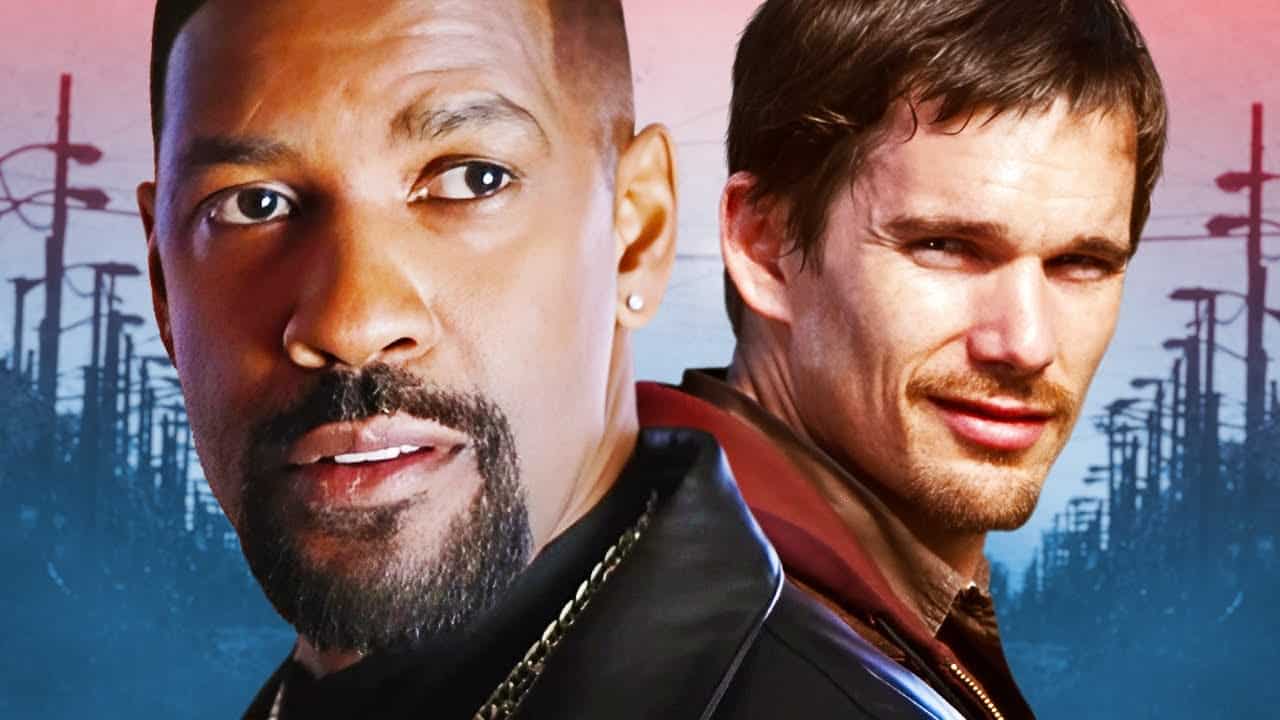
Why Training Day Became the Blueprint for Modern Crime Thrillers
You think you know a cop movie? Think again.
What if the real danger isn’t on the streets—it’s sitting next to you in the driver’s seat?
Here’s the setup: a rookie narc on his first day, eager and idealistic. Then in walks his new mentor—slick, charming, and dangerous. The kind of cop who seems to run the streets, the system, and maybe even you. From the moment he opens his mouth, you’re locked in.
Welcome to Training Day—the movie that twisted the buddy-cop formula into a full-blown moral nightmare. It’s the film that turned Denzel Washington from America’s most respected hero into its most magnetic villain and permanently changed how Hollywood looked at power, corruption, and survival.
Released in 2001, Training Day was a shot of adrenaline straight into the cop-thriller genre. Directed by Antoine Fuqua and written by David Ayer, it stripped away ’90s action gloss and dropped us into one relentless day in Los Angeles. Ethan Hawke plays Jake Hoyt, the eager rookie who doesn’t realize he’s being pulled into moral quicksand. Denzel Washington is Detective Alonzo Harris, a decorated narcotics officer whose charm is as lethal as his gun. What’s supposed to be a day of learning becomes a descent into hell.
Why Denzel’s role mattered
What made Training Day such a turning point—especially for Denzel—is how violently it shattered expectations. Before this, he was the gold standard of righteousness: Philadelphia, Malcolm X, Glory. He was America’s conscience. But here? He doesn’t just play a villain—he plays a charismatic monster you can’t look away from. It was a huge gamble, and it paid off big.
The movie’s messy road to the screen
David Ayer wrote the script in 1995, inspired partly by the LAPD Rampart scandal—a real corruption case involving planted evidence, stolen drugs, and framed suspects. The script bounced around Hollywood for years. At one point the studio eyed Samuel L. Jackson and Bruce Willis. Another draft considered Eminem as the rookie before he bailed to make 8 Mile. Eventually, Antoine Fuqua took over, bringing his gritty, music-video precision and turning the film into something timeless.
Fuqua wanted realism over Hollywood fantasy. He shot on location in the actual neighborhoods the story takes place in. The production worked with local residents, real gang members, and street advisers to ground everything in authenticity. Many on-screen “extras” were just locals. They even had to negotiate with gang leaders to shoot in certain areas. Denzel, ever the perfectionist, studied real LAPD narcotics officers and based Alonzo’s look on Rafael Pérez, one of the central Rampart figures. He even carried a real badge and gun between takes to stay in character—and you can tell.
The film’s tension
There’s electricity in Training Day that most thrillers only dream about. From the moment Jake gets into Alonzo’s black Monte Carlo, the movie becomes a psychological cage match. Alonzo tests him, manipulates him, exposes him to danger, and chisels away at his morality. When he forces Jake to smoke that laced joint “to prove he’s not a rookie,” the tension is bone-deep. It’s not about drugs—it’s about domination. And the deeper the day goes, the more Jake realizes he isn’t learning police work; he’s learning corruption.
Denzel’s unforgettable performance
Denzel is the engine that drives the film. Magnetic. Terrifying. Effortlessly cool. Every line drips authority. Every smirk hides a threat. Alonzo isn’t just a crooked cop—he’s a prophet of power, preaching survival. He struts through the story with diamond chains, a crooked grin, and a voice like sin wrapped in silk. When he hits the iconic “King Kong ain’t got nothin’ on me!” you know you’re watching controlled chaos at its finest.
Critical acclaim and Oscars
When Training Day premiered, critics immediately recognized its power. It wasn’t just a cop movie—it was an acting showcase wrapped in a moral nightmare. Ethan Hawke matched Denzel beat for beat, grounding the film in conscience and fear. Their chemistry crackles, making every scene dangerous.
Awards season? The movie crushed.
Denzel won the Academy Award for Best Actor—only the second Black actor ever to win that category after Sidney Poitier. Hawke earned a Best Supporting Actor nomination. Denzel’s win was more than recognition—it was a statement. Audiences and critics were ready for complexity. He proved a Black actor didn’t need to play a saint to earn the industry’s highest honors.
Industry impact and ripple effects
Training Day redefined cop thrillers. It made audiences question authority, morality, and themselves. It blended the realism of Serpico with the swagger of Scarface while keeping viewers glued to the screen for two unbroken hours.
The success supercharged the careers behind it. Fuqua went on to make Tears of the Sun, Shooter, and The Equalizer trilogy—Denzel’s only sequel franchise. Ayer moved on to End of Watch and Fury, spiritual cousins to Training Day in tone and authenticity. And for Denzel, this kicked off a new era of complex antiheroes—Man on Fire, American Gangster, Flight, and The Equalizer all trace back to Alonzo Harris.
The authenticity that made it timeless
The neighborhoods in Training Day aren’t just settings—they’re living characters. Fuqua shot in real locations like Imperial Courts and Baldwin Village, areas seldom shown in mainstream cinema. Locals were hired as extras, advisers, even security. The result is a film that doesn’t just look real—it is real, which charges every quiet moment with danger.
Behind-the-scenes trivia
Denzel initially turned down the role, nervous about playing a villain after so many heroes. Ethan Hawke, meanwhile, rode with real narcotics officers to understand how idealism dies on the job. Their opposite prep styles make perfect sense: one grounding the film in reality, the other elevating it into myth.
Despite releasing less than a month after 9/11, Training Day opened at number one and earned over $100 million worldwide on a $45 million budget. Roger Ebert gave it four stars. The New York Times called it “an urban western disguised as a cop thriller.” Fans quoted it for months.
Legacy and cultural impact
Over time, Training Day has become a cultural landmark. Alonzo Harris now ranks among cinema’s greatest villains. The film inspired shows like The Shield and even a short-lived Training Day TV adaptation. But none captured the same lightning-in-a-bottle magic.
The movie helped usher in an era of “prestige grit”—adult R-rated dramas mixing character study with genre intensity. It reminded Hollywood that audiences crave flawed heroes and believable villains. It also solidified Denzel as one of the greatest living actors.
Why it still hits today
Training Day endures because its world never disappeared. Corruption, ego, performative morality—it’s all still here, now with body cams and hashtags. The film’s questions about service, protection, and power feel more urgent than ever.
The big picture
Training Day is more than a thriller. It’s a study in temptation—how power corrupts, how charisma manipulates, how good men can be broken. Morality isn’t a ladder; it’s a loop, and eventually, you meet yourself coming back around.
By the end, Training Day didn’t just earn Denzel an Oscar—it cemented his legend. He turned a crooked cop into a Shakespearean villain with swagger, rhythm, and unforgettable presence.
Lightning like that rarely strikes twice. There’s only one Denzel and only one Alonzo Harris. And as Alonzo might’ve said: you wanna go toe-to-toe with greatness, you better bring more than a badge—you better bring a prayer.
Because the scariest part isn’t that Alonzo Harris existed.
It’s that we still keep meeting him.
Just in different uniforms.
The post Why Training Day Became the Blueprint for Modern Crime Thrillers appeared first on JoBlo.