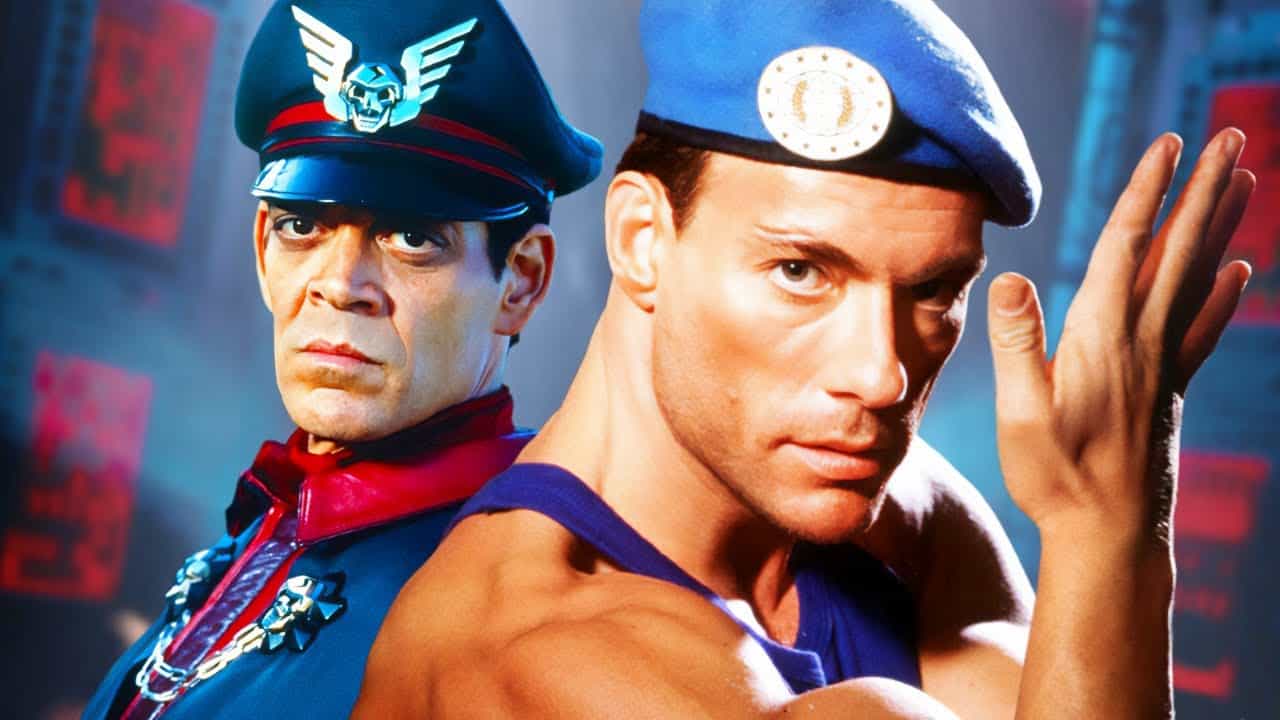
Were the critics wrong about the 1994 Street Fighter movie?
The upcoming Street Fighter movie reboot recently revealed its cast and teased some of the looks of the characters from the film. It remains to be seen how they’ll blend the tone of the game into a new feature, but prior to this newer live-action interpretation, a movie from 1994 attempted to bring the game to the big screen for the first time (not counting Jackie Chan’s nod in 1993’s City Hunter). The 1994 film is the Jean-Claude Van Damme vehicle from Universal Pictures, which is a movie that has a divisive reputation among audiences and fans. Today, we take a look at it from a different angle. While it may not be a faithful Street Fighter film, I submit to you that it could actually pass for a fun satire of a megalomaniacal wannabe dictator. So, let’s break it down!
The Game Vs. The Movie
Street Fighter in arcades:
Street Fighter. In the arcades, it was pure adrenaline — bright characters, chaotic gameplay with novice-friendly button-mashing action and iconic animation and music. When Hollywood announced a live-action movie in the early 90s, and that Van Damme would be starring in it, it didn’t seem like things could easily go wrong. After all, Van Damme starred in Bloodsport, which was a martial arts tournament movie with plenty of fighters of varying backgrounds and styles. It was basically a more grounded version of Street Fighter.
Movie changes:
However, instead of a tournament story, audiences ended up with a chaotic hostage-rescue plot, starring Van Damme as the all-American Guile and Raul Julia — in his final role — as General M. Bison. Critics and fans complained that the movie felt overstuffed by trying to juggle too many characters at once. The consensus was that the dialogue leaned cheesy, the fights lacked the impact of the games, and the tone swung awkwardly between straight-faced action and unintentional comedy.
Character adaptations:
While it looks like characters were adapted from game to movie, it’s only on the surface, and for some characters, it’s only a passing resemblance. So, here are the main differences of the game vs the movie. The heart of Street Fighter II, in which the movie was based, was a world martial arts tournament. Each fighter traveled the globe to compete, each with their own motivation — some noble, some selfish. In the movie, however, instead of fighters gathering for a competition, the story is a hostage rescue mission. M. Bison is rewritten as a warlord in the fictional country of Shadaloo, who kidnaps 63 Allied Nations relief workers and demanding a huge ransom.
Key character shifts:
In the Street Fighter II video game, Ryu, is actually the protagonist and Guile is more of a supporting character. Ryu and Ken are similar warriors seeking strength and honor, whereas in the movie, Ryu and Ken are reimagined as small-time hustlers. Actors Byron Mann and Damian Chapa are in their own buddy-comedy that’s set against the war backdrop. In the game, the character of Chun-Li is an Interpol agent avenging her father, whereas in the movie, she’s a reporter on the frontlines, but her vengeance backstory is somewhat intact. In the game, Guile is a soldier whose out for justice for his friend, Charlie, whereas in the movie, he’s leading the Allied Nations’ rescue for the hostages. In the game, M. Bison is a mysterious crime lord running the Shadaloo syndicate from the shadows, whereas in the movie, he’s a comically over-the-top Bond villain of sorts. But we’ll get to him later…
Supporting cast changes:
The rest of the supporting fighters from the game have their various motivations to enter the tournament, and they would be the ones who are more restructured to fit the film’s plot in a myriad of supporting roles.
The Difficult Production of the Film
Street Fighter was screenwriter Steven E. de Souza’s directorial debut. He had previously written some of the most notable action movies from the 80s, including 48 Hrs., Commando, The Running Man and the first two Die Hard films. Street Fighter was supposed to be his big leap from action screenwriter to blockbuster director. Instead, it turned into one of, if not the most difficult productions of his career, thanks to a mix of corporate pressure, impossible deadlines, and on-set chaos.
Capcom pressures and deadlines:
Capcom, the company who makes the games, financed the movie and they gave de Souza a huge challenge right from the start: he had to write, cast, and shoot the entire film in less than a year so it could hit theaters by Christmas 1994. That tight schedule meant there was no time for rehearsals, rewrites, or reshoots. The production began filming in Thailand and Australia before the final script was even locked. Capcom would also constantly breathe over de Souza to ensure he met their ever-changing requirements by adding or removing characters, costumes, and props to match merchandising plans.
Star complications:
Additionally, Van Damme and Raul Julia consumed a large chunk of the film’s $35 million budget, leaving little for fight choreography or effects (which are pretty important for a martial arts fantasy property). Both the lead stars would also present their own challenges during shooting. Van Damme was at the height of his fame at this time and also at the height of the indulgence in his fame. Reports were that Van Damme was incredibly unreliable behind the scenes, where he would either show up late or not at all and de Souza was forced to shoot around him. He was also said to be high on cocaine the entire time. He’d get distracted from work or be dealing with personal problems. Meanwhile, Julia was in a fragile physical state at the time as he battled stomach cancer. He was incredibly thin, but throughout shooting, he did start putting weight back on, so his more physically demanding scenes were pushed to later in the schedule.
On-set conditions:
Filming conditions were said to be hell too. Shooting on location in Thailand meant facing extreme heat, difficulty with transporting equipment, and inexperienced local crews slowing everything down. Fights were shortened or improvised on set because of time constraints. De Souza later admitted he had to shoot up to four units simultaneously just to finish on schedule, bouncing between them by boat and radio. In interviews, de Souza described the experience as “a battle on every front” — between Capcom’s merchandising interests, studio politics, star egos, and the ticking clock.
De Souza’s Vision
So, whenever screenwriters adapt from source material to feature film, they have the job of condensing lore and changing things around for dramatic purposes if need be. It’s happened countless times with books. It was still a relatively new practice of bringing video games to life on the big screen with Super Mario Bros. hitting theaters just a year prior in 1993. There wasn’t a Batman-type of movie that provided the kind of blueprint for videos game adaptations as there were for comic books. Super Mario Bros. was an infamous dud and the Double Dragon movie that was released a month prior to Street Fighter also failed to make any kind of waves.
So, while the video games Street Fighter and Street Fighter II had enough plot to serve as a jumping off point, De Souza didn’t want to make a film that simply mimicked the game’s tournament setup. He felt that structure was “schlocky” and over-used. He wanted more narrative weight, more of a mission/plot beyond just fights. The plan was to turn M. Bison into a supervillain with grandeur rather than the game’s somewhat mysterious crime boss. Capcom agreed with this direction. De Souza wanted stakes beyond just individual duels: war, ethics, political danger. According to De Souza in a 2015 interview with the Bristol Bad Film Club, he explained, “Capcom had a long range plan where M. Bison would be a Bond-like villain, and sent me blueprints for his underground lair … I followed their plans of going in a Bond direction.”
The Satire of a Megalomaniac
With the film looking to appeal to players of the game, namely kids and teens, De Souza opted to bring some humor to the film. While there’s definitely plenty of unintentional humor to laugh at, the writer/director says that comedy was always part of the plan. On a recent rewatch, it was surprising how predominant the comedy actually is. I’m sure those who are really initiated with the film wonder how anyone could miss it. However, much of the reception with Street Fighter had been bogged down by the disappointment of not respecting the source material. Additionally, some jokes were subtle and had gone over my head as a kid, I caught them this time around. To appreciate this vision, you have to look at the film with the angle that it’s a satire instead of a Street Fighter II adaptation.
Raul Julia’s performance:
First and foremost, a big reason the angle is successful is because of the immaculate performance by Raul Julia. Julia was known to be ill at the time, but the actor, who had recently been seen in the popular Addams Family movies, took on the role of Bison for his children, who were big fans of the game.
Comedic beats in the film:
While purists probably wouldn’t have minded if there had been an appropriate amount of levity, there still is a lot of broad humor that I feel can be appreciated on its own. There’s a fun little bit with Ryu and Vega that plays on Vega’s narcissism. Vega soaks up the attention of an underground fighting crowd, which includes swooning women with signs. But when Ryu’s physique is revealed, Vega catches wind of a woman who loses interest in him, throws away her sign and it annihilates him! Also, watching this now as an adult, I do find Zangief’s simple-mindedness to be amusingly charming (“Quick! Change the channel!”). There’s plenty of cheese and Naked Gun-type visual gags, like Zangief and E. Honda fighting on a scale model with Godzilla sound effects playing over it. A lot of these can be hit or miss, but I found it to be quite entertaining for what it was.
Julia’s theatrical Bison:
The real star here is Julia with how he handles Bison. Early in Julia’s career, he had ample experience doing Shakespeare and a number of other theatre productions, so his theatrics really come through in Street Fighter. He looked to be in on the joke and gave his character a dramatic flair that hilariously showcases the character’s ego.
Bison feels like part Stalin, part Bond villain, part televangelist. Julia knows he’s in a campy video game movie—but he treats the material like grand theater. Never really mocking the role—he’s elevating it, giving this absurd tyrant the full gravitas of Macbeth.
Meme-worthy moments:
People have kind of caught on to it, as one of the current popular memes born from the movie is Bison’s “It was Tuesday” speech. For those who aren’t familiar, there’s a scene where Bison takes Chun-Li into his private quarters, obviously wanting to seduce her. He even makes himself comfortable by cartoonishly changing behind a dressing screen. Chun-Li reveals that she’s seeking vengeance on Bison after pillaging her home and killing her father in the process. Bison then gives a speech about how that day was the the most important of her life due to the horrific events. “But for me, it was Tuesday.” Chun-Li’s reaction is straight out of a Naked Gun whenever anyone interacted with Frank Drebin.
The Bison persona escalates:
And that’s just one example of Bison’s superiority complex. I don’t want the video to simply become a clip show, but there’s no other way to showcase just how funny this angle is without cutting to certain scenes. Julia plays Bison with the perfect kind of dry humor, like the scene where he’s making plans for his capital city — “I think the food court should be larger. All the big franchises will want in.” Bison’s number 2 is Dee Jay, who is a far cry from his video game counterpart, and played here by Miguel Nuñez Jr. Throughtout the movie, Dee Jay sticks by Bison and witnesses every speech, every strange decision firsthand, and always gives a hilarious side-eye to his boss. He makes no attempt to hide his ambivalence.
Bison’s delusions of grandeur:
Bison’s narcissism knows no bounds as everything he wants to build is steeped in the very image of him. He wants his capital city called “Bisonopolis” in his totalitarian world named “Bisonica” where they spend the “Bison Dollar.” He’s even arrogant enough to preemptively use Bison Dollars in his dealings with other figures before its worth anything.
Finale madness:
It all culminates in a surreal finale where Bison is somehow given the powers of super-conductor electromagnetism. And he feels he’s finally achieved what he calls “godhood.” Julia is totally unhinged in the finale and it’s an incredible tour de force. “For I beheld Satan as he fell from Heaven. LIKE LIGHTNING!”
Final Thoughts
It’s messy, yes. It’s cartoonish. But it’s also funny—and often, intentionally so. And in the end, it won’t satisfy anyone who’s looking for a close adaptation of the video game. That wound would only get salt poured on it when the Mortal Kombat movie opened a year later and pleased fans by staying pretty true to the story and tone of the source material. Street Fighter may not have fared as well, but now that a new one will make attempt to capture the game, perhaps we can look back on this movie with a different sensibility.
Plus, despite the hectic production, the movie could’ve turned out far worse. Cue Street Fighter: The Legend of Chun-Li.
The post Were the critics wrong about the 1994 Street Fighter movie? appeared first on JoBlo.