Warlock III: Straight-to-Video Chaos, Hellraiser Vibes, and Unexpected Charm
Warlock III: The End of Innocence is one of those horror sequels that gets dismissed as a pointless late-’90s straight-to-video afterthought. But honestly, it has more charm than it gets credit for. While turning movies into franchises certainly isn’t unique to horror (just look at James Bond, Marvel, DC, or even Fast & Furious), the genre is absolutely the king of endless sequels. Sometimes this makes sense. Halloween, Friday the 13th, A Nightmare on Elm Street, those franchises (mostly) stayed profitable with genuine fan appeal. But then we also get the absurdly long lines of The Howling, Children of the Corn, and Hellraiser sequels that never sniffed a theatrical release. And speaking of straight-to-video oddities, today’s movie, Warlock III: The End of Innocence, gets unfairly tossed aside as a “nothing burger,” when in reality it’s watchable, weirdly charming, and far more entertaining than its reputation.
The Warlock Series: A Quick Overview
Like many horror franchises, Warlock started with theatrical hope and ended in the land of video-store goblins. The first film (Warlock, 1989) made just over $9 million on a $15 million budget. Not great, not terrible, but it performed strongly on VHS and LaserDisc. The sequel, Warlock: The Armageddon, pulled in around $4 million on a budget somewhere between $3.9 and $6.5 million. Again, not hits, but solid on home video. Then things got weird.
We got a Warlock video game on Sega Genesis and Super Nintendo in 1995, four years after the second film. And then, in 1999, Trimark released Warlock III straight to video on a drastically slashed $2 million budget. And yes, it definitely made that back.
New Team, New Warlock
Trimark couldn’t get the original directors (Steve Miner, Anthony Hickox) or the series’ iconic star, the late great Julian Sands. Maybe it was the long gap, maybe the budget, maybe nobody cared to revisit this franchise. But Trimark still owned the distribution rights, so a third film happened.
The script comes from Eric Freiser and Bruce Eisen. For Eisen, this is his only writing credit, though he did help produce fun DTV horror sequels like The Dentist 2, Leprechaun in the Hood, and Sometimes They Come Back… For More. Freiser wrote and directed the movie, though he didn’t have much else in the tank career-wise.
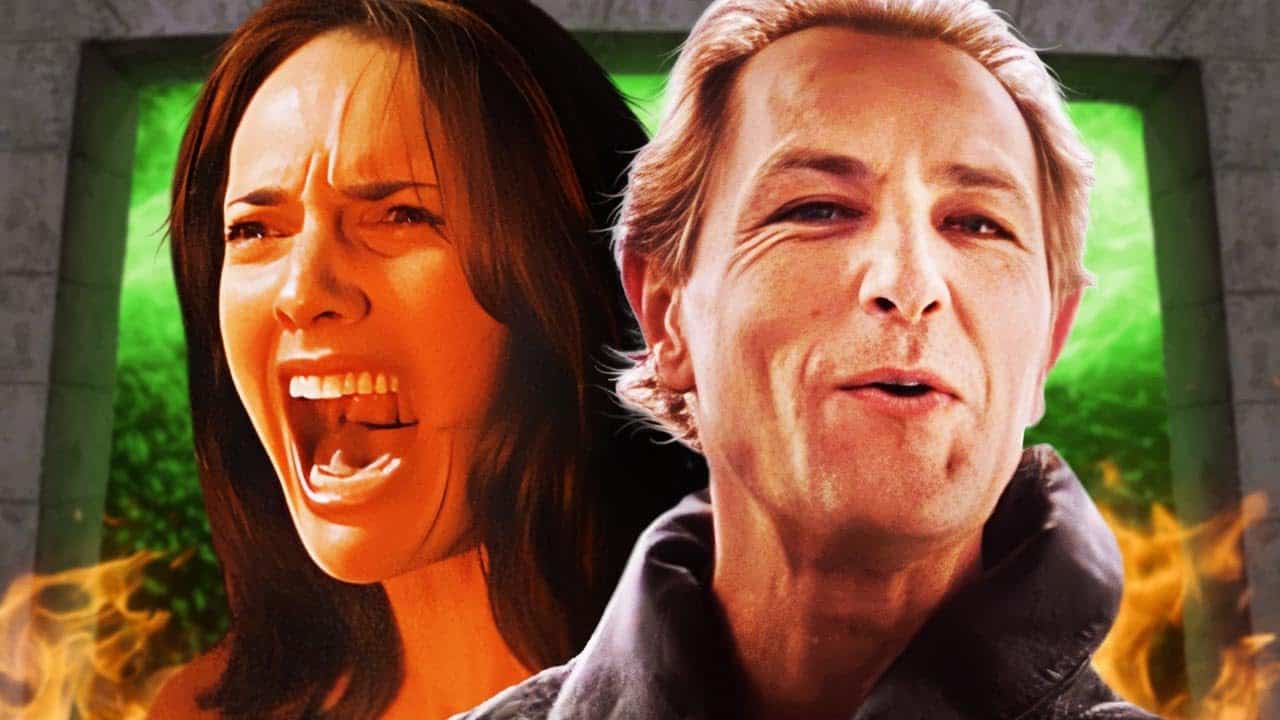
Replacing Julian Sands required tweaking the character entirely – and honestly, Bruce Payne does his own thing with the role. Gone is Sands’ subtle menace; in its place is Payne’s overtly evil, slick, slightly Pinhead-ish charm.
Payne’s career has been wild. He had tiny early roles like in The Keep, major turns like Passenger 57, and worked on plenty of straight-to-video horror movies, including Howling VI and Necronomicon. The rest of the cast is full of fun “that guy/that girl” actors, but the standout is Ashley Laurence, our beloved Kirsty from Hellraiser. She instantly makes the movie more fun. Oddly enough, she and Payne barely interact, but when they’re on screen, the film wakes up.
Is This… a Recycled Hellraiser Script?
This movie technically takes place in the same universe as the first two films, though this Warlock is a different entity, not a simple recast.
The plot follows college student Kris (Ashley Laurence), who inherits a giant mansion from family she never knew. She brings her boyfriend and her group of very “late-’90s horror sequel” friends: the witchy girl, the insecure guy, and of course, someone with frosted tips. A historian shows up to provide exposition and warn them about the Warlock sealed in the house… until the boyfriend accidentally frees him by fixing the pipes.
And here’s my theory: This was absolutely a Hellraiser script at some point. I can’t prove it, but the clues are there:
The villain feels WAY more like Pinhead than the original Warlock.
Ashley Laurence is the lead.
Every friend who dies ends up in Hell.
The bookend sequences (past-life ties, ghost mom, sacrifice themes) scream Cenobite drama.
It has Wishmaster energy too, but structurally? It’s Hellraiser-ish as hell.
The Backstory and the Kill Parade
Kris discovers she has a past-life connection to the Warlock. Her mother originally trapped him in the mansion, and now Kris must finish the job.
Before her friends arrive, the film gives us a solid stretch of Ashley Laurence wandering the haunted house, a great reminder of how strong she is as a horror lead. Once the Warlock is freed, the killing begins:
The historian gets the classic Payne combo of witty one-liners and a corresponding gory death.
The witchy friend gets frozen and shattered.
Throats are ripped out.
People get “naked tortured” (the best kind, as we all know).
And honestly, the effects are WAY better than late-’90s DTV should allow.
The throat rip works, the ice shatter works, even the burn makeup looks cool on Jerry when he’s tempted to betray Kris.
Kris eventually discovers the truth through letters and confrontations, but she’s trapped in the house while her friends either betray her or die horribly. Jerry is the most tragic; secretly in love, manipulated by the Warlock showing him fake footage of Kris saying awful things. And yes, she did say them. Her denial is one of the movie’s best moments.
Final Battle and Bonkers Ending
The final showdown gives Bruce Payne a genuinely great villain monologue, though it’s hilariously undermined by an eagle sound effect the movie uses like twenty times. Kris stabs him with a knife hidden in her childhood doll, which turns him into a Jim Henson creature before he dies. She gets a pep talk from ghost mom and finds tarot cards that basically give her girl-boss powers.
Then she walks out like she didn’t just experience trauma, lose all her friends to Hell, and defeat a centuries-old demon. Just another Tuesday.
Final Thoughts
Warlock III: The End of Innocence (or Wishmaster Returns to Hellraiser, as it spiritually feels) is not a great movie. The music is annoying, most of the acting is rough, and that eagle sound effect could kill you in a drinking game. But it has charm. Ashley Laurence and Bruce Payne are absolutely worth watching, and the kills/effects hit the horror-hound sweet spot.
It’s not a good Warlock movie, but it’s undeniably the black sheep of the series, and a surprisingly worthwhile entry for your horror-movie marathon.
A couple of the previous episodes of The Black Sheep can be seen at the bottom of this article. To see more, head over to the JoBlo Horror Originals YouTube channel – and subscribe while you’re there!
The post Warlock III: Straight-to-Video Chaos, Hellraiser Vibes, and Unexpected Charm appeared first on JoBlo.