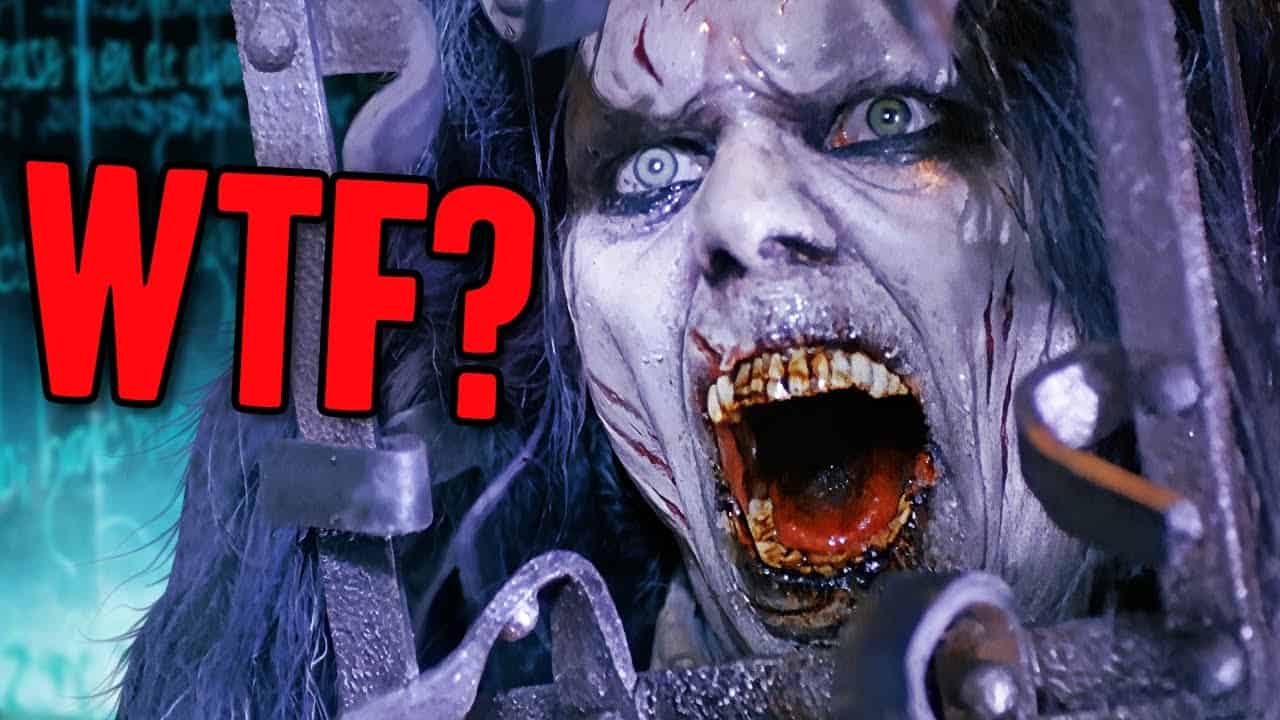
Thirteen Ghosts: How a Critically Hated Horror Movie Became a Cult Classic
We’d all like to leave something behind when we leave this world. Preferably a large bank account for our loved ones and some good memories. Maybe not twelve murderous ghosts inside a gigantic glass house that requires someone to sacrifice themselves to open a knowledge portal into Hell. But hey, who knows what your interests are? Today we’re talking about a film that was hated by some viewers and almost all critics upon release, and how the very things it was hated for are exactly why it’s a fan favorite almost twenty-five years later. A movie that exists because of a powerful producer’s love for architecture and stylish bank commercials, and nearly didn’t happen because the director of one of those commercials wouldn’t stop asking for script changes. This is what happened to one of the wackiest horror movies you’ll ever see, and a staple of early-2000s horror: Thirteen Ghosts.
The Birth of Dark Castle and a William Castle Remake
Joel Silver, Robert Zemeckis, and Gilbert Adler founded Dark Castle Entertainment with the explicit goal of reworking films from legendary showman William Castle. After remaking House on Haunted Hill, they decided their next project would be Thirteen Ghosts.
This wouldn’t just be a remake of a movie, but of a full theatrical experience. Castle’s original 1960 release used a gimmick called “Illusion-O.” Audience members were handed viewers with a red and a blue rectangle, similar to early 3D glasses. When prompted, they could look through the “Ghost Viewer” to see the ghosts on screen. If things got too scary, they could switch to the “Ghost Remover” and make the ghost disappear. Honestly, it sounds like a blast. Shame they don’t make these for that one family member at Thanksgiving who won’t shut up about politics. You know the one.
Writing the Script… Then Losing It
Writer Neal Marshall Stevens had recently written a script called Deader, which he describes as a hot Hollywood property with multiple studios interested. The script ended up being reworked into a direct-to-video Hellraiser sequel, but that initial momentum led him to hire an agent, and soon after he was sent by Dark Castle executive Susan Levin (now Susan Downey) to pitch his take on Thirteen Ghosts.
The pitch landed, but with complications. Stevens’ version didn’t include a modern update of the Illusion-O gimmick, something Joel Silver was eager to figure out. Dark Castle even hired Industrial Light & Magic to explore a way to make the gimmick work in theaters and on home video, but physics and reality quickly shut that idea down. Instead, Silver approached Stevens with a different vision. A fan of innovative architecture, Silver had recently visited the glass-heavy planetarium at the American Museum of Natural History in New York. Inspired by its design, he wanted the movie centered around a house made almost entirely of glass.
After four months and several drafts, Stevens delivered a script that felt ready for production.
Enter the Commercial Director
Steve Beck, a commercial and music video director, was hired to direct his first feature film. Beck, who would only direct one more movie (Ghost Ship), wasn’t even a horror fan. He got the job after Silver was impressed by a Super Bowl commercial Beck directed… for a bank. Freshly emboldened, Beck sent Stevens a massive document of notes that essentially reshaped the entire film.
Stevens tried to accommodate the changes, but was eventually let go without ceremony as other writers were brought in to chase the director’s vision. One of those writers was James Gunn, uncredited, years before Guardians of the Galaxy.
More than a year later, Dark Castle reached back out looking for a writer to help organize the script. Stevens’ agent reminded them that Stevens was still contractually owed another pass. He returned to find what he described as an “unshootable nightmare” created by excessive notes and conflicting rewrites.
Eventually, Beck was reminded, politely but firmly, that he wasn’t hired to write the script.
Exit Exit Wounds writer Richard D’Ovidio, who was brought in for another pass. He added the nanny character and shifted Arthur’s problems from mental to financial. However, Stevens’ core concepts, the twelve ghosts and the Black Zodiac, remained intact.
Casting the Chaos
F. Murray Abraham was cast as Cyrus Kriticos, a role he played with just the right amount of smug menace. Matthew Lillard, on an absolute tear in the late ’90s and early 2000s, became Rafkin; spastic, cursed, morally questionable, and unforgettable.
Tony Shalhoub was cast as Albert, the grieving and financially struggling father who somehow still manages to afford a nanny. That nanny, Maggie, was played by musician Rah Digga. Shannon Elizabeth, fresh off American Pie, Scary Movie, and Jay and Silent Bob Strike Back, played eldest daughter Kathy. Embeth Davidtz took on the role of Kalina, the mysterious spirit liberator.
It’s a fun cast, but the real stars of Thirteen Ghosts are exactly what the title promises.
The Twelve Ghosts and the Black Zodiac
Each ghost represents a corrupted Zodiac archetype. Cyrus needs twelve of them to power his machine, plus a thirteenth, one that must be created through an act of true love.
The ghosts include:
The First Born Son, a stubborn boy obsessed with westerns.
The Torso, a dismembered gambler wrapped in cellophane.
The Bound Woman, murdered and left in her prom dress.
The Withered Lover, Arthur’s wife, killed in a house fire.
The Torn Prince, a drag racer sabotaged before a race.
The Angry Princess, consumed by self-loathing.
The Pilgrimess, wrongly accused and executed.
The Great Child and the Dire Mother, a tragic circus pairing.
The Hammer, brutally executed by a mob.
The Jackal, a violent asylum patient.
The Juggernaut, a serial killer brought down by police.
Each ghost has its own backstory, design, and personality, world-building that fans would later latch onto in a big way.
Building a Glass Nightmare
Making a $42 million horror movie inside a massive glass house was, unsurprisingly, a logistical nightmare. Crew reflections had to be avoided. Plot points couldn’t be accidentally revealed through transparent walls. Heavier, safer glass required massive steel supports. And yes, an absurd amount of Windex.
The film blended practical effects and visual effects under the guidance of Greg Nicotero and visual effects supervisor Dan Glass. Yes. His name really is Dan Glass.
Style, Sound, and Sensory Overload
The early-2000s visual chaos of Thirteen Ghosts comes courtesy of cinematographer Gale Tattersall, whose résumé includes Tank Girl, Virtuosity, and Ghost Ship. The score was composed by John Frizzell, alongside a Rah Digga track and the aggressively early-2000s song “Excess” by Tricky.
Release, Backlash, and Reappraisal
Thirteen Ghosts was released on October 26, 2001. It opened in second place, earned over $15 million its first weekend, and went on to gross $68 million worldwide.
Critics hated it. Roger Ebert called the experience “literally painful.” Others trashed the editing, sound design, script, and volume… of everything. The consensus was that Dark Castle took a kitschy William Castle classic, threw a ton of money at it, and watched it explode as loudly as possible.
But critical backlash isn’t a eulogy. Yes, Thirteen Ghosts is loud, messy, and feels like it was edited by Jason Statham’s character from Crank. But it’s also wildly unique, packed with memorable characters, and built around a genuinely killer premise. Horror fans have continued discovering and rediscovering it for nearly twenty-five years.
In 2023, Dark Castle Entertainment referred to Thirteen Ghosts as the “crown jewel” of their library, with plans pitched for a television series that would give each ghost its own episode, each directed by a different filmmaker. If that ever happens, it might finally be the resurrection this chaotic cult classic deserves.
Until then, that’s what happened to the movie critics hated in 2001 and horror fans still love in 2025 and beyond: Thirteen Ghosts.
A couple of previous episodes of this show can be seen below. For more, check out the JoBlo Horror Originals YouTube channel—and don’t forget to subscribe!
The post Thirteen Ghosts: How a Critically Hated Horror Movie Became a Cult Classic appeared first on JoBlo.