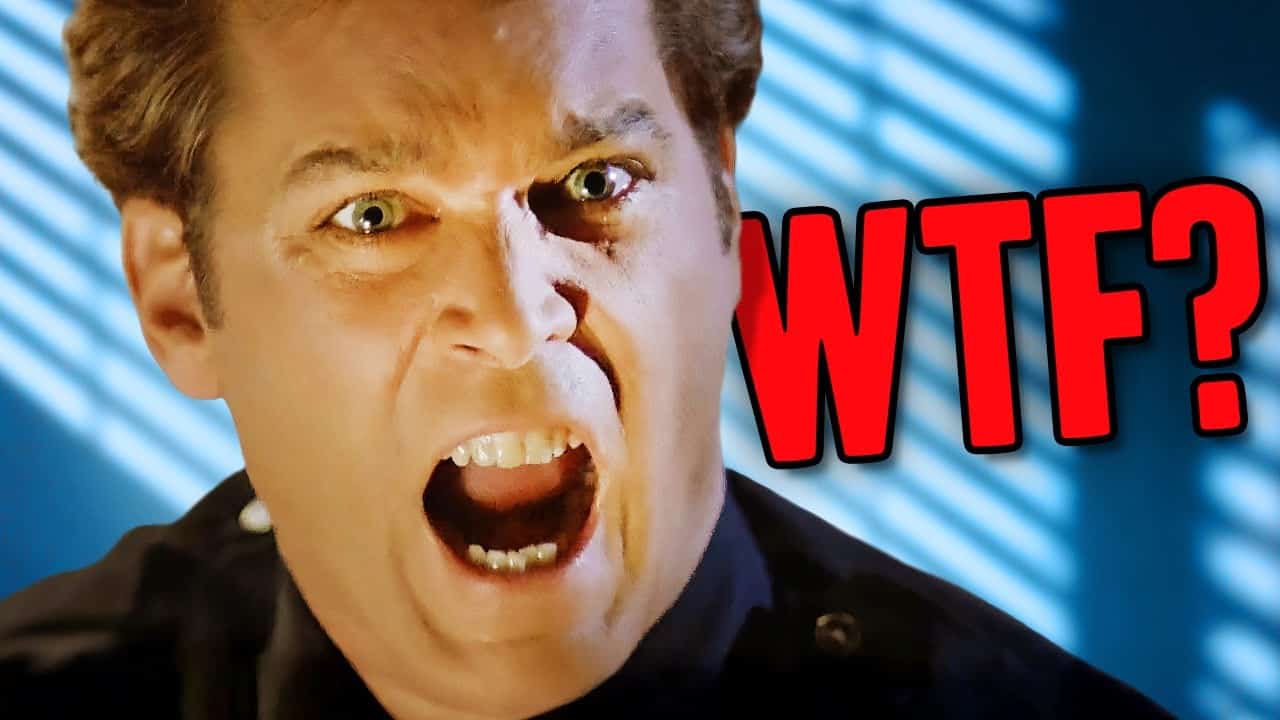
Why Unlawful Entry Is One of the Most Underrated Thrillers of the 90s
The early ’90s were a buffet of sexy danger for thriller fans, and today’s unheralded 1992 man-vs-man-for-all-the-marbles psycho-fest has it all. It’s a creepy stalker movie packed with all-time great actors and a look into what happens when a happy couple has their world wrecked by inner-city crime reaching into their suburban safe haven. This movie is full of sex, horror, and questionable decisions. It even ends with a fistfight in the kitchen that makes the Halloween Ends Laurie vs. Michael Myers throwdown look like a gentle cuddle. Unfortunately, it also involves a scene depicting police brutality during a boiling point in America, something that cast a shadow over the film’s release and nearly buried it forever. This is the story of what happened to Unlawful Entry.
The Simple, Terrifying Premise
There isn’t a ton of information about where the inspiration for Unlawful Entry came from. Maybe it was simply a desire to jump on the thriller boom with a psycho-cop angle. At its most basic level, the movie asks a genuinely unsettling question: Who do you call when the guy who wants your wife is a cop?
That question was explored by writers George Putnam (NYPD Blue, Deadwood), John Katchmer, and Lewis Colick, who would later write thrillers like Judgment Night and Domestic Disturbance. Largo Entertainment, fresh off several entertaining Fox releases including Point Break and The Super, optioned the script in the summer of 1991.
When Suburban Safety Shatters
The film follows Michael Carr, a wealthy but otherwise average guy, and his beautiful yet naive wife Karen. Their suburban bliss is shattered when a home intruder puts a knife to Karen’s throat after Michael fails to restrain him. The intruder flees, but the psychological damage is done. When the police arrive, Officers Pete Davis and Roy Cole take the report. Almost immediately, something feels off about Pete. His stare lingers too long. His interest in Karen is unmistakable. Even his partner senses it. From that moment on, you know this situation is going to spiral.
Horror From Both Sides of the Badge
What makes Unlawful Entry so effective is its two-pronged horror. On one level, it’s about a rage-fueled, mentally unstable cop roaming the streets of Los Angeles at night. On the other, it forces the audience to imagine what they’d do if that cop turned his attention toward their spouse.
To make matters worse, Karen is clearly drawn to Pete’s sad-eyed, misunderstood-cop persona. It’s a nightmare scenario for Michael, who soon finds himself targeted in the most sadistic ways possible. As Pete uses his authority and connections to dismantle Michael’s life piece by piece, Michael is forced to rise to the occasion to save both himself and his wife.
Jonathan Kaplan and a Perfectly Cast Trio
The film was directed by Jonathan Kaplan, best known for The Accused and a long list of music video work. His approach turns Unlawful Entry into a psychological karate kick aimed squarely at the average man’s worst fears.
Casting was crucial, and they nailed it.
Ray Liotta, fresh off Goodfellas and Field of Dreams, plays Officer Pete Davis in one of his most underappreciated performances. His presence is deeply unsettling. Sometimes he doesn’t even do anything, he just watches. His performance evokes echoes of Taxi Driver, Nightcrawler, and even American Psycho. The difference is that this Patrick Bateman has a badge.
Opposite him is Kurt Russell, who deserves serious credit for taking a role many actors would’ve passed on. For much of the movie, Russell plays a man who is powerless, scared, and being outmatched at every turn. But when the time comes, he snaps, and it’s deeply satisfying. Russell perfected this “everyman pushed too far” role in films like Breakdown and Executive Decision, and Unlawful Entry is an early example of how well he could sell it.
Roger Ebert even noted that Russell and Liotta felt like twisted reflections of one another on screen. Their face-off is pitch-perfect; more Cape Fear than traditional stalker fare.
Between them is Madeleine Stowe as Karen, delivering a performance that walks a tricky line. She’s strong, likable, and tragically blind to how dangerous Pete truly is. Stowe had already proven herself in erotic thrillers like Revenge, and here she makes Karen’s denial feel frustrating but believable. When the film shifts from stalking to full-blown slasher territory, Stowe sells the desperation and terror without losing the audience’s sympathy.
The supporting cast is stacked with reliable character actors, including Roger E. Mosley, Ken Lerner, and Deborah Offner, all adding weight to the story.
Real-World Tragedy and an Uncomfortable Parallel
Unlawful Entry was filmed in Los Angeles in 1991, and the production became unintentionally entangled with real-world events. On March 3, 1991, Rodney King was brutally beaten by LAPD officers following a high-speed chase. The footage was released publicly the next day. Unfortunately, Unlawful Entry featured a pivotal scene in which Officer Pete brutally assaults the man who broke into the Carrs’ home, partly to show off in front of Michael. As the Rodney King case unfolded and the 1992 LA riots erupted just two months before the film’s release, the similarities became impossible to ignore.
The director and producers heavily edited the scene, and the cast repeatedly emphasized in interviews that the film was intended purely as entertainment. Thankfully, audiences seemed to understand this context, and the film was able to survive rather than be erased.
Chaos on Set and a Reworked Ending
Behind the scenes, the production was just as intense as the movie itself. Liotta described Kaplan as “an intense little dude,” while Russell affectionately referred to him as “a frantic Santa Claus.” Stowe even admitted that while she and Liotta barely spoke off-camera, she found herself genuinely drawn to him while in character, a strange but telling detail.
The film’s ending was rewritten multiple times, leading to confusion even among the cast during filming. While some critics felt the final act was rushed, the chaotic energy actually works in the movie’s favor. The final confrontation between Michael and Pete is raw, frantic, and vicious, culminating in a kitchen fight that feels earned after all the psychological torment.
Yes, Even the Cat Matters
One unforgettable element of the film is the Carrs’ cat, Tiny, which was played by three different cats during production. The cat consistently prefers Pete over Michael, subtly undermining the old horror-movie idea that animals can sense evil. It’s a small but clever touch that adds another layer of humiliation and unease for Michael.
Even after everything Michael endures to save his family, the cat still chooses Karen over him. It’s darkly funny, strangely human, and maybe proof that I’ve watched this movie too many times.
Music, Release, and Legacy
Legendary composer James Horner scored the film, though not without some creative friction. Kaplan, whose father was composer Sol Kaplan, had very specific ideas about the music’s tone. The result is an underrated score that feels like a traditional thriller theme with just enough eerie restraint to avoid tipping the audience off too early.
Unlawful Entry hit theaters on June 26, 1992, opening in second place at the box office. It grossed over $10 million its first weekend and went on to earn $57 million domestically against a $23 million budget. A solid success. Critical reception was generally positive, with many reviewers praising Liotta’s performance while acknowledging some stretches in believability.
Final Verdict
Even if it doesn’t have the name recognition of Basic Instinct, Unlawful Entry remains one of the most entertaining, rewatchable, and well-acted thrillers from the golden age of the genre. And that is what happened to Unlawful Entry.
A couple of previous episodes of this show can be seen below. For more, check out the JoBlo Horror Originals YouTube channel—and don’t forget to subscribe!
The post Why Unlawful Entry Is One of the Most Underrated Thrillers of the 90s appeared first on JoBlo.