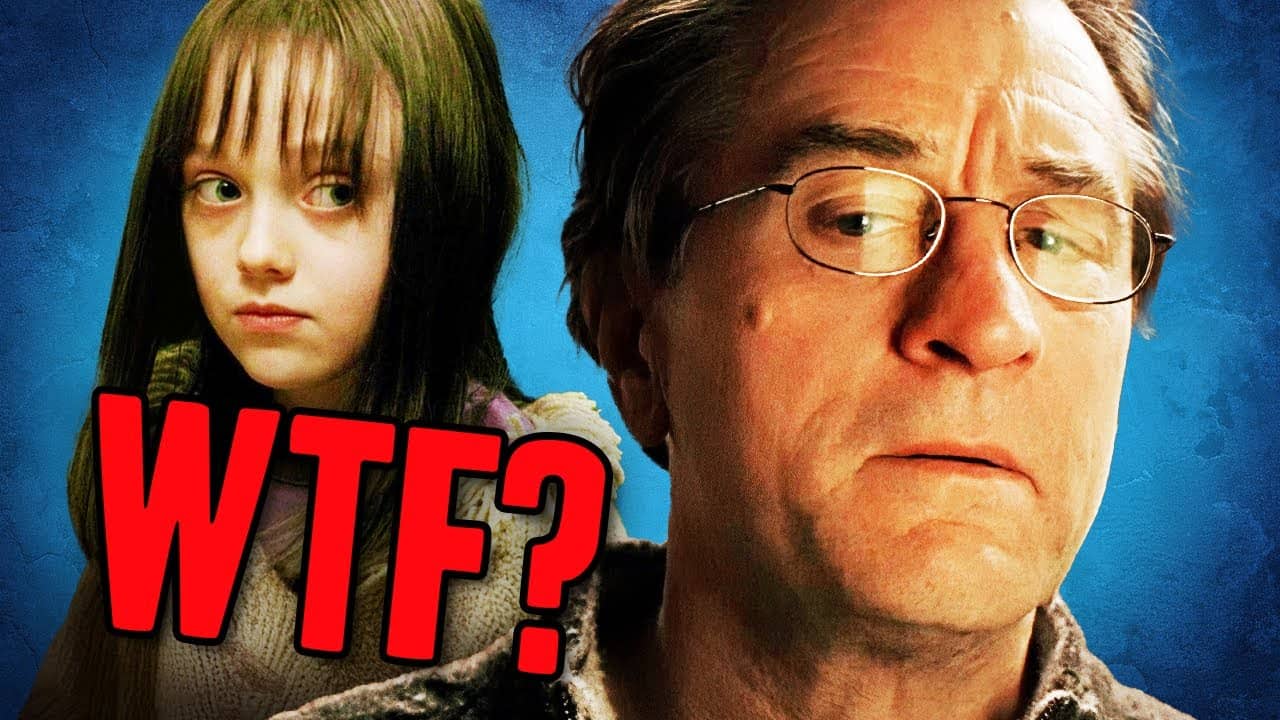
What Happened to Hide and Seek? Robert De Niro’s Forgotten Horror Hit with Five Endings
If you had a sharp knife to your melon and were forced to name legendary Robert De Niro’s most underrated horror movie on record, what would your honest answer be? While most are likely to avoid Godsend like a biblical plague, the laughable 2004 debacle co-starring Greg Kinnear, it’s harder to run away from Hide and Seek, the well-acted but absurdly predictable 2005 psycho-thriller featuring Dakota Fanning in a breakout performance.
Straight up: did you know that five different endings were filmed for Hide and Seek? Were you aware that, depending on where the film was released, a different theatrical ending was used? Hell, did you realize that, for the first time in 70 years, 20th Century Fox delivered prints of Hide and Seek to movie theaters without the final reel, shipping the mysterious third act separately to preserve secrecy?
Well, as the film celebrates its 20th anniversary, we’re turning over every stone, checking every closet, and looking under all the beds to find out what happened to Hide and Seek.
Plot Refresher
Directed by Swimfan’s John Polson from a script by first-time screenwriter Ari Schlossberg, Hide and Seek centers on the psychological trauma experienced by Emily Callaway (Dakota Fanning), a nine-year-old girl reeling from her mother’s bathtub suicide in Manhattan.
Emily’s father, psychologist David Callaway (Robert De Niro), believes it’s best to remove his daughter from the home where the tragedy occurred. He relocates them to an isolated upstate New York lakehouse in the dead of winter. The change in scenery only worsens Emily’s fractured mindset as she becomes increasingly tormented by her imaginary friend, Charlie, whose presence escalates from unsettling to outright dangerous, targeting David and those around him.
Development & Pre-Production
Development on Hide and Seek began with Ari Schlossberg’s debut screenplay. According to Schlossberg: “I wanted to write a really scary movie. I grew up in New York City, and the woods always held an element of fear for me. So, of course, I set my story in a rural, woodsy town.”
To fully immerse himself in the material, Schlossberg wrote the script alone in the dark at night, performing each role out loud to reinforce the story’s multiple-identity themes.
The completed screenplay landed with producer Barry Josephson shortly after his success with the Coen brothers’ The Ladykillers. Josephson purchased the script and brought it to 20th Century Fox, assuring Schlossberg he would remain involved throughout revisions with no additional writers brought on.
Director John Polson, coming off the abysmal stalker thriller Swimfan (2003), was particularly excited by the chance to showcase De Niro in a rare role: an emotionally unraveling father desperately trying to keep his family intact.
Famke Janssen, who plays Dr. Katherine “Kate” Carson, later stated that De Niro’s involvement was the sole reason she signed on.
Casting Emily proved crucial. Despite being one of Hollywood’s most sought-after child actors at the time, Dakota Fanning still had to audition. Polson initially assumed she’d be unavailable and began searching for “the next Dakota Fanning.” Although AnnaSophia Robb was considered, Fanning won the role with ease.
In a notable contractual move, Fanning waived her usual seven-figure fee in exchange for equal above-the-title billing with De Niro.
Before accepting the role, Fanning recalled being genuinely terrified by the script: “I started reading it in my room upstairs, but I got so scared I had to go downstairs where my dad and sister were. Emily is definitely scared and in some sort of trouble, but she keeps you guessing about who or what is really causing these scary things.”
Principal Photography
With an estimated $30 million budget, principal photography ran from January 19 to March 26, 2004. While the Callaway house exterior was filmed in Haworth, New Jersey, most of Hide and Seek was shot on location in Manhattan and at Silvercup Studios in Queens.
To transform her appearance, Fanning wore a brown wig over her blonde hair and heavy under-eye makeup to create a gaunt, haunted look. Cinematographer Dariusz Wolski enhanced the effect through a gradual descent into shadow, visually darkening the film as the story progresses.
One of the film’s most disturbing early moments is the death of the family cat, Sebastian, which is blamed on Charlie. Later, Emily pierces a live ground beetle with a fishing hook to use as bait. Though horrifyingly realistic, no animals were harmed. Twenty-four beetles were used, with prop masters attaching a fake blood sac using surgical adhesive. Fanning was carefully instructed on how to execute the shot safely, resulting in one of the film’s most viscerally unsettling scenes.
Composer John Ottman (Gothika, Cellular) added another layer of unease by subtly incorporating Fanning’s singing voice into the score.
Meanwhile, Production Designer Steven J. Jordan oversaw Emily’s increasingly disturbing drawings of Charlie. Hundreds of sketches were created to support the movie’s twist ending, giving Polson maximum flexibility during post-production.
Multiple Endings & Deleted Scenes
Two different drawings were created to support five alternate endings, a key element of Fox’s marketing strategy. To avoid spoilers, Fox shipped prints without the final reel and hired security guards to hand-deliver the endings, each reel individually numbered.
Fox executive Richard Myerson justified the secrecy: “Hide and Seek is a terrific picture with an ending everyone will be talking about. We think it’s worth the effort.”
For the first hour or so, Hide and Seek indeed flirts with becoming a terrific picture. Alas, the flickers of brilliance are abruptly dashed by the easily spottable resolution regarding the murderer’s true identity. Even so, there’s much more to the predictable ending that Fox was trying hard to keep shrouded in mystery.
What begins as an eerily atmospheric and genuinely unsettling spook-story ultimately becomes a mysterious meditation on mental health. Once the movie reveals that Charlie is not a figment of Emily’s imagination and is a product of David’s dissociative identity disorder, David turns out to be the murderer of his wife. While that part is disappointingly predictable for every hardened horror head, the movie goes one step further to explore whether Emily has inherited the mental disorder.
Hide and Seek ends with Emily drawing a portrait of her and Kate (played by Famke Janssen) while living in her new environment and preparing for school. The U.S. theatrical version of the film concludes with the camera panning across Emily’s drawing and revealing her with two heads and a happy face, suggesting that David’s psychosis has been genetically passed to her. This ending is also featured as an alternate ending on DVD copies featuring the different international ending. Believe it or not, that was one of five different endings written and filmed for Hide and Seek.
The second ending is precisely the same as the first, with one key difference. Emily is shown with only one head and a happy face, suggesting that she has not inherited her father’s split personality disorder and is destined to live a happy, prosperous life.
The third ending is by far the most effective and radically altered of the bunch. Emily appears in a new apartment bedroom that viewers do not recognize. Acting similarly to Emily’s mother at the beginning of the movie, Kate consoles Emily and tells her that she loves her. As Kate leaves the room, Emily asks her to leave the door ajar. Kate says she cannot leave the door open before slowly shutting it. After showing a barred security window on the door, the camera cuts to the outside of the room, which is revealed to be inside a children’s psychiatric ward. As Kate locks the door, Emily climbs out of bed and begins her Hide and Seek countdown. Emily ambles toward the closet, opens it, and flashes a sinister grin at her reflection in the mirror. This indicates that Emily is bound to repeat the cycle of psychosis that her father suffered from.
The fourth Hide and Seek ending is the same as the third, with two key differences. Emily neither gets out of bed and performs the Hide and Seek countdown, nor gives an evil smile to her mirror reflection. Instead, the movie ends with Kate shutting the door. You can still recognize the hospital setting by the wired window and antiseptic hall light, hinting at a much more tragic set of circumstances for Emily. This fourth ending was included in the theatrical release of Hide and Seek overseas. That means, depending on where you saw the film in theaters in 2005, you witnessed a completely different ending from someone around the globe. Pretty wild!
The fifth ending is similar to the third and fourth. Rather than the psych ward setting, Emily wakes in bed in her new home with Kate. After Kate refuses to leave the door open, Emily gets out of bed, heads to her closet, and starts the Hide and Seek countdown to her reflection in the mirror. While not as disturbing as awaking in a mental hospital, this ending reinforces Emily’s doomed psychological fate.
It’s also worth noting that 19 minutes of deleted scenes were cut from the final film, many of which were unneeded filler, while others subtly hinted at the ending that supports Emily’s psychotic fate. The unnecessary scenes involve David interacting with the clerk and the town Sheriff (played by Dylan Baker) at the bait shop, having a lengthy dinner conversation and a sexual encounter with Elizabeth (played by Elisabeth Shue), and a few unnerving home showdowns with Emily.
The more telling scenes that would have played well in the theatrical cut include Emily catching a fish. As David unhooks the fish and prepares to throw it back in the lake, Emily asks with a deadpan glint in her eye, “Wait, aren’t we gonna eat it?”
Another creepily effective deleted scene involves Emily pulling a macabre prank on her babysitter by pretending to slit her wrists with gory fake blood. When David arrives at home, the babysitter darts off the property and refuses to return ever again.
And perhaps best of all, another excised scene features Emily rushing into the woods at night in a yellow raincoat. With a surreal, dreamlike tableau, David sees Emily through the window and chases after her. He finds Emily calmly hiding behind a tree, waiting for Charlie. David slowly nears a rotted tree trunk, and just as he approaches what he thinks is Charlie, a large bird flies out and squawks loudly. Whether the scenes were cut for pacing purposes or to accommodate the happier alternate endings, they certainly hint at Emily’s unstable mindstate.
Meanwhile, all five alternate endings are featured on the Hide and Seek DVD, which has an option to play one randomly, a la Clue back in the day.
Release & Reception
Released January 28, 2005, Hide and Seek debuted at number one, beating Are We There Yet?, Million Dollar Baby, Coach Carter, Meet the Fockers, and The Aviator.
Despite a brutal 12% Rotten Tomatoes score and 35 Metascore, the film grossed $127 million worldwide on a $30 million budget.
Dakota Fanning won Best Frightened Performance at the 2005 MTV Movie Awards and earned a Fangoria Chainsaw Award nomination. Still, poor word of mouth prevented any sequel or continuation.
Legacy
Director John Polson made only one more feature, the forgettable Tenderness (2009), before moving into television. Schlossberg’s writing career fizzled after Lucky 13 and Harper’s Island. De Niro has not returned to horror since. Fanning, however, continued working in the genre and recently appeared in Bryan Bertino’s Vicious.
Despite quadrupling its budget, Hide and Seek couldn’t escape poor reviews, multiple endings, and a twist most horror fans saw coming from a mile away. Whether it remains De Niro’s worst horror movie or his most underrated, that’s what happened to Hide and Seek.
A couple of previous episodes of this show can be seen below. For more, check out the JoBlo Horror Originals YouTube channel—and don’t forget to subscribe!
The post What Happened to Hide and Seek? Robert De Niro’s Forgotten Horror Hit with Five Endings appeared first on JoBlo.