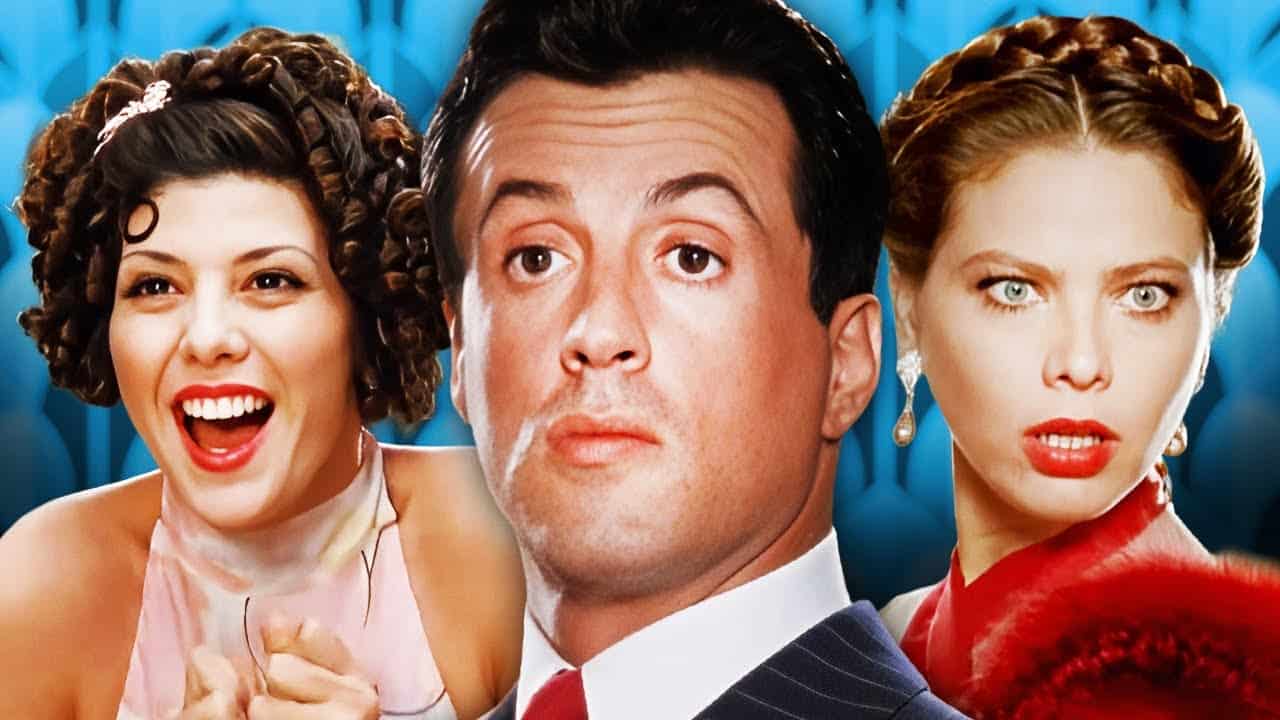
Why Oscar (1991) Deserves a Second Look as Sylvester Stallone’s Best Comedy
If you grew up in the 1980s, you probably remember when action stars inevitably tried their hand at comedy. It was practically a rite of passage. While many stumbled, one actor pulled it off better than anyone else — Arnold Schwarzenegger. But in the shadow of Arnold’s success lies a forgotten, unfairly maligned comedy that proves Sylvester Stallone was far better at comedy than history suggests: John Landis’ Oscar.
When Action Stars Started Doing Comedy
If you’re a child of the eighties, you remember when all the action stars of the era started to do comedy. It was just a thing that would inevitably happen for all of them once they reached a certain level. Everyone did it — but there was one guy who did it better than anyone else, and that was Arnold Schwarzenegger.
Arnie’s detour into comedy was so wildly successful it elevated his action game, broadened his fan base, and didn’t go unnoticed by his contemporaries. It also arguably climaxed in total disaster for his biggest competitor of the era, Sylvester Stallone, whose Stop! Or My Mom Will Shoot is the movie he’ll never live down.
Yet Stallone was better at comedy than anyone really gives him credit for, and today we’re going to look at one of his movies that — despite now being hugely obscure — is actually pretty good: John Landis’ gangster farce Oscar.
Clint Eastwood, Clyde the Orangutan, and the Blueprint
Jump back to 1978, when the whole notion of action heroes doing comedy really began. At the time, there was no bigger box office star in the world than Clint Eastwood, but he grew tired of his increasingly grim action movies and wanted to try something lighter.
That’s why he co-starred with an orangutan named Clyde in the truck-driving, yee-haw good-old-boy comedy Every Which Way But Loose. Eastwood played a nice-guy trucker and bareknuckle brawling champ (hey — it’s still an Eastwood movie), with Clyde as his BFF (cut to Clyde flipping off a biker).
Everyone begged him not to do it. His longtime friend Burt Reynolds warned audiences would never accept him in a movie that — frankly — Burt himself probably should have starred in. Instead, it made over $100 million in 1978 money, becoming Clint’s biggest hit ever, spawning a sequel (Any Which Way You Can) and even pushing Reynolds into making his own against-type film, Sharky’s Machine, one of his best.
Maybe there was something to this against-type thing after all.
Arnold Schwarzenegger and the Comedy Crossover
One person who took notice of Clint’s monkey movie was Arnold Schwarzenegger. His Hollywood dreams hadn’t fully materialized yet, but once he hit peak action-star status, he decided it was time to try comedy.
That movie was Twins, pairing Arnold with Danny DeVito under Ivan Reitman’s direction. It became Arnie’s biggest hit ever and introduced him to an entirely new audience. I remember seeing it in theaters as a six-year-old — the audience was in hysterics the entire time.
Suddenly, Arnold had crossover appeal, and when he returned to action, the results were massive: Total Recall and Terminator 2.
Stallone’s Rivalry with Arnold — and a Bad Moment to Try Comedy
One of the most famous gags in Twins has Arnold walking past a theater playing Rambo III and laughing at the size of Stallone’s muscles. Their rivalry was real, even if good-natured.
If Arnold could get raves for comedy, Stallone wanted in. Unfortunately, it came at the worst possible time. Rambo IIIunderperformed, Lock Up flopped, Tango & Cash did fine, and Rocky V tanked badly. Now was not the time to gamble on comedy — but Sly did anyway.
John Landis, Oscar, and a Risky Comeback
Enter John Landis. Like Stallone, Landis was at a low ebb — not because of flops, but because of tragedy. His ’80s output (The Blues Brothers, Trading Places, Spies Like Us, The Three Amigos, Coming to America) was wildly successful, but his involvement in Twilight Zone: The Movie resulted in a devastating on-set accident that killed Vic Morrow and two child actors.
Though acquitted, Landis was effectively blacklisted.
Needing a hit, he turned to Disney’s Touchstone Pictures and proposed remaking the 1967 French farce Oscar, originally starring Louis de Funès. Landis reimagined the industrialist as a 1930s gangster and infused the tone with Damon Runyon-style humor.
Why Sylvester Stallone Works in Oscar
Originally envisioned as a John Belushi or even Al Pacino vehicle, the role of “Snaps” Provolone ultimately went to Stallone. Critics scoffed, but the truth is Stallone is surprisingly effective.
Playing it like a 1930s screwball farce in the vein of Edward G. Robinson, Stallone gives Snaps a gentle charm. He’s overwhelmed, passive, and constantly reacting to chaos — which is exactly what makes him funny. He handles the dialogue well, has a twinkle in his eye, and looks the part.
In retrospect, he may not be Louis de Funès-level caustic, but the approach works.
An Insanely Stacked Supporting Cast
Landis’ production values are immaculate, but the cast is outrageous:
Peter Riegert steals scenes as Aldo, Snaps’ perpetually confused right-hand man
Marisa Tomei, in an early role, is electric as Oscar’s pregnant daughter — paving the way for My Cousin Vinny
Ornella Muti is excellent as Snaps’ paranoid wife
Chazz Palminteri, Kurtwood Smith, Tim Curry, Martin Ferrero, Harry Shearer, and Don Ameche all shine
There’s even a memorable cameo from Kirk Douglas, slapping Stallone repeatedly — notable given their tense history from First Blood. For those who don’t know, Douglas was originally signed to play Col. Trautman (the role later played by Richard Crenna) but quit when the script was changed to allow Rambo to survive at the end, rather than be killed by Trautman.
Why Oscar Failed — and Why It’s Better Than Its Reputation
Critics demolished Oscar, with the notable exception of Siskel and Ebert, who gave it two thumbs up. Much of the backlash stemmed from resentment toward both Stallone and Landis rather than the film itself.
Audiences expected shirtless violence, not a period farce. Coming on the heels of Rhinestone didn’t help either. The movie earned just $23 million domestically.
Yet time has been kind. Retrospective reviews are far more generous, and many now view Oscar as a sharp, well-crafted comedy unfairly maligned on release.
The Aftermath: Comedy, Comebacks, and Legacy
Stallone had already started Stop! Or My Mom Will Shoot before Oscar flopped, briefly derailing his career. Luckily, he rebounded with Cliffhanger and Demolition Man. Meanwhile, Arnold would stumble with Last Action Hero — his only real flop of the era.
Action-comedy would return in the 2000s with The Pacifier, The Game Plan, and others. Today, it’s practically mandatory.
As for Stallone, Oscar remains his best pure comedy — and proof that when judged on its own terms, it deserved far better than it got.
The post Why Oscar (1991) Deserves a Second Look as Sylvester Stallone’s Best Comedy appeared first on JoBlo.