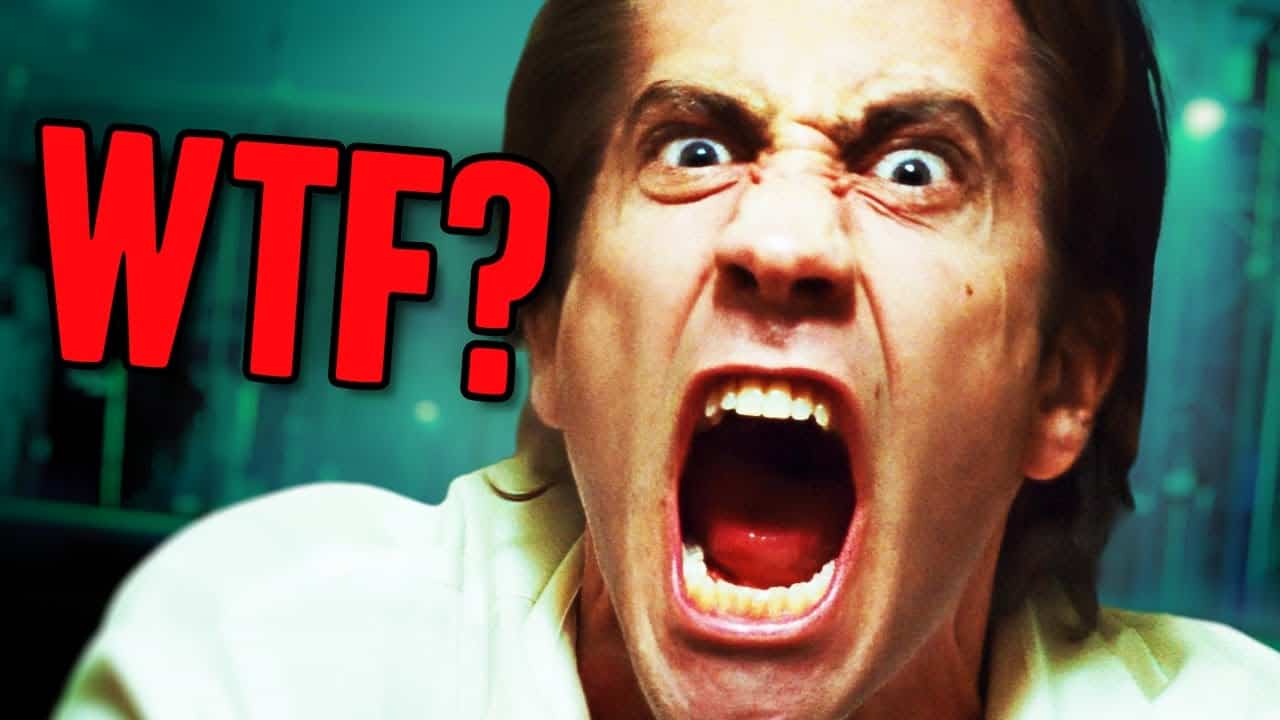
What Happened to Nightcrawler: The Making of Jake Gyllenhaal’s Most Disturbing Role
If you see him, it’s likely you’re having the worst day of your life.
Today, we’re diving deep into the cracked yet ambitious psyche of Louis Bloom. A man so obsessed with success he’s willing to film you dying slowly to get there, and a whole lot more.
We’re going to learn how Jake Gyllenhaal’s dedication to creating one of the most memorable characters of his career ended with forty-four stitches. We’ll talk about a fellow actor calling him “weird” on set, albeit in the best way possible, as he dealt with losing a considerable amount of weight for the role. And we’re going to use steady hands as we crawl into the headspace of the genius minds who created one of the most fascinating, frightening, and hilarious (in that psycho sort of way) characters in modern cinema.
Because if you want to win the lottery, you have to make the money to buy a ticket. And if you’re Nina, you have to do the things he asks you to do when you’re alone together in her apartment. Not like the last time.
This is what happened to Nightcrawler.
The Origins of Nightcrawler
For writer and director Dan Gilroy, the idea for Nightcrawler began way back in 1988. The writer of Freejack and the underrated football betting movie Two for the Money became inspired by the work of New York City street photographer Weegee.
Weegee’s photographs were famous for capturing the sensational dark side of New York in the 1930s and 40s. He followed emergency services on calls and documented the aftermath: mob shootouts, horrific injuries, and crime scenes, sometimes selling the photos to tabloids.
Gilroy worked on the idea for years and likened it to Chinatown. But in 1992, Joe Pesci’s The Public Eye was released, and it felt a little too close to his original concept. So Gilroy scrapped the project entirely.
That changed after he moved to Los Angeles and became fascinated with the “if it bleeds, it leads” mentality of daily news programs. These broadcasts often showcased the city’s worst crimes, using fear as a tractor beam for viewers. Gilroy noticed the recurring “footage obtained by” logos attached to these tragic moments, which led him to discover the profession of stringers, freelance camera operators who monitor police scanners, chase crime scenes, and sell footage to local news stations.
Much like Weegee decades earlier, the idea clicked. Gilroy began writing Nightcrawler.
Creating Lou Bloom
Gilroy has openly admitted that his writing process involves countless rewrites, and Nightcrawler was no exception. Over several years, the script evolved until he landed on the idea of an anti-hero – or more accurately, a protagonist with no heroism at all.
Gilroy has said that Lou Bloom leapt off the page and grabbed him by the throat, demanding to be written. Which, as long as you aren’t suffering from hallucinations, is usually a pretty good sign you’re onto something.
At that point, Gilroy knew this would be his directorial debut. The story was too personal and too specific to risk someone else misinterpreting it. Studios are often wary of first-time writer-directors, but when Gilroy’s brother, respected filmmaker Tony Gilroy (Michael Clayton), signed on as producer and eventually editor, those concerns likely eased.
Lou Bloom was designed to be a character with almost no morals, obsessed with capitalist self-help messaging, who never changes. Even as the credits roll. Instead of learning or growing, Lou bends the world to his will, leaving the audience staring back at themselves and the systems they tolerate.
Lou Bloom has no character arc. He starts as a psychopath and uses it to succeed. And that should probably scare us.
Enter Jake Gyllenhaal
Hired to embody that nightmare was Donnie Darko himself, Jake Gyllenhaal. At the time, Gyllenhaal was already on a hot streak… which, in fairness, has basically been his entire career.
He’d shown a knack for dark characters before, including a disturbing turn in a music video where he portrays a man growing increasingly disgusted with the world before unleashing violent urges. It’s easy to see why Gilroy had him in mind.
Gyllenhaal was Gilroy’s first and only choice. When a previously planned project fell apart, Gyllenhaal met with Gilroy, read the script, and signed on. Gilroy even flew to Atlanta, where Gyllenhaal was filming Prisoners alongside Hugh Jackman, and the two discussed framing Nightcrawler as a horror story disguised as a success story.
Gilroy described Lou Bloom as a coyote driven by insatiable hunger, an idea Gyllenhaal fully embraced. To physically transform, he followed a strict diet and lost nearly thirty pounds from an already lean frame. Some people on set worried the choice might be wrong for the character, but Gilroy trusted Gyllenhaal’s instincts.
One look at Bloom’s sunken face, sharp delivery, and unsettling posture tells you everything you need to know. This is a guy who might have a dead body in his trunk.
Gyllenhaal didn’t just commit to the role, he committed to the film. He participated in early rehearsals, crew discussions, and creative decisions across the production.
The Supporting Cast
For Lou Bloom’s “love interest” (though “victim” is probably more accurate) Gilroy turned to his wife, Rene Russo. The two had been married since meeting on the set of Freejack in the early ’90s.
The character of Nina is desperate, morally conflicted, ambitious, and fierce. Russo was interested in the role even while Gilroy was still writing the script, largely because it was unlike anything she’d ever played. She absolutely crushed it.
Lou’s unfortunate sidekick, Rick, was played by Riz Ahmed. At the time, Ahmed’s real-life situation wasn’t far off from his character’s desperation. He was close to quitting acting altogether and couldn’t even afford a flight to Los Angeles for the audition.
He bet on himself, figured it out, and got into the room with Gyllenhaal. Thankfully, the rest is history.
Ahmed later recalled that Gyllenhaal was a real-life “weirdo” on set, in the best possible way, as he starved himself and fully transformed into Lou Bloom.
Bill Paxton was cast as veteran stringer Joe Loder. While there’s no official confirmation that the name is a nod to MTV News anchor Kurt Loder, it’s hard not to believe it. Paxton, one of the great character actors of all time, brought fearless energy and dark humor to a man barely surviving a brutal profession while being threatened by an even more frightening up-and-comer.
Crafting the Look and Sound
Academy Award–winning cinematographer Robert Elswit (There Will Be Blood, The Town) brought nocturnal Los Angeles to life. The camera was designed as an extension of Lou’s eyes, reinforcing his isolation and hunger in every frame.
James Newton Howard’s cold, electric score perfectly complemented that vision. The music lives inside Lou’s mind; obsessive, precise, and deeply unsettling.
Elswit lit the film using existing light sources like streetlights, traffic signals, and neon signage. This allowed for faster setups and gave the film an unnervingly authentic look.
A Brutal Shoot
Principal photography lasted less than a month, with the crew working roughly twenty-two consecutive nights. Anyone who’s worked night shifts knows how brutal that can be on the body. The production bounced between nearly eighty different Los Angeles locations, avoiding familiar landmarks in favor of overlooked neighborhoods that matched the film’s predatory tone.
Scenes involving the news station were filmed at KTLA in Hollywood, adding another layer of realism.
To maintain authenticity, Gilroy and Gyllenhaal worked closely with real-life stringers, the Raishbrook Brothers, who took them on ride-alongs and served as consultants during production.
Ironically, Gyllenhaal survived those dangerous excursions without injury. It was the acting that nearly did him in.
During a particularly intense mirror scene, Gyllenhaal cut his hand badly enough to require forty-four stitches. True to form, he returned to set within hours to keep filming.
Some of the footage captured by handheld cameras during production was later used in the film, while other shots employed subtle CGI to create camera-within-camera perspectives.
Release and Legacy
Even the marketing for Nightcrawler was creative, featuring viral materials written entirely in Lou Bloom’s voice.
When the film screened at Cannes, it sparked a bidding war among distributors. Open Road Films won the U.S. rights, and Nightcrawler was released on Halloween 2014. Appropriate for the content, less so for box office competition.
Still, the film’s $8.5 million budget was covered in its opening domestic weekend, eventually earning over $47 million worldwide.
It’s tempting to imagine a future where Lou Bloom rises to the top of a major corporation, running out of achievements to obsess over. What does a man like that do once he reaches the summit?
Thankfully, and wisely, Dan Gilroy has shut down all talk of a sequel. Some stories are better left untouched.
With near-universal acclaim and a Rotten Tomatoes score sitting at 95 percent, Nightcrawler remains a financial and critical darling.
And for now, and probably forever, that’s what happened to Nightcrawler, my friends.
A friend is a gift you give yourself.
A couple of previous episodes of this show can be seen below. For more, check out the JoBlo Horror Originals YouTube channel—and don’t forget to subscribe!
The post What Happened to Nightcrawler: The Making of Jake Gyllenhaal’s Most Disturbing Role appeared first on JoBlo.