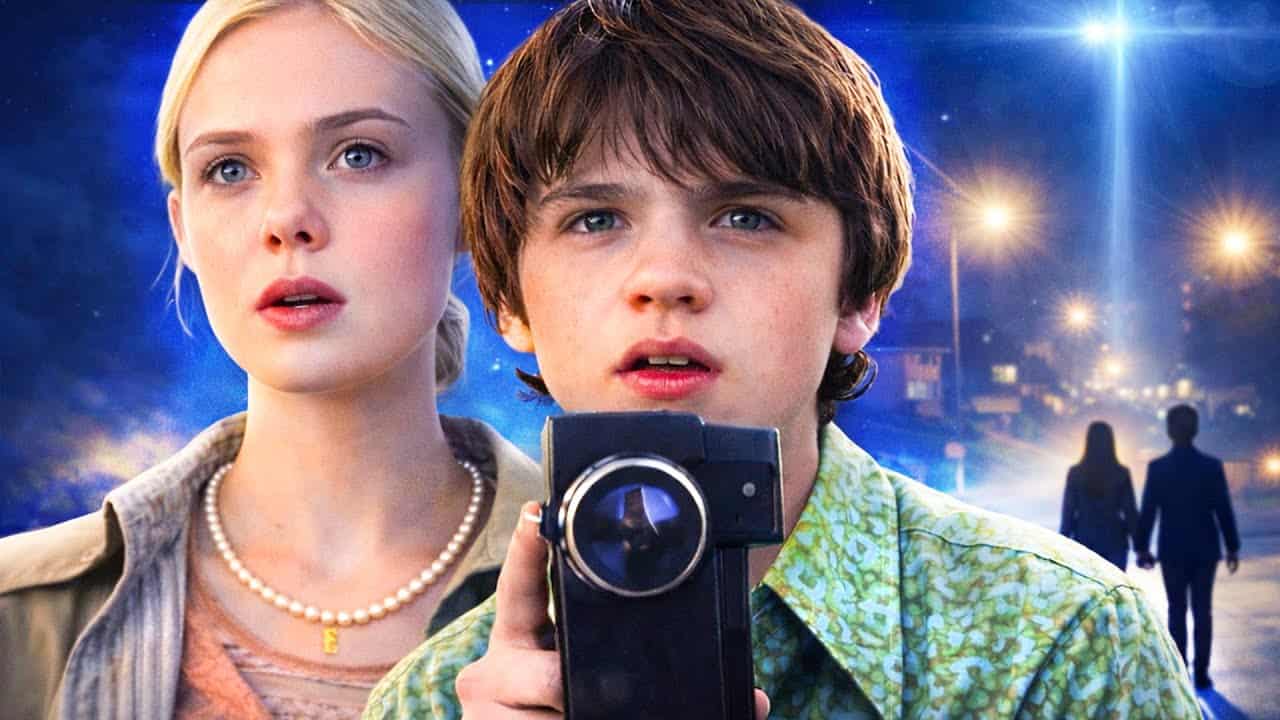
Super 8: The Movie That Remembered Why We Loved Movies
There’s a quiet magic in Super 8 that doesn’t announce itself with fireworks. It doesn’t rely on grand set pieces to tell you where it stands. Instead, it reveals itself in smaller moments: a group of kids arguing over a camera angle, rewinding Super 8 film by hand, learning a 1970s song together just because they’re kids in a movie set in summer. Those sequences are often dismissed as scene-setting or texture, but they are intentional. Super 8 is about remembrance, about a filmmaker digging into what childhood felt like before screens got sharp, before audiences got cynical, and before blockbuster surfaces got louder than their cores. J.J. Abrams was not ghostwriting nostalgia. He was reimagining a mindset.
At its core, Super 8 is a storytelling experiment. What if the emotional logic of the Amblin era was placed inside a modern blockbuster engine? Instead of just winking at E.T. or The Goonies with visual cues, Abrams chose to dig deeper. He wanted audiences to feel what it was like to be a kid seeing something inexplicable and extraordinary happen for the first time. That ambition is born not just from admiration but from lived experience. Abrams himself was obsessed with Super 8 filmmaking as a child, shooting films with friends, experimenting with cameras, learning by doing. He didn’t want to ape that feeling. He wanted to put the audience back in it.
Super 8 did not begin as a single idea. Abrams was tinkering with two different concepts: a heartfelt coming-of-age story about kids making movies, and a grounded sci-fi mystery involving a mysterious transport from Area 51 gone wrong. For months, neither idea found its footing on its own. Then, like matching two puzzle pieces, Abrams realized combining them could yield something evocative — a genre collision where personal storytelling and a larger mystery could elevate each other. That fusion is the DNA of Super 8.
That the movie was also produced by Steven Spielberg, the master of the cinematic emotional toolbox that Abrams was drawing from, is essential. This wasn’t marketing by association. Abrams wanted a collaborator who built this style of filmmaking in the first place. Spielberg’s fingerprints aren’t just in the kid-on-bicycle moments or the whey-bright summer light. They’re in the priority of emotional logic over spectacle, where the emotional beats of grief, friendship, and wonder are given equal weight to mystery and sci-fi thrills.
Behind the camera, Super 8 was unusually thoughtful in how it built that world. The casting process was exhaustive, not for star power but for authenticity. Abrams conducted a talent search that ultimately found Joel Courtney as Joe on the first day of his first audition ever, seeing something in him that felt different and emotionally open in a way that traditional casting often misses. Other young actors, like Riley Griffiths and Ryan Lee, secured their parts through self-taped auditions that offered glimpses of real personality rather than blank acting technique.
On set, Abrams encouraged the young cast to be kids, literally. He had them learn and bond over the 1970s rock hit “My Sharona.” Kids riding their bikes around Bad Robot wasn’t just scene blocking. It was part of building camaraderie and genuine physical comfort that would translate onscreen. The production was careful about era details too, teaching actors how to use rotary phones or giving them cheat sheets of period slang, while also expressly forbidding modern vernacular.
While the kids’ filmmaking world feels handmade and tactile in the final cut, there’s a fascinating layer of meta-filmmaking that underpins Super 8. The Super 8 film they’re shooting within the movie, titled The Case, is not just a throwaway gag. It was largely written and directed by the young actors themselves, with adults stepping in mainly to handle lighting and technical setup. That The Case plays in full over the end credits is more than a novelty. It’s a narrative thesis — a celebration of the act of making movies being given value in its own right, not merely as a setup for alien mayhem.
Even the blockbuster spectacle — the train derailment that unleashes the alien presence — integrates practical and digital effects in ways that serve emotional truth rather than just spectacle. Industrial Light & Magic used clever techniques during the derailment scene, adding CGI debris corresponding to actors’ reactions to match physical instinct and make danger feel raw without exposing actors to real risk. Cinematographer Larry Fong also composed shots so that the kids and explosions appeared closer than they were, bringing visceral intensity without losing the innocence of the kids’ perspective.
The marketing around Super 8 itself was a masterclass in mystery and engagement. In a callback to Abrams’ earlier work on Cloverfield, the first teaser dropped without revealing the creature or full context, instead showing a train crash and cryptic messages embedded in the final frames. Fans deciphered hidden clues leading to viral websites with simulated old computing systems and puzzles that fleshed out backstory elements like Area 51 connections. That sense of participatory mystery wasn’t just hype. It mirrored the ethos of the kids in the film trying to piece together something bigger than themselves.
Throughout all this, the emotional core never loses focus. Joe’s grief over his mother’s death isn’t a subplot. It’s the gravitational center that the alien narrative orbits around. His father’s struggle to connect with him mirrors the townspeople’s broader inability to understand what’s happening around them. Joe’s eventual empathy with the alien — a creature frightened, trapped, and fundamentally misunderstood — is less about beating the monster and more about relearning how to feel without armor. That choice reframes Super 8 from a genre picture into a meditation on connection.
Composer Michael Giacchino’s score reinforces this emotional logic. The music, recorded with the Hollywood Studio Symphony, draws inspiration from the work of John Williams, another Spielberg collaborator, but never mimics it outright. Instead, it plays with nostalgia as a feeling — a memory lodged in harmonies and motifs — strengthening bridges between the audience’s own recollections and what the characters are experiencing.
It’s rare for a movie to intentionally place craft, memory, and creative play at the center of its narrative, especially within the framework of a summer blockbuster. But Super 8 wasn’t just a nostalgic throwback. It was an attempt to reignite something in the culture: the idea that movies could still create space for wonder, vulnerability, and the joy of storytelling without irony. Where many films would trade authenticity for spectacle or brand synergy, Super 8 doubled down on sincerity, trusting audiences to feel something genuine.
By the time audiences first saw Super 8 on June 10, 2011, it had already carried years of evolution, from Abrams’ childhood dreams to viral teasers, from meticulous production design to heartfelt performances from a cast of newcomers and veterans alike. The film grossed over $260 million worldwide, but its impact wasn’t measured in box office alone. It reminded us why we made space for movies where kids could be kids again for a couple of hours, and why the language of wonder still matters.
In the end, Super 8 persists not because it recycles the beats of ’80s classics but because it reconstructs their emotional architecture. It’s a film about trauma and healing, about friendship and curiosity, about being on the cusp of something immeasurably large and not knowing where it will take you. It asks the audience not to remember childhood, but to relive it — the way the kids in the film pick up cameras, make mistakes, discover hidden layers, and find that the universe is bigger, stranger, and more beautiful than they ever expected.
And maybe that’s the most enduring trick of all. A blockbuster that doesn’t just entertain the eyes, but quietly invites the heart to open wider, like a Super 8 reel catching light for the first time.
What makes Super 8 linger long after the credits roll is how quietly it earns its emotions. It doesn’t rush to underline its themes or announce its intentions. Instead, it trusts the audience to meet it halfway, to recognize pieces of themselves in these kids without being told exactly what to feel. That trust is rare, especially in a blockbuster. The movie believes that grief doesn’t need speeches, that creativity doesn’t need validation, and that growing up often happens in moments you don’t realize are important until years later. That confidence is part of why the film still feels sincere rather than calculated.
There’s also something deeply comforting about how Super 8 frames creativity as survival. The kids don’t make movies because they think it will lead somewhere. They do it because it gives shape to their lives. It gives them control in a world that feels increasingly unstable. That idea hits harder as you get older, when you realize how often creative outlets are treated as luxuries instead of necessities. Super 8 understands that for kids — and for a lot of adults — making something is how you make sense of loss, fear, and change.
On a personal level, Super 8 feels like one of those movies that sneaks up on you depending on when you see it. Watching it younger, it feels like an adventure with emotional weight. Watching it later, it feels like a memory you didn’t know you had. The bikes. The summers that felt endless. The friendships that felt permanent even though they weren’t. The movie doesn’t romanticize those things, but it does honor them. It understands that the magic wasn’t in the era. It was in the perspective.
The film’s restraint is another reason it ages well. In an era where nostalgia is often loud and self-congratulatory, Super 8 is surprisingly modest. It doesn’t parade its influences. It absorbs them. You can feel Spielberg’s DNA, but you’re not distracted by it. You can sense Abrams’ affection for that style of filmmaking, but it never becomes imitation. The movie isn’t interested in proving how much it loves the past. It’s interested in showing what that past gave us.
That’s especially clear in how the movie treats its ending. There’s no triumphant victory lap. No final joke to cut the emotion. The story resolves quietly and imperfectly, the way real emotional milestones do. Joe doesn’t fix everything. He doesn’t suddenly understand his father completely. He doesn’t get all the answers. He just learns how to let go of something he’s been carrying. That’s a small victory, but it’s a meaningful one, and Super 8 understands the difference.
Rewatching the film now, it also feels like a snapshot of a brief window in blockbuster filmmaking when sincerity was still allowed to breathe — before everything needed to be franchised, rebooted, or algorithm-approved. Super 8 exists in that space where studios still took risks on original stories with emotional ambition. It wasn’t perfect, but it was earnest. And earnestness, in hindsight, feels like a rare commodity.
There’s also something quietly powerful about the film’s belief that kids are capable of emotional intelligence — that they can process grief, recognize fear, and make compassionate choices without being condescended to. Super 8 never treats its young characters as naïve or disposable. It lets them be confused, scared, and brave all at once. That kind of respect sticks with you, especially if you grew up on movies that trusted kids to handle big ideas without softening them.
In the end, Super 8 doesn’t endure because it reminds us of better movies from the past. It endures because it reminds us of ourselves at a time when everything felt possible and terrifying in equal measure. It captures the feeling of standing at the edge of something you don’t fully understand and choosing curiosity over fear. That’s not just a childhood experience. That’s a human one.
And maybe that’s why Super 8 still matters. Not because it recreates the magic of the Amblin era beat for beat, but because it understands what that magic was really about. It wasn’t about aliens or bikes or glowing spaceships. It was about emotion without embarrassment. Imagination without apology. And the belief that telling stories, no matter how small, was a way to survive growing up.
The post Super 8: The Movie That Remembered Why We Loved Movies appeared first on JoBlo.