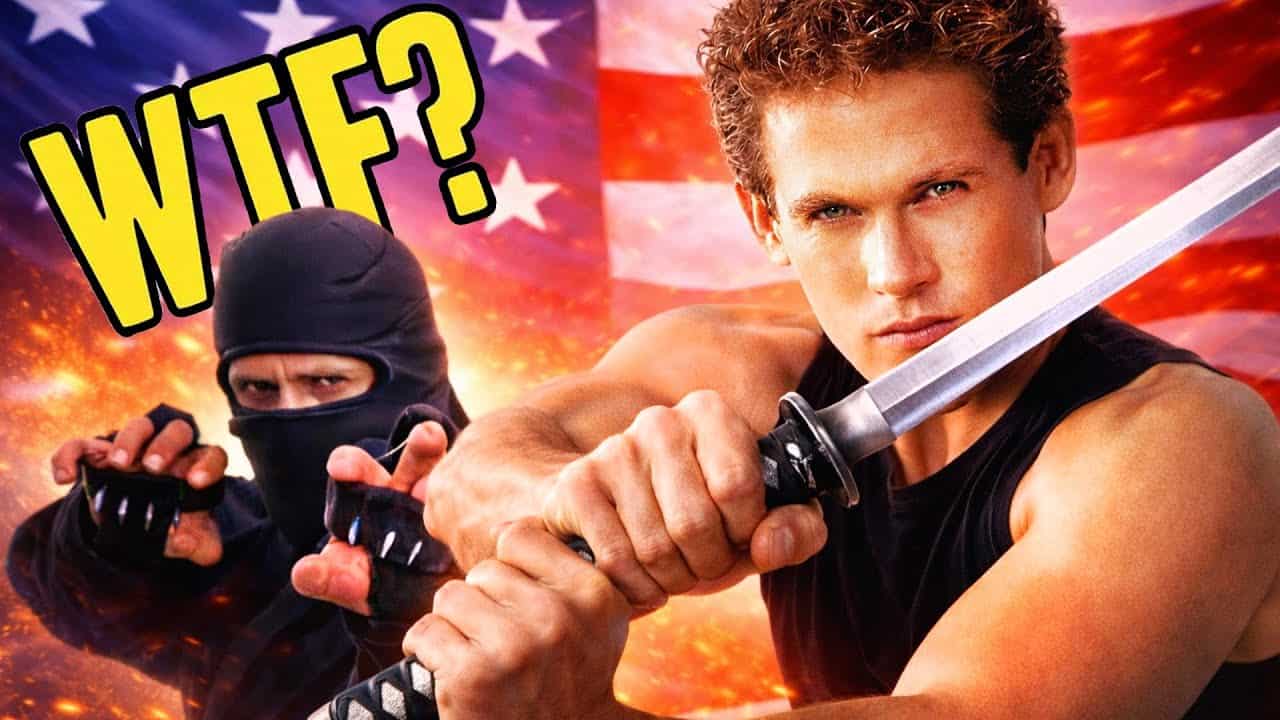
WTF Happened to American Ninja? The $1M Cannon Hit That Made Michael Dudikoff a Star
When ninjas working as mercenaries in the Philippines try to steal advanced military weaponry they can sell to the highest bidder, only one man can stop them — the American Ninja! So how did a movie starring a complete unknown become a runaway box office hit worldwide, spawning a franchise? It’s a groovy tale of ninja treachery, an aloof Chuck Norris, low-budget shooting in the Philippines, and… Bachelor Party? Stay with us as we tell you all about WTF Happened to American Ninja!
The Rise (and Fall) of Cannon Films
If you’ve never heard of Cannon Films, you’re missing out. Back in the 1980s, this independent company, run by Israeli cousins Menahem Golan and Yoram Globus, disrupted the studio system with a series of hugely successful low-budget action movies that — for a while — made them the envy of the industry. It all came crashing down when they became victims of their own success, greenlighting a slew of big-budget movies featuring top-tier talent, many of which performed disastrously and burned the company to the ground. But before any of that happened, The Cannon Group was known for cranking out a reliable series of low-budget action movies, most of which turned a profit. Basically, Cannon had five kinds of movies they made. On the one hand, there were the Chuck Norris movies, which typically sported bigger-than-usual budgets for the studio and came closest to breaking into the mainstream. These were movies like The Delta Force, Invasion U.S.A., and the Missing in Action series. The next tier down were the Charles Bronson movies. These were cheaper than the Norris movies and mostly made to capitalize on the home video market, with the most successful films being 10 to Midnight and the Death Wish sequels. Then there were the arthouse movies, with Menahem Golan — who yearned for critical respectability — funneling the Norris and Bronson profits into projects like John Cassavetes’ Love Streams, Jean-Luc Godard’s King Lear, and — best of all — Andrei Konchalovsky’s Runaway Train, arguably the best movie they ever produced. Then there were the fad movies, built around growing trends like breakdancing, with the Breakin’ films especially popular. Last — and perhaps least, as they had the lowest budgets — were the ninja movies.
Enter the Ninja Era
In 1981, Golan himself directed a movie called Enter the Ninja, which improbably cast Italian actor Franco Nero — dubbed — as an American ninja. He was blown off the screen by the movie’s villain, Sho Kosugi, who was such a sensation that he led the sequels, Revenge of the Ninja and Ninja III: The Domination. These films were directed by Sam Firstenberg, a young Israeli director with a keen sense of pacing and action. However, the third film in the series — a killer combo of Flashdance, The Exorcist, and a ninja movie — ticked off Kosugi, who felt he had been sidelined. He left the studio to make his own series of ninja movies, including 9 Deaths of the Ninja, Rage & Honor, and Black Eagle, which co-starred a young Jean-Claude Van Damme.
The Birth of American Ninja
So what was the studio to do with their ninja movies, which were still making money in theaters and on home video? The idea was hatched to return to the premise of Enter the Ninja by making the lead an American. Soon, Cannon announced that Chuck Norris would play the lead in American Ninja. Whether he was ever seriously intended to star is up for debate. Some sources say he didn’t want to just run around wearing a ninja mask — and given the finished film, he likely would have been miscast. Instead, the choice was made to go with an unknown. The man hired for the job was a young actor named Michael Dudikoff, who had co-starred a year earlier in the Tom Hanks comedy Bachelor Party. Dudikoff had no martial arts experience whatsoever, but Golan liked his look, admitting he resembled a young James Dean. The role was tailored to that presence, with his character, Joe, being an aloof rebel with a chip on his shoulder.
Plot Breakdown
In the film, we learn that Joe has no memory of his childhood and enlisted in the army after running into trouble with the law. When his unit is attacked by ninjas, Joe suddenly finds himself able to fight them off with skills that resemble their own — something that initially gets him into hot water but soon wins him a loyal friend in Steve James’ Jackson, the unit’s martial arts expert, as well as the adoration of his colonel’s daughter, Patricia (played by Judie Aronson).
Michael Dudikoff: The Unlikely Action Hero
Dudikoff, as mentioned earlier, was not a martial artist. Yet he was young, in good shape, and — most importantly — a gifted mimic. The movie’s martial arts choreographer, Mike Stone, and director Sam Firstenberg quickly realized that Dudikoff could recreate all the moves he was shown. While his on-screen fight scenes aren’t as dynamic as those of accomplished martial artists like Chuck Norris or Jean-Claude Van Damme, they still come off as credible — especially compared to someone like Ralph Macchio throwing unconvincing kicks in The Karate Kid movies. Dudikoff also benefits from having an amazing co-star in Steve James.
Steve James: The Secret Weapon
James was a familiar face in action movies of the era. A classically trained actor with superb martial arts skills, he was typically cast as the “best friend” in action films such as The Exterminator, the American Ninja series, McBain, and others. He also memorably played Kung Fu Joe in Keenen Ivory Wayans’ I’m Gonna Git You Sucka. He never truly got the chance to headline his own movie, although Firstenberg did cast him in the largely unknown film Riverbend, which has since been restored and screened at festivals. Sadly, James died at just forty-one years old from pancreatic cancer, never fully getting the opportunity to showcase his full range as a leading man. His charisma and chemistry with Dudikoff give American Ninja much of its heart.
Ninjas… In This Part of the World?
One of the most entertaining aspects of American Ninja is how casually the existence of ninjas is treated. When James tells his colonel, “Well, sir — I believe this is the work of ninjas,” and the response is, “Ninjas? In this part of the world?” — the film barely blinks. The evil clan, the Black Star Order, is led by the Black Star Ninja, played by Tadashi Yamashita. The character is practically a supervillain — vanishing into thin air and even shooting lasers — making him feel closer to a G.I. Joe villain than anything grounded in reality. Interestingly, Yamashita had once been marketed as “Bronson Lee” during the Bruceploitation era, capitalizing on both Bruce Lee and Charles Bronson’s popularity.
Low Budget, Big Success
Despite a reported budget of around $1 million, American Ninja looks far more expensive. Shot in the Philippines during the tail end of the Marcos regime — when many exploitation films were produced there — Firstenberg stretched every dollar to its limit. The film became a massive hit, earning more than ten times its budget in North America alone and performing even better overseas. Yet Cannon arguably failed Dudikoff. Instead of elevating him to bigger productions, they kept him confined to low-budget fare.
The Sequels and Aftermath
Dudikoff re-teamed with Firstenberg for Avenging Force — convolutedly a sequel to Invasion U.S.A. — and later starred in American Ninja 2: The Confrontation. However, shrinking budgets hurt the sequels. By the time American Ninja IIIrolled around, Dudikoff was absent, only returning midway through the fourth film. These later entries, shot in apartheid-era South Africa and not directed by Firstenberg, lacked the spark of the originals. As Cannon collapsed, Dudikoff continued in direct-to-video films before eventually stepping away from the spotlight.
Legacy
It’s hard not to wonder what might have happened had Cannon nurtured Dudikoff’s crossover appeal. He had presence, charisma, and a certain eighties cool that could have carried him into bigger projects. Even so, American Ninja remains a blast of eighties nostalgia — scrappy, earnest, and endlessly rewatchable. And sometimes, that’s more than enough.
The post WTF Happened to American Ninja? The $1M Cannon Hit That Made Michael Dudikoff a Star appeared first on JoBlo.