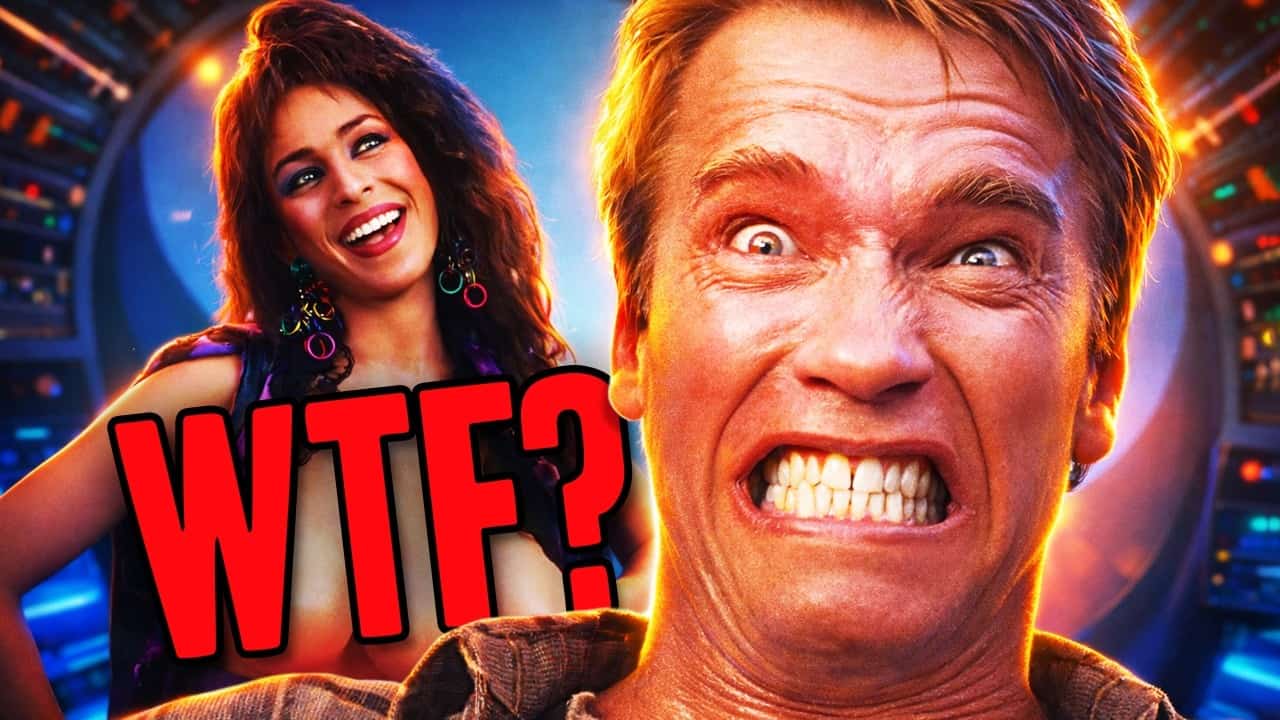
What Happened to Total Recall (1990)? The Chaotic Story Behind the Sci-Fi Classic
The What Happened to This Horror Movie episode on Total Recall was written by Jaime Vasquez:
Total Recall made a powerful debut, and its impact has lasted for decades. It’s loud, violent, satirical, and frequently absurd. But underneath the explosions and one-liners is a deeply uncomfortable idea: that even our memories might be something we can buy, sell, or rewrite. And somehow, Arnold Schwarzenegger, Paul Verhoeven, a fearless cast, and an enormous crew managed to bring that strange, ambitious story to life and do it justice.
At the time of its production, Total Recall was officially the most expensive movie ever made… second only to Rambo III. But beyond the massive financial cost, the film came with a very real emotional and physical toll on the people making it.
So what did it actually cost the cast and crew to finish the production? Which actors were considered for the role of Douglas Quaid before it ultimately went to Arnold Schwarzenegger? And are the events of Total Recall meant to be reality… or just an implanted dream? We’re headed to Mars on a mission to find out what happened to Total Recall.
The Philip K. Dick Story That Started It All
Writer Philip K. Dick originated the story that would eventually become Total Recall as a 23-page short story titled We Can Remember It for You Wholesale, published in The Magazine of Fantasy & Science Fiction.
While the title didn’t exactly scream summer blockbuster, screenwriter Ronald Shusett immediately saw the cinematic potential in Dick’s engagingly strange premise about a construction worker named Douglas Quaid whose dream vacation to Mars goes catastrophically wrong.
Shusett teamed up with Dan O’Bannon, fresh off co-writing Alien, to adapt the story for the screen. What followed was a development process that spiraled almost as wildly as the film itself. The screenplay went through at least forty drafts and bounced between multiple studios before finally landing with producer Dino De Laurentiis.
The Long Development Hell
Over the years, several directors cycled through the project, including David Cronenberg and Richard Rush.
Rush became particularly invested in a revised ending proposed by Shusett and O’Bannon, in which Quaid discovers an ancient alien device capable of restoring air to Mars. The problem was that De Laurentiis hated the idea, insisting he couldn’t visualize how it would work onscreen.
That skepticism briefly vanished when director Bruce Beresford signed on and bluntly told De Laurentiis that the ending was not only workable, but the strongest part of the script, and that scrapping it would be a mistake.
Against expectations, De Laurentiis relented, and for a moment Total Recall finally seemed ready to move forward.
And then… it didn’t.
Production stalled completely when Dino De Laurentiis’s company went bankrupt following a string of box-office failures. With its massive scope and expensive production estimates, the film sat in limbo for years, seemingly too ambitious to get off the ground.
Arnold Schwarzenegger Takes Control
Arnold Schwarzenegger, however, never forgot about the project.
After reading the script, he became captivated by its strange, cerebral take on action and science fiction, quietly tracking it as it bounced between studios.
When De Laurentiis, who never wanted Schwarzenegger in the lead role, was forced to step away, Arnold saw his opening. Partnering with producer Joel Silver, he moved to revive the film himself.
Schwarzenegger suggested Paul Verhoeven as director. The two hadn’t worked together yet, but Arnold admired Verhoeven’s bold, confrontational style and wanted a filmmaker who would challenge him rather than simply showcase him.
Ironically, Schwarzenegger had previously been deemed too bulky to fit into the RoboCop suit for Verhoeven’s 1987 hit RoboCop, but Total Recall would give them their first collaboration instead.
With Schwarzenegger attached, Carolco Pictures agreed to finance the project, greenlighting a budget estimated at around $65 million.
His international star power didn’t just secure funding, it ensured creative leverage. By this point, Arnold wasn’t just starring in Total Recall. He was helping steer it.
Casting Douglas Quaid
Dino De Laurentiis originally resisted casting Schwarzenegger because he didn’t think the former Mr. Universe could convincingly play an “everyday guy.”
During that time, Patrick Swayze was attached to play Quaid. Richard Dreyfuss was also seriously considered, since the role was originally envisioned as a more cerebral, ordinary man.
Other actors in the mix included Christopher Reeve, Matthew Broderick, and William Hurt.
Ironically, Schwarzenegger’s eventual involvement was exactly what allowed the film to finally move forward. And despite concerns, his performance leans heavily into vulnerability and uncertainty rather than brute force.
For a story built around memory, identity, and paranoia, that softer edge ends up being a surprisingly strong fit for Douglas Quaid.
Sharon Stone’s Intense Preparation
Schwarzenegger wasn’t the only one pushing beyond expectations.
His co-star Sharon Stone took the film’s physical demands just as seriously. Schwarzenegger later praised her work ethic and even referred to her as a “female Terminator.”
To prepare for the role of Lori Quaid, Stone trained extensively, lifting weights and studying Tae Kwon Do. She was eventually inducted as an honorary member of the Stuntwomen’s Association thanks to her work on the film.
The commitment came with a cost. By the end of production, Stone said she was covered in bruises.
While filming a love scene, Verhoeven asked Stone to reveal more than she was comfortable with, and she declined. Verhoeven ultimately worked with the footage he already had.
He later joked in a DVD commentary that he “got his revenge” on Stone in their next collaboration, Basic Instinct.
Michael Ironside and a Personal Struggle
Another casting choice Schwarzenegger strongly supported was Michael Ironside as Richter.
While his performance comes across as intimidating and precise on screen, the shoot was an emotionally difficult period for him.
During production, Ironside’s sister was battling cancer. Schwarzenegger noticed Ironside frequently stepping away between takes to use the phone and eventually asked what was going on.
After learning about the situation, Arnold invited Ironside into his trailer. The two spent more than an hour on a three-way call with his sister, offering encouragement and advice about exercise and nutrition.
Ironside later described the moment as deeply moving for both him and his sister.
Building Mars in Mexico City
Production moved to Mexico City and quickly grew into a massive undertaking.
For nearly nine months, working seven days a week, a crew of around 500 people built enormous environments using large-scale miniature sets. In total, the production used 45 sets across eight sound stages.
Many miniature environments were constructed on stages measuring roughly 180 by 90 feet, giving the filmmakers a massive physical playground to recreate the surface of Mars.
Total Recall became one of the last major Hollywood productions to rely heavily on practical miniature effects rather than digital imagery. The film uses very little CGI, with the most notable example being the brief X-ray skeleton gag.
The Production Was Brutal on the Crew
Production designer William Sandell later recalled that getting sick on set became almost routine in Mexico City.
Production manager and assistant director Elliot Schick was even hospitalized after struggling to breathe in the city’s heavy air, which Sandell compared to smoking two packs of cigarettes a day.
Screenwriter Ronald Shusett took unusually strict precautions, brushing his teeth only with bottled water and getting a vitamin B12 shot every week. While some crew members thought he was being overly cautious, Shusett later pointed out that he was one of the few people who avoided getting sick during production.
Paul Verhoeven Directed from a Stretcher
Director Paul Verhoeven later claimed he suffered severe food poisoning for nearly the entire shoot.
The production’s insurance didn’t cover his first three days in the hospital, and every additional day he couldn’t work would have meant a $150,000 deduction from the film’s budget.
By the end of the shoot, his condition became so serious that an ambulance was kept on standby on set at all times.
At one point Verhoeven was reportedly too weak to stand. Instead, he continued directing from a stretcher placed on top of a minivan.
Despite everything, he pushed through and finished the film.
On-Set Injuries and Accidents
The difficult conditions weren’t limited to the crew.
During the elevator fight sequence, Michael Ironside cracked a rib but continued filming by wearing a protective rib guard.
Schwarzenegger also suffered injuries during production. While filming the scene where Quaid shoots Dr. Edgemar, he broke a finger on his right hand and had to wear a cast. Scenes afterward were staged carefully to keep his hand out of frame.
Later, during the sequence where Quaid smashes through a train window, a small explosive charge meant to shatter the glass failed to trigger on cue. Schwarzenegger hit the window anyway and badly cut his hand.
The Three-Breasted Woman
Total Recall is also responsible for one of the most famously bizarre visual gags in mainstream science fiction.
Mary, the three-breasted woman briefly seen in a Martian bar, was originally designed with four breasts. The idea was dropped because the effect looked too much like a cow’s udder.
Actress Lycia Naff wore a full prosthetic chest plate that took roughly eight hours a day to apply.
She later said she initially accepted the role as a harmless joke but grew uncomfortable with the attention the scene received. Naff avoided promotional appearances and later expressed regret over taking the role.
Marketing the Movie
When it came time to promote the film, Schwarzenegger wasn’t happy with the original trailer. He felt it didn’t capture how strange and large-scale Total Recall really was.
He brought his concerns to producers Peter Guber and Jon Peters, who agreed that the marketing needed improvement.
A new trailer was cut that leaned more heavily into the film’s bizarre sci-fi tone.
Even then, Schwarzenegger wasn’t satisfied. Just weeks before release, public awareness was around 43 percent. Arnold pushed Carolco to spend more on advertising.
The studio agreed.
By the time Total Recall hit theaters, awareness had climbed to an astonishing 99 percent.
Release and Box Office Success
Total Recall premiered on June 1, 1990, opening at number one at the box office—an impressive debut for a film that had spent years in development hell.
It earned $119 million in the United States and Canada and another $142 million overseas, bringing its worldwide total to $261 million on an estimated $65 million budget.
Critics and audiences responded positively. The film holds an 81 percent approval rating on Rotten Tomatoes with a nearly identical audience score.
Oscar Recognition
The Academy also took notice.
Total Recall received nominations for Best Sound and Best Sound Effects Editing. It also won a Special Achievement Academy Award for Visual Effects.
The award recognized artists Eric Brevig, Rob Bottin, Tim McGovern, and Alex Funke.
The win was notable because the film relied primarily on practical miniature-based effects during a period when CGI was beginning to take over the industry.
Was It All a Dream?
Decades later, one question still follows Total Recall everywhere it goes.
Was any of it actually real?
Or was it all an implanted memory?
According to Paul Verhoeven, at least part of the story is grounded in reality. He has said that roughly the first twenty minutes, from the opening through the moment Quaid undergoes the Rekall memory implantation, are meant to be real events.
After that point, the line between fantasy and reality becomes intentionally blurred.
The 2012 Remake
In 2012, the film received a modern remake titled Total Recall, starring Colin Farrell, Kate Beckinsale, and Jessica Biel.
While the new version removed much of the original’s pulpy weirdness, it struggled to escape the shadow of Verhoeven’s film.
For many fans, the remake only reinforced how uniquely strange and difficult to replicate the 1990 version really is.
Legacy
That strangeness and lingering ambiguity is exactly why Total Recall has endured.
It represents a rare collision of blockbuster spectacle and genuinely strange storytelling. The film combines massive practical effects, ambitious world-building, and a director willing to embrace absurdity.
Schwarzenegger himself still remembers it as the most spectacular set he has ever worked on.
And somehow, all of the chaos behind the scenes helped create one of the most enduring, strange, and unforgettable science fiction action films of the 1990s.
And that, my friends, is what happened to Total Recall.
A couple of previous episodes of this show can be seen below. For more, check out the JoBlo Horror Originals YouTube channel—and don’t forget to subscribe!
The post What Happened to Total Recall (1990)? The Chaotic Story Behind the Sci-Fi Classic appeared first on JoBlo.