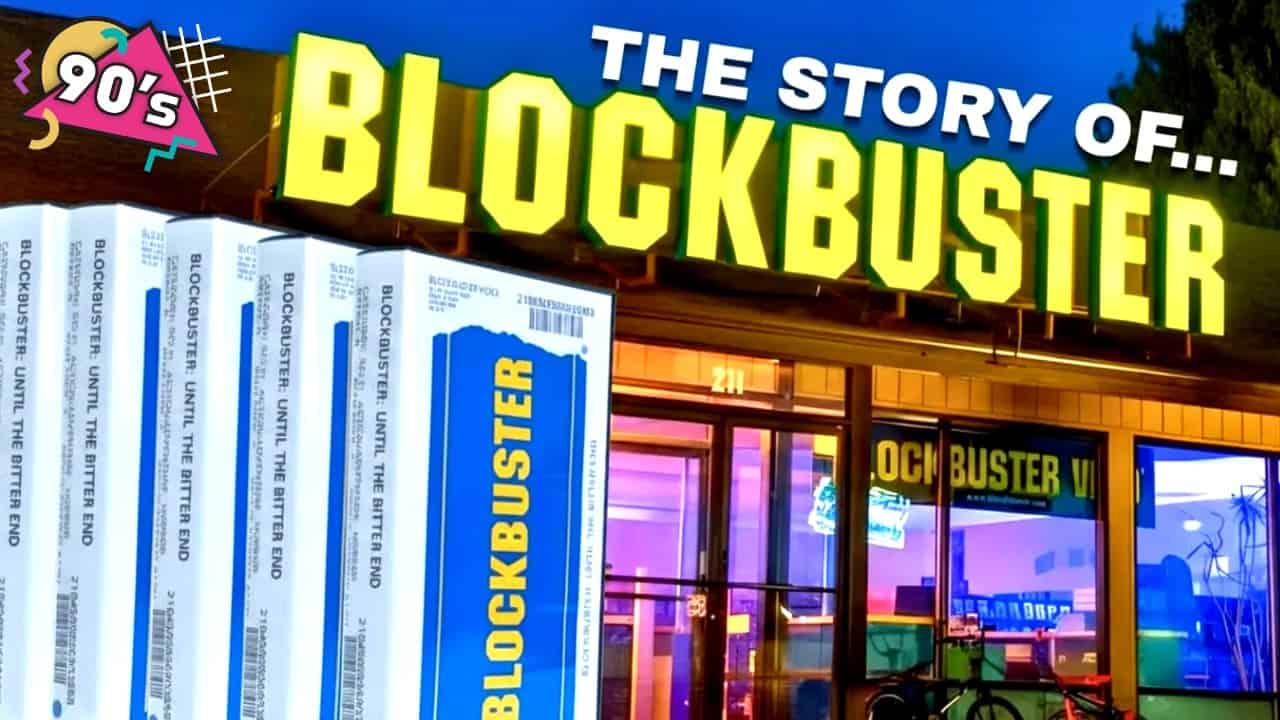
The Rise and Fall of Blockbuster Video: Why Renting Movies in the 90s Was the Best
Remembering the Magic of Video Stores
Today we’re basking in the 90s memories of heading to the video store with the family, your friends, a date, or yourself to rent a couple of those blue and yellow boxes. Something that used to be a requirement before a few hours of laughing, crying, or hiding behind the couch pillows in fear on a Friday night. We’ll also be covering the birth of video rentals and the rise and fall of Blockbuster Video specifically. Sure, the company itself did some terrible things and we’ll cover those too. But our nostalgia isn’t meant for the ghost of a corporate entity. It just so happens that their blue and yellow logo is simply the face of a bygone era of pure, unbridled, inconvenient joy. So with that being said, this is the story of the rise and fall of Blockbuster. But more importantly it’s a conduit to relive the awesome feeling of renting some video tapes in the 90s.
The Birth of Video Rentals
Blockbuster didn’t invent the idea of renting movies. That goes back at least as far as 1975 when Eckhard Baum in Kassel, Germany collected Super 8 films and began to rent them out. Two years later over in the United States, entrepreneur George Atkinson created The Video Station in Los Angeles with an inventory of around 50 VHS and Betamax tapes. He would charge $50 for annual membership or $100 for a lifetime membership that would allow customers to rent a VHS tape for $10 a day. If that seems steep, you have to remember that home video was but a luxury at the time with a Star Wars VHS tape running you almost $80, with your own VCR costing anywhere from $1000 to $1400. Which, adjusted for inflation, would be around five grand. Of course he was threatened with lawsuits from a Hollywood that wished they’d thought of his idea but realized that US Copyright Law allowed him the right to rent property that he purchased fair and square. And so it began.
How Blockbuster Video Started
Meanwhile, businessman David Cook was looking to get out of the software industry and into the home video rental market thanks to the smart advice of his wife, Sandy Cook. He started by hitching his wagon to the video store franchise Video Works in Dallas, TX but quickly jumped ship when they wouldn’t allow him to use the now iconic blue and yellow color design he had hoped to implement. And so, by 1985 Cook sold his software business and used the capital to open the very first Blockbuster Video.
The Technology That Helped Blockbuster Take Over
Through Cook’s research of the home video industry at the time he made several observations. Most companies were keeping their videos off the shelves for fear of theft of the expensive tapes. This in turn led to the employees spending copious amounts of time retrieving them for the customers. So he used his software skills to develop a system for inventory control and checkout. This is where those nostalgic little laser-scannable strips on the corners of those Blockbuster video tapes come from, as well as those sexy little plastic membership cards that we would constantly lose and have to ask the dude behind the counter to make again for us, all the while knowing that he knows that you still owe $27 in late fees for renting Ace Ventura for the fifth time and forgetting to return it. Lamination be damned, the process still saved a ton of time at the desk and made for a more organized, digital approach. To combat theft, they employed a magnetic anti-theft device on the tapes with a sensor at the door.
Cook also realized that he needed to differentiate his inventory from the competition. When the first Blockbuster opened in Dallas, TX the store featured over 8,000 tapes covering 6,500 different films. This would be key to Blockbuster’s success as for a while the bulk of their business actually came from film fans renting older, lesser-known films.
Blockbuster’s Explosive Growth
By 1987, Cook had nineteen Blockbuster stores and teamed up with a few other titans of industry in the Waste Management business (I know, it sounds like a Sopranos gag but it was actually the largest garbage disposal business in the world at the time). This included co-founder Wayne Huizenga as they expanded further. Huizenga and partners became an evil Pac-Man of sorts in the industry, buying up many of Blockbuster’s rival businesses. Cook, who had been more interested in simply franchising and selling his streamlined process to other entrepreneurs, left the company just two months later. No matter how hard they tried (probably not at all) the new owners of Blockbuster just couldn’t contain their insatiable bloodlust for murders and executions. Sorry, mergers and acquisitions. Just two years later, Blockbuster ran over 700 stores nationwide and were more than thriving. They were dominating. Conan style. I don’t mean that in a positive way for the business. It’s just an excuse to play this clip Conan.
Blockbuster at Its Peak
By 1993 the company controlled 25% of the global video market, making it the undisputed king of home entertainment. The pinnacle of this era occurred in 1994 when Viacom acquired Blockbuster for $8.4 billion. For several years the company felt invincible, fueled by a brilliant revenue-sharing model with movie studios that allowed them to stock hundreds of copies of new releases. At its height in 2004 the chain reached over 9,000 stores worldwide.
What It Was Like to Rent Movies in the 90s
But what goes up must come down and this is the part of the video where we stop talking about the suits and start talking about what it was like to be alive in the heyday of movie rentals. What sadly many will never experience about video rental was that it wasn’t just a successful business. It was a major pillar in the “what do you want to do tonight?” of human existence. As kids we begged our parents to take us to the rental store to rent a movie or five (after all, the older videos were cheaper and you could often rent them for longer). I remember spending summer days rounding up change from couch cushions and catching a ride to see just how many movies I could rent in a single trip based on change (my record was eight by the way and included GoldenEye, Billy Madison, and Halloween 6: The Curse of Michael Myers. Don’t you judge me).
Sure, it’s far more convenient to plop down on the sofa and pick up the remote and have a world of movies at your fingertips pants-less. But it doesn’t carry the same sense of community, reward, or experience as walking the aisles laughing about dumb movie titles or arguing about what to rent that evening. I once had a date tell me that we’re probably just “too different” to be together because she wanted to rent George Clooney’s Syriana and I held Beavis and Butt-Head Do America in my palms with a kung fu death grip. Sure, the hassle of returning the tapes was annoying and often the late fees were downright infuriating but the sights and smells and experiences were worth it. Whether that smell be dirty carpet in one of those rental stores with the porno back room or the fresh plastic smell of Blockbuster retail commerce in the morning didn’t matter. It was the place you went to start your evening, weekend, or summer day. Even better if you hit up takeout on the way home and popped the VHS in as you sat down to eat. As a kid I remember sitting in the car and opening the VHS tapes before we even got home to check out their nuances. Shoutout to Johnny Mnemonic’s orange VHS tape by the way. That one blew my mind.
Though it was probably, in the end, more expensive than clicking “rent” on Amazon Prime when it was all said and done, it was also a cheap way to turn watching a movie into an event. For ten bucks or so you could leave the house with your friends and have an experience before retiring home to pop that sucker in a VCR and see if you made the right decision. It was more of a gamble than you know, and you’d often end up watching something that sucked out of pure spite. Maybe it doesn’t sound like it. But I promise you. It was the fucking best. But as we know… it wasn’t meant to last.
Blockbuster’s Attempts to Expand
Over the years, the joy of video rentals turned to video game rentals as well. Despite, once again, the video game industry and specifically Nintendo trying to sue the option away. As time went on, Blockbuster alongside others tried desperately to innovate in ways to keep the home video market alive amidst an ever-changing landscape threatening to stop their massive takeover of the world, if not snuff them out entirely. In 1992, Blockbuster decided to get in on the compact disc craze by purchasing the Music Plus and Sound Warehouse chains and rebranding them as Blockbuster Music locations. On the surface it definitely made sense. There was nothing more infuriating than having to spend almost twenty bucks on a CD to find out the only good song on the entire album. You really had to fight, scratch, and claw to discover and own new music at the time. I can tell you it was exciting as a kid because you could go to what they called “listening stations” and hear snippets of bands and CDs that you had never heard before. They’d even let you return open CDs after you purchased them and briefly let you rent CDs as you would videos. However they flew too close to the sun with the music companies refusing to play ball and later the dawn of Napster changing everything. But that’s another video altogether. We’ll make it too, so make sure you click that subscribe button. By 1998 Blockbuster sold the music division for $115 million after spending nearly $200 million purchasing it from Music Plus and Sound Warehouse.
Why did Blockbuster go out of business?
After the acquisition by Viacom and for a while massive success, Blockbuster became ever douchey and heavily reliant on annoying and hefty late fees that were generating them $800 million in annual profit. At those rates no wonder even Patrick Bateman was worried about having his tapes dropped off in time. As much as I fondly remember the time period, I have to say it was an awful feeling to have wash over you that your copy of Broken Arrow fell off the back of your Zenith TV three weeks ago and you didn’t find out about it until the dude at the front desk refused to let you rent Mrs. Doubtfireuntil the $55 was paid. That’s when you went down to Hollywood Video and started a new line of debt.
These led to some crazy stories by the 2000s where in one instance a copy of Freddy Got Fingered led to a man having an active warrant for his arrest. In another case a woman spent the night in jail for forgetting to return Jennifer Lopez’s Monster-in-Law, albeit to a different video store. Some customers would drop their videos into the night bin only to have the employee miss the scan and find out years later they had accrued thousands in debt. This all led to Blockbuster declaring “the end of late fees” in 2005 in an attempt to combat streaming only to be sued by 47 state attorneys general for deceptive marketing, because in truth they were just charging folks the full price of the movie after seven days. Even if you returned the movie afterward your account was refunded, but not before it was hit with a “restocking fee.”
The Netflix Mistake
While Blockbuster was massively buying up everything it could during its heyday, these lawsuits were just one sign of many that they were actually building a house of cards ready to tumble down in spectacular fashion. Like the fun part of Solitaire when the cards go all over the screen. But like, not fun. You know the story. Netflix, then just a mail-in movie service, offered to sell to Blockbuster for a team-up at the price of a cool $50 million and were laughed out of the boardroom. Blockbuster followed up this poor decision to pivot with the times with a series of bad deals with Viacom and corporate infighting that led to them shedding their own streaming service Total Access (that was actually beating Netflix at the time). Then Redbox arrived, along with the convenience of renting movies for a dollar in front of every Walmart and CVS on every corner. Walmart themselves even started selling DVDs at prices so low they rivaled the cost of renting them for the night.
The Fall of Blockbuster
By 2010, Blockbuster filed for Chapter 11 bankruptcy and sold their remains to Dish Network for the $320 million fraction of what once was a business that had once been valued at $8.4 billion.
Today Blockbuster is a vision of nostalgia despite their brash corporate tactics. On one hand the company is a living museum, with its last location in Bend, Oregon still surviving. There’s even a documentary about its survival titled The Last Blockbuster, which you can ironically stream on Tubi for free. The brand itself is a corporate ghost, kept in the Dish Network vault that was briefly used as a streaming service called “Blockbuster on Demand” and is no longer in service.
And so that is the story of the company of Blockbuster. But the memories and fun of video rentals will forever live on in the hearts of 90s kids everywhere.
The post The Rise and Fall of Blockbuster Video: Why Renting Movies in the 90s Was the Best appeared first on JoBlo.