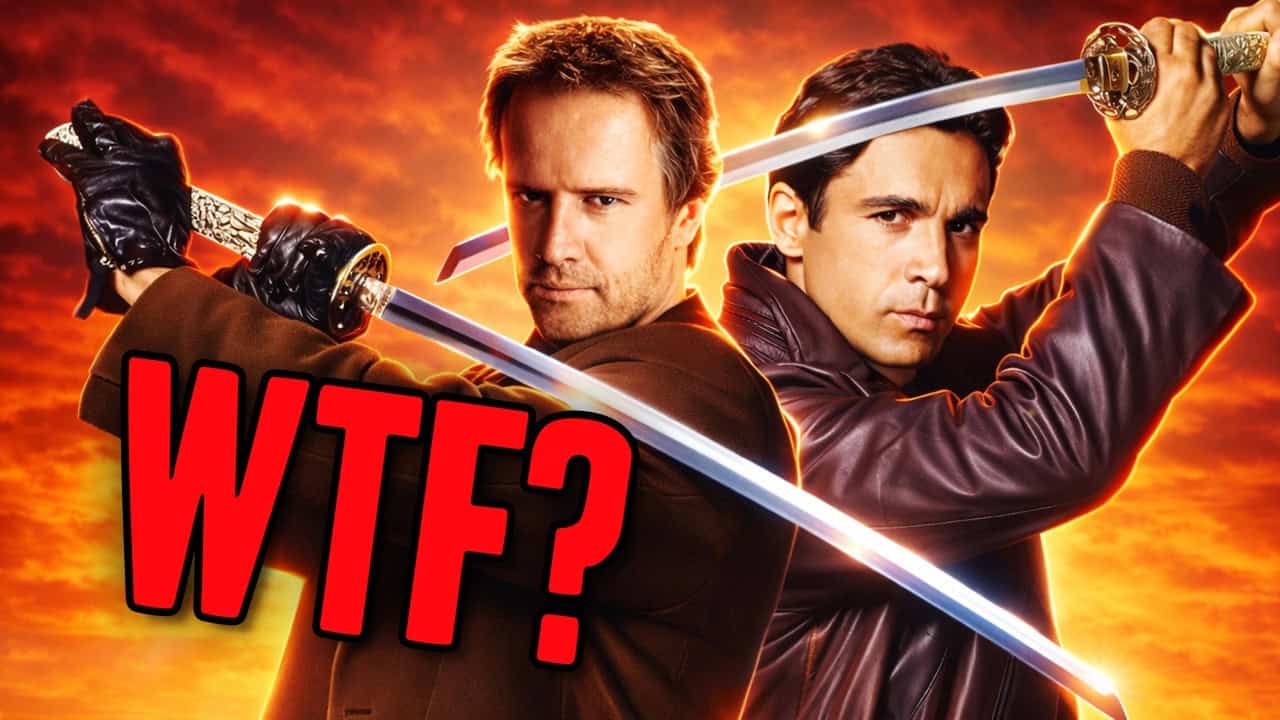
Highlander: Endgame: The Messy Film That Tried to Unite the Franchise
As we continue to chronicle the checkered production history of the cinematic Highlander saga, all eyes turn to Highlander: Endgame, the fourth theatrical entry in the film franchise that also functions as a continual mashup of the TV series starring Adrian Paul. Famously uniting the big and small-screen characters Connor and Duncan MacLeod, Highlander: Endgame bridges the gap between the movie and television versions and marks the fifth and final time Christopher Lambert starred as the badass Scottish warrior.
Originally envisioned to connect Highlander: The Series with the TV spin-off Highlander: The Raven, plans were radically altered when The Raven was swiftly canceled due to poor ratings and a network change. The result created a massive disparity between the original screenplay draft and the final cut of Highlander: Endgame, forcing Miramax to delay the release and prompting a contentious “Producer’s Cut” that ran 14 minutes longer than the theatrical cut and featured an alternate ending.
Perhaps most troubling, Highlander: Endgame shamelessly recycles enhanced footage from the original Highlander and feels like a patchwork hodgepodge of franchise loose ends hastily tied together at the last minute. And yet, it still might be better than the previous two installments combined.
So, as the expensive new franchise reboot continues to attract big names, it’s time to unearth the Holy Ground and find out what happened to Highlander: Endgame roughly 25 years ago.
Development
The confusing nature of Highlander: Endgame is directly related to its misguided intent. Meant to fuse the mythological canon between the film and TV series, the original screenplay bears little resemblance to the theatrical release. For instance, Kate MacLeod was named Alexis in early drafts, with most of the flashbacks taking place in Shanghai rather than Ireland. In those versions, the TV character Hugh Fitzcairn appeared during these sequences. Methos’ home was originally located in Paris instead of London, and Duncan lived aboard a French cargo ship during the contemporary timeline.
Original Highlander screenwriter Gregory Widen worked on several early drafts under titles such as:
The Immortals
The Search for Connor
World Without End
Although Widen, who directed The Prophecy, was once in talks to helm Highlander: Endgame, he ultimately received only a “Characters Created By” credit when Eric Bernt and Gillian Horvath began developing the story and Joel Soisson wrote the final screenplay. With too many chefs in the kitchen, Highlander 4 was already overcooked before filming began.
Before Bruce Payne was cast as Jacob Kell, the villainous immortal who murders Connor’s mother and forces the MacLeods into battle, several surprising names were considered for the role, including:
David Bowie
Billy Idol
Jean-Claude Van Damme
Notably, Kell marked the fourth Highlander villain whose name began with the letter K, following the Kurgan, Katana, and Kane.
Meanwhile, Lucy Lawless and Juliet Landau were considered for the role of Kate (also known as Faith). Lawless was interested but had to decline due to scheduling conflicts with her hit TV series Xena: Warrior Princess. The role ultimately went to Lisa Barbuscia.
The character Jin Ke was loosely inspired by Jing Ke, the historical figure known for his failed attempt to assassinate Emperor Qin Shi Huang in 227 BC. Martial arts legend Donnie Yen played Jin Ke and also served as the film’s martial arts choreographer.
If it seems strange that director Doug Aarniokoski hasn’t been mentioned yet, there’s a reason: he was hired only five weeks before principal photography began. With almost no pre-production time, it’s no surprise that Highlander: Endgame often feels like a rushed rehash of the original.
Producers Peter Davis and William Panzer initially wanted to shoot the film in Vancouver, Canada, to match the TV series’ production. However, Dimension Films insisted on filming in Romania as a cost-saving measure, a decision that frustrated the producers and strained their relationship with the studio.
Principal Photography
Armed with a $25 million budget, Highlander: Endgame began filming in Romania on October 22, 1999, and wrapped on March 7, 2000.
The film was photographed by Full Metal Jacket cinematographer Douglas Milsome.
While most filming took place on location and at Castel Film Studios in Bucharest, additional scenes were shot in:
London
Paris
New York
Appin in the Scottish Highlands
Specific Scottish locations included Loch Linnhe, Loch Laich, and Castle Stalker.
Faith’s fashion show sequence was filmed during London’s Millennium Dome Exhibition.
During production, Bruce Payne became severely ill with bronchitis, forcing the production to declare a “Force Majeure” shutdown for nearly three months. When filming resumed, Payne refused to return to Romania, and most of his remaining fight scenes were filmed in London instead.
One unusual filming location involved the Sanctuary scenes. When the story jumps ahead to 1994 and Connor visits the Sanctuary following Rachel’s death, the interior scenes were filmed 600 feet underground in a deserted salt mine in Bucharest. With only a single working elevator, cast and crew had to take turns traveling between the surface and the set.
Interestingly, fans later complained about the script repeatedly referring to the Sanctuary as “Holy Ground,” since the Highlander mythos traditionally forbids immortals from fighting on such sacred land. As a result, these references were removed from the DVD release.
Script Changes and Editing Problems
Just as there were major differences between the script and the theatrical version, there were also huge discrepancies between what was filmed and what ultimately appeared on screen.
For example, Connor originally set the town of Glenfinnan on fire in the 1555 timeline. Producers felt this made the character too cruel, so the scene was re-edited to imply the fire started accidentally.
An early subplot also required Kell to kill 666 immortals to gain immense supernatural power. To reach that number, he slaughtered many of his own followers before targeting Jin Ke. However, when Jin Ke commits suicide, Kell instead turns his attention to Duncan to reach the fatal threshold. This entire storyline was removed from the theatrical version, although traces remain, including a moment when Kell’s kill count reaches 661.
The infamous “Last Supper” sequence also changed drastically in editing. Jin Ke was originally supposed to impale a wall with his sword and decapitate himself using the blade when he realized Kell couldn’t be defeated. Instead, the final cut awkwardly implies Kell kills him off-screen.
Because of these inconsistencies between writing, filming, and editing, the narrative became a confusing jumble. Eventually, Davis and Panzer released their own “Producer’s Cut” on DVD featuring a different ending.
Studio Cuts and Trailer Footage That Never Appeared
After filming wrapped in March 2000, distributor Dimension Films demanded heavy edits to speed up the film’s pacing. Unfortunately, many of the removed scenes contained crucial exposition explaining the rules of the Highlander universe. Without these explanations, new viewers were left confused.
Originally, the film was supposed to open with a sequence explaining that the story takes place in an alternate reality created after Connor won the Prize in Highlander. This concept was abandoned because it was deemed far too complicated.
Even the movie’s trailer features footage that never appears in the final film. In the trailer, Kell displays supernatural powers such as:
creating clones of himself
summoning mystical orbs
generating protective force fields
None of these abilities appear in the finished movie.
Another unused moment shows Connor and Duncan jumping through a time portal together.
Director Doug Aarniokoski later claimed this footage was created solely for promotional purposes.
Recycled Footage from the Original Highlander
Perhaps the most awkward moment in the film is its blatant reuse of footage from the original Highlander.
Four shots were lifted directly from the 1986 film:
A CG-altered shot of Glenfinnan originally showing Connor leaving his village.
The Silvercup Studios sign from the scene where the Kurgan escorts Brenda.
Two rooftop Quickening shots of Connor and Heather.
Fans quickly noticed the recycled footage.
Release, Reception, and Franchise Fallout
Highlander: Endgame was originally meant to release in 1999 alongside the TV spin-off Highlander: The Raven. When the show was canceled due to low ratings and syndication changes, the film’s release was delayed. The movie finally opened on September 1, 2000.
At the box office, it earned $15.8 million against a $25 million budget, making it a disappointment.
Critics were mixed. Some enjoyed it more than Highlander II: The Quickening and Highlander III: The Sorcerer, but few considered it a good film. The franchise went dormant for seven years, until the release of Highlander: The Source in 2007.
The Producer’s Cut and Alternate Ending
After Dimension Films forced the theatrical version down to 87 minutes, producers Davis and Panzer assembled their own Producer’s Cut for DVD. This version added roughly 12 minutes of footage, along with improved color grading, sound, and visual effects.
The biggest difference involved Kate’s fate. In the theatrical version, it’s implied that Kell kills Kate during the Last Supper massacre. In the Producer’s Cut, however, she survives.
The alternate ending shows Duncan celebrating New Year’s in the United States when Kate suddenly appears and reveals that Kell spared her life. Assuring Duncan that her Faith persona is gone forever, she kisses him and the two rekindle their romance.
Additional restored scenes include:
a new opening sequence in New York
Rachel entering Connor’s antiques store before it explodes
an extended confrontation between Duncan and Kell
the introduction and death of Watcher Matthew Hale
a longer flashback to Duncan and Kate’s wedding
A rough workprint version on the Region 1 DVD also introduced a subplot where Connor donated Christmas trees to an orphanage every year, a tradition Duncan continues after Connor’s death.
Most fans agree the Producer’s Cut is the superior version, as it restores crucial mythology and narrative clarity.
The Future of the Franchise
Meanwhile, a long-gestating Highlander reboot has remained in development since 2008. The newest version will star Henry Cavill as MacLeod and will be directed by John Wick filmmaker Chad Stahelski.
Recent announcements indicate a large cast that includes:
Dave Bautista as the Kurgan
Russell Crowe as Ramirez
Karen Gillan as Heather MacLeod
Drew McIntyre as Angus MacLeod
With the reboot generating renewed excitement, now is the perfect time to revisit the chaotic production of Highlander: Endgame.
A couple of previous episodes of this show can be seen below. For more, check out the JoBlo Horror Originals YouTube channel—and don’t forget to subscribe!
The post Highlander: Endgame: The Messy Film That Tried to Unite the Franchise appeared first on JoBlo.