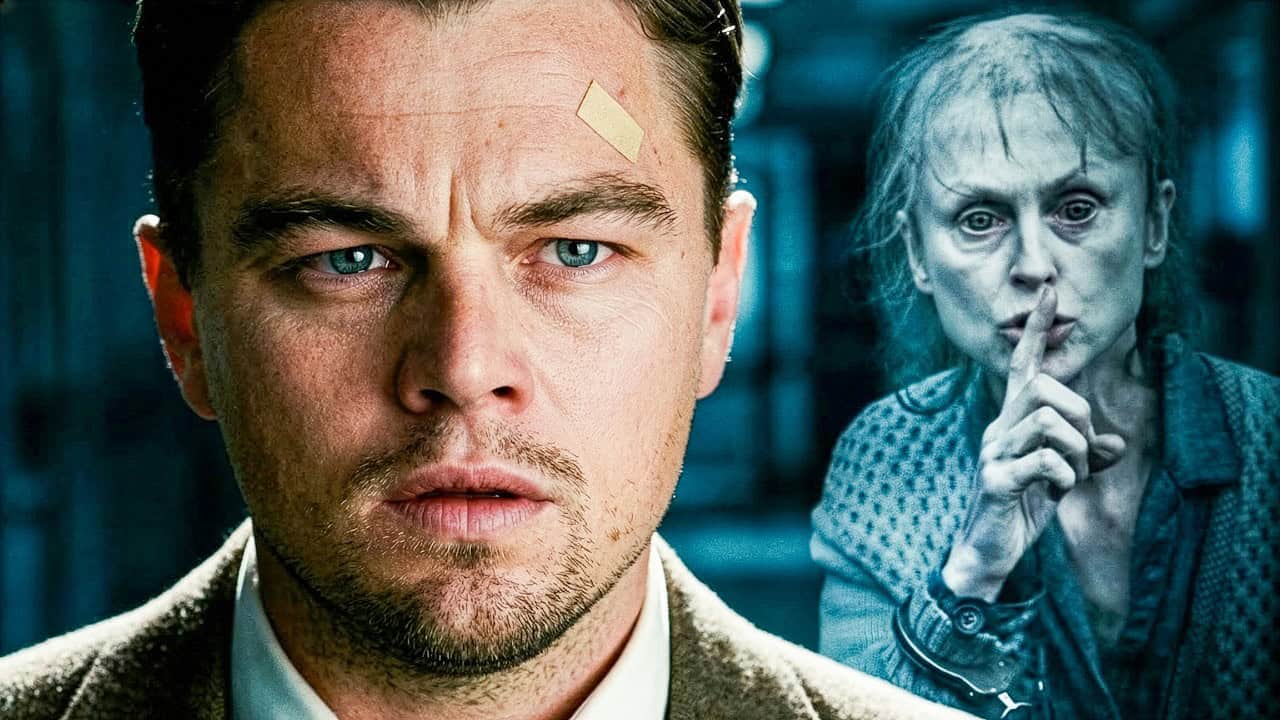
Shutter Island Explained: The Soul-Crushing Truth You Missed
Who doesn’t love a good conspiracy theory? Don’t worry—we’re only talking movies here.
Whether it’s Jar Jar Binks secretly being a Sith Lord, John Mason in The Rock actually being 007, or even my personal favorite—Kevin McCallister growing up to be Jigsaw—we could fall down the rabbit hole for days. But what about the theory of Shutter Island being a secret government mind-control facility? Have you heard this one yet? Edward “Teddy” Daniels sure has. However, the truth is much uglier, and it’s laid out before your very eyes in the first moments of the film, in subliminal clues you didn’t even catch.
Today, we’re taking the ferry over to figure out exactly what’s going on. We’re decoding the hints you completely missed, discussing the harsh realities of one hell of a role-playing game, and explaining why the bleakest plot twist of the 2010s is NOT a cop-out. All to arrive at one final, soul-crushing question: “Which would be worse? To live as a monster, or to die as a good man?”
Let’s set the scene, shall we? The fog breaks to reveal a ferry. You hear the ominous pounding of the waves before you ever see them. A hopelessly seasick U.S. Marshal is staring into a grimy bathroom mirror, splashing water on his face to wash away a dream that—though he doesn’t know it—he’s already walking through. We know from the jump, the moment Martin Scorsese sets us down on Shutter Island, that something is horribly, fundamentally wrong.
In the majority of thrillers, the key to the mystery is carefully concealed until the big reveal in the third act. The film tricks you into thinking you’re one step ahead before blindfolding you and pointing you in the direction of the nearest cliff. It’s like hiding an ace up a sleeve until the final act, when they reveal it and yell, “Gotcha, bitch!” In Shutter Island, however, the ace is right in front of your eyes the entire time. The film shoves the brutal, heartbreaking truth right under our noses from the opening shot. It beats us into submission to the point that we’re locked inside this tortured mind, willing to do anything but see that magic trick revealed. We are shown all the pieces of the puzzle in the first 10 minutes—but we’re too blind to see them.
When the flick hit theaters in early 2010, audiences expected some creepy asylum mystery that was tonally different from Scorsese’s previous film, The Departed. The film was released as just another creepy asylum thriller. Sure, that’s what we got—but what people also received was a lesson in psychological horror. A puzzle of off-screen symbolism.
THE FEBRUARY DUMPING GROUND
Now let’s travel back to the beginning of 2010 and reality. Paramount Pictures had a big problem. At least, this is what the Hollywood trades knew for certain back then. Martin Scorsese’s hotly anticipated thriller—intended to be released in October 2009, in the heart of awards season—was being held over until February 2010.
We all follow the film business, right? It’s February. That’s the graveyard shift—the place where studios go to dump movies they can no longer spend money on advertising. Paramount claimed they didn’t have the budget in 2009 to mount an Oscar campaign, but no one bought that. Everyone immediately assumed the worst. The speculation was that Scorsese and Leonardo DiCaprio had finally created a massive, expensive failure. That it was bloated and confusing.
But once the film actually hit theaters, it subverted all of those preconceptions. It wasn’t a watered-down awards-season drama—it was a brash, pulpy, Grade-B genre film done to perfection. It showed the world that Scorsese could craft a chilling, atmospheric horror film just as easily as a crime saga. It grossed over $294 million and featured one of the most stunning plot reveals of its time—one that completely alters how you view the film on a second watch.
THE GREATEST ROLE-PLAYING GAME EVER MASTERMINDED
So let’s start with the biggest rumors. No, Shutter Island is not a government mind-control facility, and no, there are no evil doctors who brainwash U.S. Marshal Teddy Daniels by the end of the film. The reality is much more painful and personal.
DiCaprio’s Teddy Daniels is actually Andrew Laeddis—the very sick, extremely violent Patient 67 who murdered his wife after she drowned their three children in the lake behind their picturesque farmhouse.
How about Teddy’s lavish, hard-boiled investigation into the island’s dark secrets? It never actually happened. It was a game—a game of extreme, incredibly elaborate make-believe. The entire thing was scripted by Dr. Cawley and Teddy’s partner Chuck, who is actually his psychiatrist, Dr. Sheehan.
They believe that, with enough radical empathy and boundary-pushing therapy, they can cure Andrew of his violent delusions. They’re putting their careers on the line to save his life—and quite honestly, they’re the most sympathetic people in Andrew’s world.
On the other side, we have the Warden and Dr. Naehring. They believe men like Andrew are too far gone. They represent a harsher, more old-school approach to psychiatry—one that favors restraint, sedation, and ultimately lobotomy.
All of this becomes a high-stakes version of the emperor’s new clothes. Cawley and Sheehan must allow Andrew to live out his fantasy until it collapses in on itself. They must let him chase every conspiracy until he hits a literal brick wall. There’s no other way to force him to confront the nightmare of his reality.
THE MARK RUFFALO MASTERCLASS IN DECEPTION
Once you understand the rules of the game, it becomes essential to rewatch Mark Ruffalo’s performance as Chuck.
At first, he seems like a generic, slightly awkward partner. But on a second viewing, you realize he’s delivering one of the most subtle and impressive performances of his career.
Look at him in the early scenes. When they have to surrender their guns, he struggles to remove his from the holster. He’s inept. Even Teddy notices. Why would a U.S. Marshal struggle with something so basic? Because he’s not a marshal—he’s a doctor who’s probably never handled a gun.
Every word Chuck says is calculated. He asks leading questions. He validates Teddy’s paranoia. When Teddy spirals into conspiracy theories about Nazi experiments and mind control, Chuck doesn’t challenge him—he encourages him.
Ruffalo is playing a man pretending to be a cop, while also conveying the genuine concern of a doctor watching his patient unravel. It’s phenomenal acting hiding in plain sight.
FIRE, WATER, AND THE INVISIBLE CLUES
Scorsese fills the film with subtle, almost subliminal cues that we’re seeing the world through a fractured mind.
One of the most obvious motifs is the contrast between fire and water.
Fire represents Andrew’s delusion. Whenever Teddy is near fire, he experiences hallucinations—visions of his wife, Dolores, and moments where he feels heroic and in control.
Water represents truth—the unbearable truth. It’s tied directly to the death of his children. It makes him physically ill and emotionally unstable throughout the film.
There’s also the famous continuity glitch in the interrogation scene: a woman drinks from an invisible glass, which suddenly appears in the next shot. We don’t notice it because we’re experiencing reality the same way Teddy is—through a mind that refuses to acknowledge trauma.
There are countless other clues: guards acting uneasy around him, patients reacting strangely, and small details—like Teddy not having his own cigarettes—hinting that he’s not who he thinks he is.
THE FINAL TRAGEDY
The lighthouse reveal strips everything away. There are no experiments. No conspiracies. Just truth.
And the most devastating twist comes after. The treatment works. Andrew remembers everything. He understands what he’s done.
But he can’t live with it. So he makes a choice.
He chooses to become Teddy Daniels again—knowing it will lead to his lobotomy. Knowing it will erase him.
Because, in his mind, it’s better to die as a good man than to live as a monster.
This isn’t a story about mind control or sinister doctors. It’s about grief. Guilt. Trauma.
And the terrifying lengths the human mind will go to in order to escape reality. Andrew Laeddis didn’t just lose his family—he built an entire world to avoid facing what happened.And when that world finally collapsed… he chose oblivion.
That’s what makes Shutter Island so powerful. It’s not just a twist—it’s a tragedy.
The post Shutter Island Explained: The Soul-Crushing Truth You Missed appeared first on JoBlo.