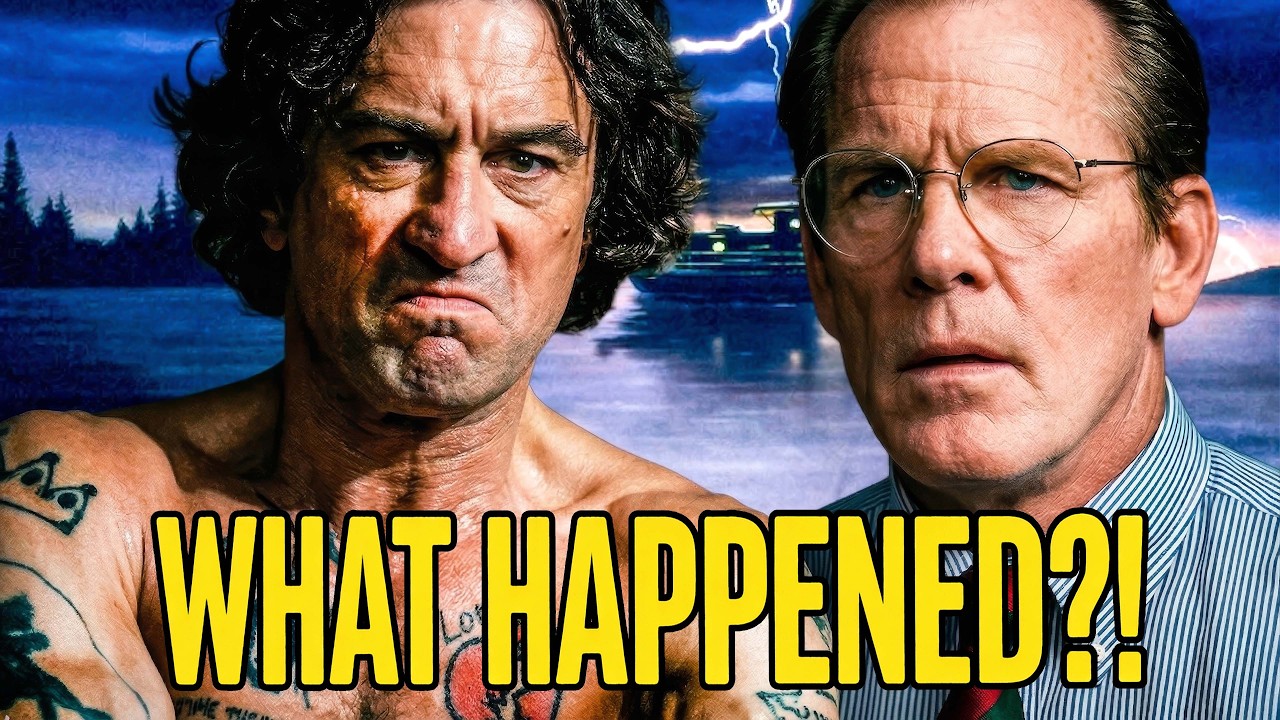
WTF Happened to Martin Scorsese’s Cape Fear?
New York, New York, The King of Comedy, After Hours, Bringing out the Dead, you name it – the peerless Martin Scorsese has no shortage of minor key masterpieces that often go overshadowed by his all-time cinematic classics. But when it comes to his most successful unmined gems, it’s hard to escape the stylish Hitchcockian homage of Cape Fear, a studio venture that became the first Scorsese film to cross the $100 million threshold at the box office. Although commercial success hardly motivates Scorsese as it does some other mainstream filmmakers, Cape Fear’s success was all the sweeter considering that it was made at Universal Studios, where Scorsese’s controversial biblical epic The Last Temptation of Christ notoriously led to death threats three years earlier.
Vowing to return the favor for Universal blessing Christ’s international release, Cape Fear was the first in a two-picture deal Scorsese agreed to with the studio. Yet, stubbornly reluctant to make the film for several years, Scorsese finally relented and agreed to make Cape Fear at the insistence of Robert De Niro, who was hellbent on playing Max Cady, and the great Steven Spielberg, who was originally set to make Cape Fear himself. Believe it or not, Scorsese was lined up to direct Schindler’s List, but agreed to trade projects with Spielberg, as they aligned better with each filmmaker’s lifelong sensibilities. But that’s just scratching the surface. With the film turning 35 this November – Come out, come out wherever you are – it’s only right we find out what the f*ck happened to Cape Fear!
It’s actually a remake
A well-funded remake of the 1962 Southern Gothic psycho-thriller starring Gregory Peck and Robert Mitchum, Cape Fear’s screenplay was adapted by Wesley Strick. Although the original movie took cues from John D. MacDonald’s 1957 novel The Executioners, Strick used James R. Webb’s screenplay for the first film as a blueprint for the remake. At the time, Steven Spielberg was developing the project at Amblin Entertainment for himself to direct. However, realizing the material was too dark and violent for his brand of cinema, Spielberg passed the project to Martin Scorsese, knowing that Cape Fear was better suited to Scorsese’s cinematic corpus. Spielberg also saw the mainstream commercial potential of Cape Fear, which would empower Scorsese and enable him to secure funding for his future films.
But Scorsese took convincing. After reading Wesley Strick’s script three times while making Goodfellas, Scorsese hated it more each time and detested how happy the cheerful Bowden family was more interested in seeing them in a state of misery. It took one year to talk Scorsese into directing the film, with 24 revisions to the screenplay made before the cameras rolled. In addition to the enhanced rewrites, Robert De Niro was obsessively adamant about portraying southern-fried serial rapist and religious fanatic Max Cady and badgered Scorsese until he agreed to collaborate on the film. To persuade the filmmaker, De Niro ran scenes as Cady with married couple Kevin Kline and Phoebe Cates playing Sam as Danielle. Once agreeing to direct, Cape Fear marked the seventh time De Niro and Scorsese worked together, in what is arguably the most famous actor-director duo of all time.
Another reason Scorsese took convincing was that he was preparing to direct Schindler’s List. However, when he decided not to make the Holocaust drama, he traded the project with Spielberg and eventually agreed to direct Cape Fear for Universal. Despite deliberately taking his personal name off the credits, Spielberg produced behind the scenes for Amblin Entertainment in the company’s first R-rated feature.
Assembling a killer cast
Once the script was polished to Scorsese’s standard, the casting phase began. With De Niro lined up to play Max Cady, Scorsese originally wanted Harrison Ford to portray the morally vexed lawyer, Sam Bowden. However, Ford was only interested in playing the psychotic Cady and flat-out refused to take the safer, more straightforward role. Scorsese had De Niro personally call Ford to persuade him to participate, but Ford ultimately declined. Other actors briefly considered included Warren Beatty, Jeff Bridges, James Caan, Kevin Costner, Richard Gere, Mel Gibson, Dennis Quaid, Christopher Reeve, and Robert Redford.
Nick Nolte, with whom Scorsese had worked in a short segment of New York Stories in 1989, was eager to play the ethically challenged Sam Bowden and convinced the director to cast him instead. For what it’s worth, when Spielberg was attached as director, he envisioned Bill Murray as Max Cady, which would have been pretty radical, to say the least.
De Niro’s transformation
Due to the height difference between the 5’9” De Niro and the 6’1” Nolte, efforts were made to put the two actors on equal footing to create a fairer fight for Cady and Bowden. For instance, Nolte lost significant weight to appear more slender than his typical tough-guy appearance. Meanwhile, De Niro spent eight months beefing up and gaining approximately 25 to 30 pounds of muscle to bolster Cady’s strapping physique, reducing his body fat to 3 or 4% by sticking to a strict diet regimen, doing 600 crunches daily.
As for his sinister southern drawl, De Niro adapted Cady’s distinct dialect after playing a character from Arkansas in Roger Corman’s Bloody Mama in 1970. De Niro prepared for the role and perfected the thick regional accent by taking dialogue from the script to various southern towns and asking locals to recite lines into a tape recorder. Scorsese was so terrified of De Niro’s wicked way of speaking that the actor would routinely telephone the director and torment him with creepy voice messages as Cady on his answering machine.
Further showing his devotion to the role, De Niro paid a dentist $5,000 to mangle his teeth to suit Cady’s poor, criminal background. After the film wrapped, he paid the same dentist $20,000 to restore his pearly whites. As for Cady’s pious tattoos, they were made of vegetable dye, which washes off after a few months. Also, before filming, De Niro studied predatory sex crimes and serial rapists to prepare for the role, going so far as to improvise the mortifying moment when Cady bites Lori Davis in bed. Taking full ownership of the character, De Niro also helped costume designer Rita Ryack select Max’s touristy wardrobe.
Despite their combative characters, De Niro and Nolte got along quite well while making Cape Fear. Such was not the case for Peck and Mitchum while filming the 1962 original. Even so, Scorsese cast Peck in his final theatrical film role as Cady’s lawyer, Lee Heller, and cast Mitchum as Lieutenant Elgart in the remake. Mitchum was a last-minute replacement for George C. Scott, who agreed to play Elgart but had to bow out due to pressing health concerns. Meanwhile, Martin Balsam, who played Police Chief Mark Dutton in the original, plays the judge in the remake. Scorsese also wanted Tellly Savalas to return, but it didn’t materialize.
Past the cool cameos that connect to the movie’s predecessor, casting Sam’s soon-to-be 16-year-old daughter Danielle proved to be far more painstaking. Several young actresses auditioned for the role, most famously including Drew Barrymore and Reese Witherspoon. Nicole Kidman aggressively lobbied for the role despite being 23 at the time, but Scorsese wanted someone younger. Actresses who were offered but declined the role included Jennifer Connelly, Winona Ryder, Tiffany Thiesen, Christina Applegate, and Alyssa Milano, who was pressured by her Who’s the Boss costar Tony Danza to decline.
Others considered for Dani included Shannen Doherty, Bridget Fonda, Jodie Foster, Helen Hunt, Diane Lane, Demi Moore, Sarah Jessica Parker, Molly Ringwald, Meg Ryan, and Brooke Shields. Of course, looking back, it’s hard to envision anyone other than Juliette Lewis playing Dani in her sole Oscar-nominated career performance.
As for Leigh Bowden, Diane Keaton discussed the part with Scorsese and De Niro before the great Jessica Lange won the role.
With a superb ensemble locked in place, Scorsese had all the studio support needed when allotted a $35 million production budget. Cape Fear commenced principal photography on November 19, 1990, and wrapped on March 17, 1991. Although the story is set in the fictional New Essex, North Carolina, the 17-week shoot took place primarily in Savannah, Georgia, and South Florida, with the Bowdens’ sprawling manse filmed in Fort Lauderdale and the boat scenes partially filmed in Jupiter.
To achieve the sweltering veneer of the sweaty south, Scorsese hired the outstanding cinematographer and accomplished horror director Freddie Francis, who famously shot The Innocents, The Elephant Man, Glory, and many others. Although Robert Richardson auditioned to light and lens Cape Fear, Scorsese went with Francis, but hired Richardson for his next film, Casino, in the first of seven career collaborations.
For the Bowden abode, Scorsese instinctively knew he wanted their home to be flanked by towering oak trees, shrouded with dangling Spanish moss, providing the perfect dark hideout for Cady towards the end of the film.
For the first time in Scorsese’s career, he opted to film Cape Fear in a widescreen 2.1:39 format. The director had previously avoided shooting on such a format out of worry that home video pan-and-scan transfers would ruin the imagery of his films. By the 1990s, Scorsese knew that movies would receive widescreen home video releases and opted for a wider frame in Cape Fear.
Striking a balance
Beyond the technical format, Scorsese and Francis purposely emulated the filmmaking style of the master of suspense, Alfred Hitchcock, as was the original 1962 version directed by J. Lee Thompson. For instance, the opening title credits were designed by the great Saul Bass, one of Hitch’s longtime collaborators. Some of the titles were recycled from unused titles for the ending of Bass’s 1974 sci-fi film Phase IV.
The opening scene itself visually mirrors and sonically echoes the beginning of Vertigo, with a red-black image fading over a woman’s face, cued to Cape Fear’s haunting original score by Bernard Herrmann. Although Elmer Bernstein was hired to arrange the music, he was instructed to rework Herrmann’s score from the 1962 version of Cape Fear. Much to Scorsese’s pleasant surprise, Bernstein suggested adding an unused piece of music from Herrmann’s score for Hitchcock’s 1966 spy thriller, Torn Curtain, to Cape Fear. The result is less of a musical homage to the original and more of an elevated adaptation.
Now, back to Lori Davis, played by Scorsese’s then-girlfriend, Ileana Douglas. One of the most memorable scenes in the film comes when Max meets Lori at a bar and uses his seductive charms to woo her into bed. First off, the entire scene was reportedly improvised. As originally written, Lori was supposed to panic and freak out when Cady cuffs her in bed. However, Douglas had the idea for Lori to start hysterically laughing and playing along during the scene, making her grisly fate far more unnerving. In addition to listening to the dulcet tones of Etta James to relax her performance, Douglas’ turn as Davis was partially based on the 1986 Central Park murder of Jennifer Levin at the hands of Robert Chambers, dubbed the “Preppy Murderer.”
Speaking of unscripted ad-libs, the moment when Max begins laughing maniacally in the movie theater was improvised. The scene initially called for Max to blow cigar smoke through the crowd. However, De Niro genuinely began to crackle uncontrollably when watching footage from Problem Child, and Scorsese kept it in the film.
Immediately afterward, the Bowdens visit an ice cream shop where Cady arrives and pays their tab in an act of intimidation. Although this scene was filmed early in the shoot, the shop owners complained that they were losing business for three days from the locals who witnessed De Niro’s menacing performance.
Okay, so it’s impossible to talk about Cape Fear without addressing that sizzling yet inappropriate auditorium scene between Max and Dani. Originally written as a chase scene, Scorsese instinctively knew it had to be more of a calculating seduction. At the time of filming, De Niro was 47, and Lewis was 17. Despite the 30-year age gap, a searing sexual energy developed between the two actors, with Lewis reportedly developing a crush on her co-star while filming the scene. De Niro came up with the idea of putting his thumb in the girl’s mouth as they drew closer. Somewhat shockingly, the scene only required three takes, using two cameras to get it right. The first take filmed is the one used in the movie.
Many firsts for Scorsese
In addition to being his first film shot in widescreen, Cape Fear marked the first time Scorsese used digital effects in a motion picture. For example, the scene where Max sits on the Bowdens’ backyard wall as fireworks light up the sky behind him was filmed using a green screen.
Another moment that was not included in the script was Max and Leigh’s first encounter outside the Bowden abode. Originally, Leigh was not to face off with Max until the climactic boat ride on the Cape Fear River. It was Jessica Lange’s wise idea to have the characters meet earlier in the story, making the climax hit even harder.
Now, it’s no exaggeration to say one of the scariest scenes in the film comes when Cady sneaks into the Bowden’s house undetected, kills the housemaid, then dresses in her outfit to murder private eye Claude Kersek (played by Joe Don Baker). Also a product of an impromptu script revision, Steven Spielberg’s brilliant idea was to have Cady don the housemaid’s clothing as he strangles Kersek with piano wire.
Another bone-chilling moment occurs when Cady is shown secretly hitching a ride beneath the Bowdens’ Jeep Wagoneer. After travelling for miles and releasing himself from the chassis, for whatever reason, Driving Miss Daisy star Esther Rolle appears in a brief cameo as the woman who spots Cady while watering the dracaenas. Perhaps it’s a subtle play on words, with Max steering the family’s travels toward doom worthy of being called Driving Miss Bowden. After all, both Daisy and Bowden, a breed of lily, are types of flowers.
Now for the unforgettable finale that ascends to biblical proportions of allegorical grandeur. Thanks to the seamless cutting by Scorsese’s longtime editor Thelma Schoonmaker, it’s nearly impossible to tell that the final swamp and river scenes were filmed in two different places across the country. For instance, the climactic swamp scene was filmed in John U. Lloyd State Park in Dania Beach, South Florida, and the Everglades National Park. When a tropical depression halted filming for four days, the production team waited for the storm to pass so it could make the required amount of rain.
Religious subtext
As for the very end, when Cady and the Bowden family slug it out as the boat capsizes, the sequence was filmed on a Hollywood soundstage. Not only did the production build two full-size mock-ups of the boat to simulate its sinking, but the epic battle was filmed in a 90-foot water tank that took four weeks to complete. The imperceptible combo of using a practical location with an artificial set amplifies the movie’s surreal ending, which hints at a far deeper biblical subtext than Cape Fear has ever been credited for.
For example, many wrongly believed that Cady was spouting pure gibberish as he floated down the river and began to sink to his demise. On the contrary, Cady was speaking in tongues, elated at the prospect of finally ascending to heaven. Given what transpires before the finale, there’s an immortal, almost supernatural quality to Cady since converting to a devout religious fanatic in prison and becoming a born-again Christian.
Indeed, rebirth is one of the film’s major religious themes. In prison, Cady mentions reading the Bible and being reborn as an instrument of God. Upon release, Cady tells Bowden to brush up on a biblical story about a man punished by God, warning that the Lord took everything away from him, even his children. Cady is alluded to himself, as he is the one who puts Bowden through hell on Earth.
Never mind the biblical quotes he tattoos on his body and the religious iconography festooning his prison cell, Cady surviving and brushing off that vicious attack orchestrated by Bowden reinforces his wraith-like existence. Even Kersek says, “That son of a bitch could survive a nuclear strike,” reinforcing Cady’s superhuman physiology. In the finale, Cady withstands scalding water thrown in his face and is impervious to grabbing a lit flare with his bare hand.
Other religious clues include a bumper sticker on Cady’s car that reads, “You’re a VIP on Earth. I’m a VIP in Heaven,” and Bowden mentioning a Force Majeure – an act of divine intervention – on the payphone en route to the Cape Fear River. The real Force Majeure comes when a biblical storm pounds the boat, washes Cady away, and allows Leigh and Dani to escape unharmed. Moments later, just as Cady aims a gun at Bowden, another rip-roaring tidal wave washes the gun from Cady’s clutch, pulling him into the abyss while spitting Bowden onto the riverbank. As Cady sails away to his own demise, he couldn’t be more ecstatic about the prospect of ascending to heaven.
While present enough to notice in the theatrical cut, the religious theme is accentuated in the nine minutes of deleted footage from the film. One deleted scene shows Leigh on the telephone asking Sam why they never put a security alarm system in the house. In the background, Leigh’s artwork sketches are prominently displayed, featuring three distinct images. The first image appears to be a scarab of some kind. In ancient religions, the scarab represents “The dawn, resurrection, and the daily rebirth of the sun.” Another image appears to depict the crest of a wave, with the third resembling a large boat with rocks in the water. Both hint at the biblical riverboat finale.
Another deleted scene features Dani and the housekeeper, Graciela (played by Zully Montero), sharing a conversation in the garden. The visuals evoke the Garden of Eden, with Dani mentioning how all she wanted was “for time to just stop” while spending summers on the houseboat on the Cape Fear River. Eden has been described as a state of “timelessness” and an “eternal day,” reinforcing the religious themes.
An additional deleted scene involves Leigh brushing Dani’s hair in her bedroom and them discussing cutting their hair short. This alludes to the ancient practice of Tonsure, an act of cutting one’s hair as a symbol of religious devotion.
One of the best subliminal visual references to the religious theme comes in another deleted scene where Dani speaks to Cady on the telephone in her bedroom at night. As she sits up in her bed, the white frilly pillowcase behind Dani is precisely framed to make them appear like angel wings. A symbol of innocence and goodness, the devilish Cady tries to corrupt, tempt, and seduce Dani.
The evidence only becomes more compelling from there. The best deleted scene that underscores Cady’s rebirth comes in an extended conversation he has with Sam on the street at night. As Cady tells Sam that his wife spurned and remarried a plumber, he states the following:
“So on the way to New Essex, I stopped off, and I paid the little woman a visit. Waited till the man of the house is out unclogging drains, and then I barred her, took her to a little old cozy motel, and I applied her with spirits, and I made her pose real creative like in front of a Polaroid camera.”
Not how the word “spirits” acts as a double entendre. Not only did Cady booze his ex-wife up before viciously assaulting her, but he also put the wrath of God on her for her so-called sins.
Cady continues:
“And there was this certain beggar named Lazarus, which was laid at his gate full of sores. And Lazarus begs for food, but the rich man wouldn’t give him anything. He only sent his dogs out to lick his wounds. One day, both men died. Lazarus went to heaven a rich man, and the rich man went to hell. And when the rich man was in hell, he looked up at Heaven, and he saw Abraham and Lazarus, and he asked Abraham if he could have Lazarus dip the tip of his finger in water, for he was tormented in death-flame.”
Perhaps too on-the-nose to be kept in the film, this wicked monologue by Cady highlights every religious theme in the movie. Cady likens himself to Lazarus’ biblical resurrection and ascension to heaven, compares Sam to the rich man who will end up in hell, and alludes to the Cape Fear River and the burning flare at the end by mentioning water and the death-flame. The point here is that, despite playing like a conventional Hollywood thriller, Scorsese encoded Cape Fear with far more subtle and complex religious subtext that the film rarely gets credited for.
Scorsese’s biggest hit (at the time)
Among Scorsese’s most critically and commercially successful movies, Cape Fear was the first film of his to gross over $100 million at the international box office. The film turned its $35 million budget into a monstrous $182 million moneymaker, giving Scorsese the creative leeway to make The Age of Innocence, Casino, Kundun, and other less commercially viable projects. Cape Fear also earned two Academy Award nominations, including one for Juliette Lewis in a supporting role and the most recent lead acting nod for Robert De Niro to date.
Nearly 25 years after its release, Cape Fear was ranked #13 on Tate of Cinema’s list of the “30 Great Psychopath Movies That are Worth Your Time,” and GamesRadar+ listed Max Cady among the “50 Creepiest Movie Psychopaths.”
The legacy doesn’t end there. In 2023, it was announced that Scorsese and Spielberg will executive-produce a Cape Fear TV adaptation for Apple TV+. The great Javier Bardem has been cast as Max Cady, with Patrick Wilson and Amy Adams set to play Thomas and Amanda Bowden, respectively. The pilot, directed by Morten Tyldum, is slated to premiere on June 5, 2026.
So yeah, that’s essentially what the f*ck happened to Cape Fear 25 years ago. The film was originally slated to be directed by Steven Spielberg before he recommended Martin Scorsese. It took one year to convince Scorsese to make the movie, with De Niro lobbying hard to play Max Cady. In addition to the Hitchcockian precision and subtextual religious themes with which the movie operates, the improvisational acting and impromptu script changes led to some of the most unforgettable moments. In sum, if Cape Fear is minor-key Scorsese, it hits all the right notes to become a bona fide psycho-thriller classic.
The post WTF Happened to Martin Scorsese’s Cape Fear? appeared first on JoBlo.