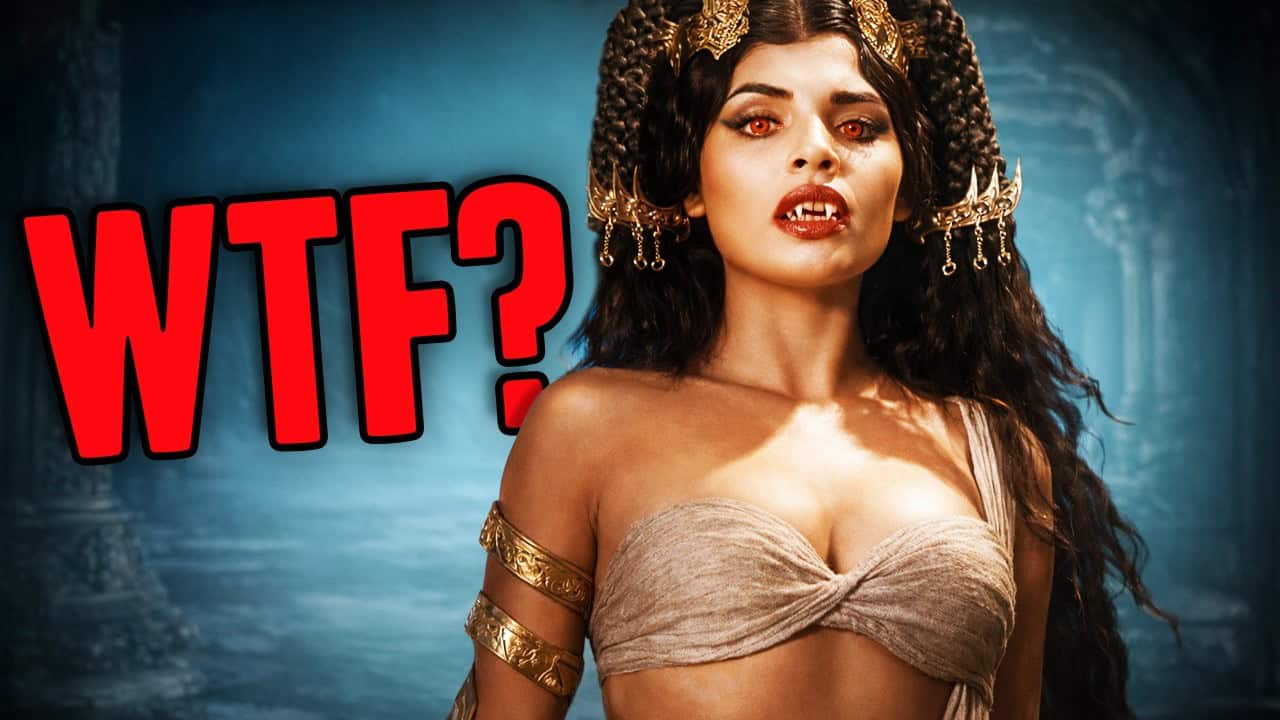
The bizarre true story behind From Dusk Till Dawn 3
The What Happened to This Horror Movie episode on From Dusk Till Dawn 3: The Hangman’s Daughter was written by Jaime Vasquez:
From Dusk Till Dawn 3: The Hangman’s Daughter arrived as part of a one-two punch alongside the franchise’s second installment. But while that standalone sequel had very few ties to the original film’s mythology, The Hangman’s Daughter ventures backward in time, revealing what happened long before Richie and Seth Gecko stumbled into a vampire-infested bar.
Leaning heavily into Western territory under director P.J. Pesce, whose strengths lay more in that genre than in horror, the prequel set out to blend dusty frontier drama with gothic bloodshed.
So how were the horror elements woven into this period setting? What real-life unsolved mystery does the film reinterpret? And how does it connect back to the original? Get your hand off the whiskey and onto your holster. We’re headed to 1910s Mexico to find out what happened to From Dusk Till Dawn 3: The Hangman’s Daughter.
Quick Answer:
From Dusk Till Dawn 3: The Hangman’s Daughter is a 2000 direct-to-video prequel that blends Western and vampire horror, explores the origin of Santanico Pandemonium, and reimagines the real-life disappearance of Ambrose Bierce within the franchise’s mythology.
Origins of From Dusk Till Dawn 3
Álvaro Rodríguez has spent nearly three decades working in Hollywood, bringing a rough-around-the-edges sensibility to projects like Machete, episodes of American Rust, and even coming full circle by writing for From Dusk Till Dawn: The Series. But long before any of those credits, Rodríguez got his start on today’s subject, working alongside his cousin and frequent collaborator, Robert Rodriguez.
Also fairly new to the industry at the time was director P.J. Pesce. After directing episodes of the horror anthology series Monsters and the action drama The Marshal, Pesce went on to co-write and direct the Sam Elliott western The Desperate Trail. The film caught the attention of producers Lawrence Bender and Quentin Tarantino, who both felt Pesce would be a strong fit for From Dusk Till Dawn 3.
Pesce first read the script in the summer of 1997 and later connected with Robert Rodriguez. The two bonded quickly over shared tastes in movies and music before eventually meeting in Austin, Texas. By the end of their first day together (after talking guitars, LaserDiscs, and everything except the movie) they realized they hadn’t actually discussed the project at all.
When they finally did, Pesce described a vision inspired by John Woo-style action, with dynamic angles and rapid cutting, filtered through a dusty Western aesthetic. He went on to rewrite portions of the script and conducted extensive research into the time period and real historical figures featured in the story.
Is Ambrose Bierce’s story real?
One of the film’s most interesting elements is its use of real-life author Ambrose Bierce.
The subtitle comes from The Monk and the Hangman’s Daughter, a short story Bierce co-wrote. But the film takes a supernatural detour by placing Bierce into the franchise’s vampire mythology.
In reality, Bierce traveled to Mexico in 1913 to cover Pancho Villa’s revolution and then mysteriously vanished. Some believe he was executed, others think he died anonymously during the conflict. No one knows for sure.
The film incorporates his real-life letters, in which he jokingly speculated about meeting a violent end, and reimagines his disappearance as a confrontation with vampires inside the franchise’s infamous tavern.
Pesce’s commitment to authenticity extended beyond story details. He was particularly strict about period-accurate hairstyles, insisting that male characters keep short hair in line with early 20th-century grooming standards, pushing back against the long-haired Western clichés seen in many films.
How does it connect to the original film?
To ground the film’s unusual mix of history and horror, the filmmakers assembled a cast that could handle both.
Michael Parks was cast as Ambrose Bierce, bringing quiet authority to the role. Parks had already appeared in the original From Dusk Till Dawn as Texas Ranger Earl McGraw, and his return added a sense of continuity to the franchise. Tarantino frequently cast Parks in similar roles, including appearances in Kill Bill and Death Proof, further cementing his connection to the universe.
Marco Leonardi stars as Johnny Madrid, an outlaw introduced at the gallows before escaping execution in a burst of gunfire. Unlike a typical Western anti-hero, Madrid is written with emotional depth, anchoring the film’s romantic and gothic elements.
Ara Celi plays Esmeralda, the hangman’s daughter… and a younger version of Santanico Pandemonium, the vampire queen made famous by Salma Hayek in the original film. Rather than imitate that iconic performance, Celi brings her own interpretation, focusing on the character’s origin.
Temuera Morrison plays Mauricio, the feared hangman and Esmeralda’s father. His pursuit of Johnny Madrid leads him into an uneasy alliance with Bierce as vampire chaos erupts.
The supporting cast includes Rebecca Gayheart and Lennie Loftin as missionaries, along with Danny Trejo reprising his role as Razor Charlie.
Production Challenges in South Africa
Like its predecessor, the film was shot in South Africa, doubling for early 1900s Mexico. One major problem? There were no authentic stagecoaches available. The production rented a prop stagecoach from a Western-themed restaurant and reinforced it with heavy iron before hitching it to a team of horses. The result was unstable, difficult to manage, and prone to falling apart during filming. A fitting metaphor for a production aiming high on a limited budget.
The crew also built an entire frontier town from scratch outside Cape Town. The film’s central tavern, a key location for the vampire sequences, was constructed inside a warehouse due to limited studio availability.
Filming was frequently interrupted by environmental factors like noise from garbage trucks and flocks of birds, adding to the already challenging shoot.
Practical Effects and Visual Style
Tonally, the biggest challenge was balancing grounded Western realism with supernatural horror. To bring the vampire elements to life, Pesce worked with Greg Nicotero of KNB EFX Group, emphasizing practical effects over CGI.
Robert Rodriguez encouraged stylistic inspiration from films like Suspiria and Jacob’s Ladder, favoring bold lighting and atmosphere. The result was a more gothic, visually stylized approach compared to the grindhouse tone of the original film.
Release and Reception
From Dusk Till Dawn 3 had a limited theatrical presence, with screenings at the Egyptian Theatre in Los Angeles on October 30, 1999, and at the Fort Lauderdale International Film Festival the following night. Its primary release came on January 18, 2000, via home video.
At the time, “direct-to-video” carried a stigma, often suggesting lower quality. However, studios like Dimension and Miramax were actively trying to reposition these releases as legitimate continuations aimed at the growing home entertainment market.
Critically, the film performed slightly better than From Dusk Till Dawn 2: Texas Blood Money, but reception was still mixed. It holds a 22% critic score and 24% audience score on Rotten Tomatoes, along with a 4.8/10 rating on IMDb. Some critics felt the film adhered too closely to the original’s structure, while others appreciated its stronger connection to the franchise mythology.
Legacy and Cult Status
While the sequels never matched the cultural impact of the original From Dusk Till Dawn, the franchise proved surprisingly resilient. More than a decade later, Robert Rodriguez revisited the property with From Dusk Till Dawn: The Series, expanding the universe for a new generation.
Over time, The Hangman’s Daughter has developed a modest cult following. Many fans consider it an improvement over Texas Blood Money, thanks to its period setting, practical effects, and deeper mythology. It may not be the franchise’s crown jewel, but it stands as one of its most unusual experiments; a dusty, blood-soaked origin story that proved the Dusk Till Dawn universe was bigger than one wild night at a roadside bar.
And that is what happened to From Dusk Till Dawn 3: The Hangman’s Daughter.
Key Takeaways
It’s a prequel set in 1910s Mexico
Inspired by the real disappearance of Ambrose Bierce
Reveals the origin of Santanico Pandemonium
Shot in South Africa with practical effects
Developed a cult following over time
A couple of previous episodes of this show can be seen below. For more, check out the JoBlo Horror Originals YouTube channel—and don’t forget to subscribe!
The post The bizarre true story behind From Dusk Till Dawn 3 appeared first on JoBlo.